





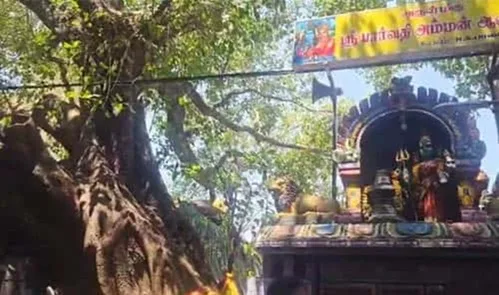
The sacred Sthala Vriksha, a 150-year-old Banyan tree at the Arulmighu Parvathi Amman Temple in Manikanda Nagar in Chennai, was saved from being felled after a public outcry and legal intervention.
The DMK government, through its Hindu Religious and Charitable Endowments (HR & CE) Department, had issued Government orders on September 9, 2024, allowing for the tree to be chopped down in connection with the temple’s Thirupani and Kumbabishekam works. Devotees and local residents strongly opposed the move, as the tree is not just old but also revered and worshipped as a living deity.
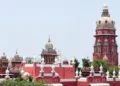
Ravindran, a devotee of the temple, filed a writ petition challenging the HR & CE order. His counsel, Advocate B. Jagannath, submitted before the First Division Bench of the Madras High Court—comprising the Honourable Chief Justice K.R. Shriram and Justice Mohammed Shaffiq—that the tree had immense spiritual significance. He argued that over 250 local residents had signed a petition urging the authorities not to fell the tree.
Wall posters appeared across the locality, condemning the government’s decision and calling on the HR & CE to stop the destruction of the Sthala Vriksha.
The petitioner’s counsel informed the court that the tree could be preserved if the temple reconstruction plan was slightly modified, such as by removing tenants behind the temple to make space.
Counsel for the HR & CE and Special Government Pleader (SGP), Mr Arun Natarajan, submitted photographs showing the tree’s roots had penetrated the temple’s structure, making reconstruction difficult. However, he clarified that the impugned order did not explicitly mandate cutting down the tree and assured the court that only the intrusive portions would be trimmed, not the entire tree.
The Division Bench questioned both parties and urged them to find a solution that would preserve the sacred tree while allowing for temple reconstruction. The SGP responded that construction could be expanded towards the rear of the premises and confirmed, upon instructions, that the main tree would remain intact.
Recording this undertaking, the Judges noted that while the tree’s roots had affected the structure, the HR & CE Department was mindful of the importance of preserving the green environment. They further observed that promoting greenery and protecting sacred trees must also be a duty of the department.
The petitioner’s counsel agreed to the recorded assurance, stating that the intent was to protect both the tree and the sanctity of the temple. Accordingly, the court closed the writ petition, having accepted the SGP’s assurance that the Sthala Vriksha would not be felled.











Comments