





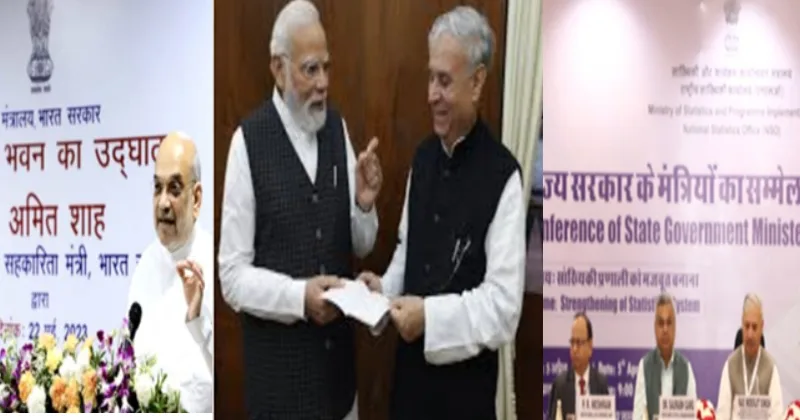
In an era where data is increasingly dubbed the “new oil,” claims that the Indian government operates in a vacuum of information—popularized by the opposition’s “NDA = No Data Available” jibe—are not just misleading, they are factually and institutionally incorrect. The recently concluded Conference of State Government Ministers on Strengthening of Statistical Systems, held on April 5, 2025 at Vigyan Bhawan, New Delhi, offers irrefutable evidence to the contrary. Far from being data-deficient, India is actively overhauling and modernizing its national statistical architecture under the Ministry of Statistics and Programme Implementation (MoSPI)—led ably by Union Minister Rao Inderjit Singh. This article outlines how India is building a robust, inclusive, and technologically advanced statistical ecosystem, how cooperative federalism is shaping a “whole-of-system” approach to data, and why timely, reliable, and granular statistics are central to realizing the Viksit Bharat 2047 and $10 Trillion economy by 2035 vision.
Under the guidance of Prime Minister Modi and Home Minister Amit Shah, the government’s commitment extends to the upcoming Population Census exercise, which will be conducted with an unprecedented level of coordination, technology integration, and inclusivity. The Census is set to provide the baseline for policies touching every Indian—education, employment, healthcare, housing, and more. In a major stride toward modernizing India’s governance framework, Union Home Minister Shri Amit Shah, inaugurated the Janganana Bhavan, marking a significant step in the transformation of India’s census operations. He reiterated that the Census is not just a count—it is the country’s blueprint for progress. The upgraded tools, systems, and processes will lay the foundation for a new, inclusive, and dynamic India, fully aligned with the vision of “Viksit Bharat”
From Rhetoric to Reality: A System in Transition
It is important to underline what this conference truly signified: the government is not only collecting data but is building an ecosystem of evidence-based governance. The interaction between MoSPI and the states reflects a functional model of cooperative federalism, where data is both a national asset and a state-level instrument of development. At a time when India’s aspirations are soaring—be it in AI, digital governance, or a $10 trillion economy—quality data is no longer optional. It is a national imperative.
The accusation that the NDA government is data-shy stems from political rhetoric—not policy reality. Under the leadership of Rao Inderjit Singh, MoSPI has adopted a participatory, state-engaged strategy rather than a top-down, extractive data-collection approach.
The criticism ignores the fact that data for policymaking is collected periodically through:
- National Sample Surveys (NSS)
- Annual Survey of Industries (ASI)
- Periodic Labour Force Survey (PLFS)
- Consumer Price Index (CPI)
- Index of Industrial Production (IIP)
- National Multidimensional Poverty Index (NMPI)
- Big Data and administrative records
- E-Sankhyiki dashboard for real-time dissemination
- MoSPI Leading India’s Data Renaissance and Policy Through Participation: A Collaborative Approach to Data
At the conference, Union Minister Rao Inderjit Singh set the tone for what can only be described as a transformative vision for India’s statistical future. In his keynote, he emphasized the indispensable role of accurate, timely, and granular data in formulating effective policies that resonate with ground realities. This is not a government that fears data. It is one that embraces and empowers it. He strongly advocated for:
- Embracing innovation in data collection
- Building state-level statistical capabilities
- Fostering data transparency and credibility
- Upskilling statistical professionals through training programs at NSSTA
- Advancing statistical reforms in support of Vikshit Bharat 2047
- A Milestone for National Statistical Reform: The 2025 Conference
The conference saw active participation from ministers across 12 States and Union Territories, including leaders from Assam, Bihar, Haryana, Jharkhand, Mizoram, Rajasthan, Tripura, Uttar Pradesh, Uttarakhand, and West Bengal. This diverse representation highlights the government’s commitment to cooperative federalism in the realm of statistics. These State Ministers unanimously advocated for:
- Making the conference an annual, institutionalized event
- Providing sub-state level estimates for targeted policymaking
- Creating state-level centres of excellence and training institutes
- Scaling up the Support for Statistical Strengthening (SSS) Scheme
- The Granularity Revolution: Sub-State Estimates & Modern Tech
Secretary, MoSPI, Dr. Saurabh Garg, drove home the need for sub-state level estimates—district-level data on GDP, CPI, and IIP—which will enable precision governance, reduce wastage, and localize national goals. He also unveiled new initiatives on Tech-Enabled Innovations and Capacity Building
Micro-data Portal for public access to anonymized datasets
Website of National Statistical Systems Training Academy (NSSTA)
Showcase of Semantic Search on NIC Codes, developed through a Hackathon at IIT Gandhinagar
Annual report: “Women and Men in India 2024”, reflecting gender-wise statistical progress
These initiatives aren’t mere token efforts—they represent India’s ambition to be a global leader in data governance and citizen-centric statistics.
State-Level Ownership: From Recipients to Partners
States are no longer passive data providers—they’re being positioned as strategic partners. Several states showcased innovations, signaling a bottom-up statistical renaissance that matches India’s top-down economic goals.The conference enabled MoSPI to capture state-specific needs and good practices worth replicating nationally. States emphasized areas for support, such as:
- Technical assistance for surveys
- Custom training modules for DES officers
- Digital tools for monitoring sub-national SDGs
- Integration of administrative and satellite data
- The Cost of Bad Data—and the Value of Reform
The cost of poor or outdated statistics is policy misalignment, inefficient resource allocation, and public distrust. The bottom line: India’s statistical system is not static—it is adaptive and evolving.
MoSPI is working aggressively to avoid this trap through reforms including:
- NMDS 2.0 (National Metadata and Data Standards)
- Real-time dashboards for schemes like MPLADS
- Environment accounts and green GDP estimates
- Revised classifications and unique identifiers
- From Stats to Strategy: Data for $10 Trillion & Vikshit Bharat
A $10 Trillion economy cannot be built on guesswork. It must be engineered through evidence, and MoSPI’s revamped ecosystem is laying the foundation for just that. India’s rise in digital public infrastructure (UPI, CoWIN, Jan Dhan-Aadhaar-Mobile) offers a global model—and the statistical system is now being aligned to match the digital scale with analog depth. Whether it’s addressing youth unemployment, regional inequality, climate resilience, or supply chain optimization, it all begins with the right data, at the right time, in the right place.
Conclusion: Let the Data Speak
As political narratives attempt to paint the government as indifferent to data, the facts paint a dramatically different picture. Rao Inderjit Singh and MoSPI are not only rejecting the “No Data Available” label, they are building a future where India is a data-first, decision-smart superpower. This isn’t just about numbers—it’s about nation-building. “Let’s not just collect data. Let’s use it to correct and connect.”
The opposition’s claim that the NDA government operates with “No Data Available” may serve political optics, but the real picture tells a vastly different story. Through Modi government leadership and the collaborative work of MoSPI, India is creating one of the most dynamic statistical systems in the developing world—built on the pillars of innovation, granularity, and cooperation. This is not the story of missing data. It is the story of India’s data awakening—and it is well underway. Through the vision of Prime Minister Modi, the executional leadership of Rao Inderjit Singh, and the tireless efforts of MoSPI, the country is laying the groundwork for a next-generation statistical system—responsive, inclusive, tech-enabled, and deeply participatory.
In a country as vast and diverse as India, data is not just a tool—it’s a national asset. The government’s commitment to strengthening its statistical foundations is not about rhetoric, but about results. With initiatives like these, India is clearly moving towards a Viksit Bharat, backed not by slogans, but by facts, figures, and foresight.















Comments