





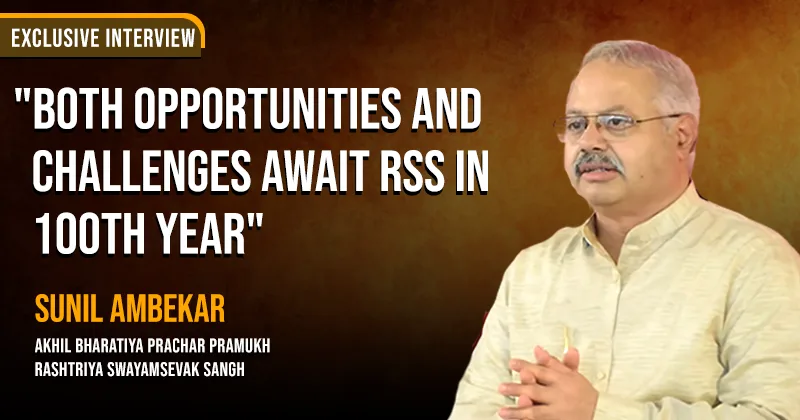
Akhil Bharatiya Prachar Pramukh of Rashtriya Swayamsevak Sangh Sunil Ambekar spoke with Prafulla Ketkar, Editor, Organiser and Hitesh Shankar, Editor, Panchjanya during the Akhil Bharatiya Pratinidhi Sabha held in Bengaluru from March 21 to 23. He spoke at length about various aspects of RSS and on the plans of completion of centenary year of Sangh work. Excerpts:
In the context of the centenary year of Rashtriya Swayamsevak Sangh (RSS), what was special about the Akhil Bharatiya Pratinidhi Sabha held in Bengaluru? Was it different from the regularly held annual meetings?
This Pratinidhi Sabha held special significance as it was convened during the centenary year of the organisation. For the swayamsevaks, this milestone in the journey of a hundred years of continuous service was an emotional and inspiring experience, and the same sentiment was reflected throughout the Sabha.
Over the last three years, many efforts were made towards organisational expansion. For instance, around 2,482 full-time volunteers dedicated two years of their lives to the organisation on Sarsanghchalak ji’s call. They served in the role of Shatabdi Vistarak (Centenary Expansion Volunteers).
As a result, the number of shakhas (daily assemblies) grew to over 83,000. Additionally, more than 32,000 Milans (weekly or monthly gatherings) were conducted, totalling approximately 1.15 lakh shakha-milan events across the country. These numbers highlight the unprecedented growth of the work.
Along with these efforts, there seems to be increased acceptance and positivity in society toward the RSS. Can you elaborate on this?
Indeed, in recent years, there has been growing enthusiasm in society regarding the Sangh. Earlier, swayamsevaks were largely focused on their internal work, but now there is a structured outreach effort to connect with different sections of society. We reached out to individuals and organisations who are actively working for societal betterment and involved them in the Sangh’s broader efforts. This was a deliberate outreach initiative.
“Celebration has never been a tradition of the Sangh. It is an organisation rooted in the goal of uniting society. While completing 100 years is certainly significant, our approach is to treat it as a moment of resolve, not merely celebration”
As a result, support for the organisation has grown. Many respectable individuals now express a desire to associate with the Sangh. This brings both an opportunity and a challenge—to meaningfully engage such people, and assign roles that match their potential and interests.
People expected grand celebrations during the centenary year, but instead, the Sangh emphasised a solemn resolve. Why was that?
Celebration has never been a tradition of the Sangh. It is an organisation rooted in the goal of uniting society. While completing 100 years is certainly significant, our approach is to treat it as a moment of resolve, not merely celebration.
For the past three years, the focus has been on expansion, qualitative growth, and social outreach. During this Pratinidhi Sabha, we resolved that no section of Hindu society should remain untouched by the Sangh. The work started by Dr Hedgewar now needs to reach its full expression. With the strength of the shakha network, we can now reach every section of society, and that responsibility lies with all of us.
One of the resolutions passed in the Sabha addressed the persecution of Hindus in Bangladesh. Why do you consider this a matter of global concern?
This issue is not merely an internal matter of Bangladesh; it is related to human rights, democracy, and global peace. The atrocities committed against women and children, the looting of homes—these acts were not isolated but organised and institutional.
The role of the governing authorities was questionable—either indifferent or complicit. If such incidents are not curbed in time, their impact is not limited to one region; they can spread globally. Islamic fundamentalism has become a global problem. Hence, this is not just a concern for Bharat but a serious issue for the entire world.
Often in such matters, civil society and human rights organisations remain silent when it concerns Hindus. Do you agree?
Absolutely. This is a clear case of hypocrisy and double standards. Those who speak of human rights and civil society often remain silent in such cases. This has been seen not only in Bharat but also in many other parts of the world. The time has come for the civilised society to confront and expose this duplicity and ensure that the truth comes out clearly and boldly.
This year, figures like Rani Abbakka and in previous years, Lokmata Ahilyabai Holkar were highlighted prominently in the Sabha. Is this part of a special initiative?
The Sangh has always believed that people from all regions, all sections—including women—have contributed significantly to our nation’s history. Unfortunately, due to colonial influences and even post-Independence neglect, many such inspiring chapters were ignored. The Sangh has consistently tried to bring forward the tales of such unsung heroes and heroines. Rani Abbakka, for example, is a source of great inspiration—she courageously fought against foreign invaders in the 16th century. These are treasures of our cultural heritage that must be brought to light.
You are currently heading the publicity wing of the Sangh. Earlier, there was indifference in the media towards the RSS. Now there seems to be hyper-activity and deep interest. Do you think the media is now portraying the Sangh’s work positively?
It would be unfair to paint the entire media with one brush. Like in any section of society, the media also has all kinds of people. Today, many journalists are taking a closer and more genuine interest in understanding the Sangh’s work. They are trying to understand the methodology, perspective, and language of the Sangh. This is a positive development. The rise of digital media has further ensured that information about the Sangh reaches diverse sections of society. Hence, we must maintain open communication and continue to bring constructive efforts before society through every possible platform.












Comments