





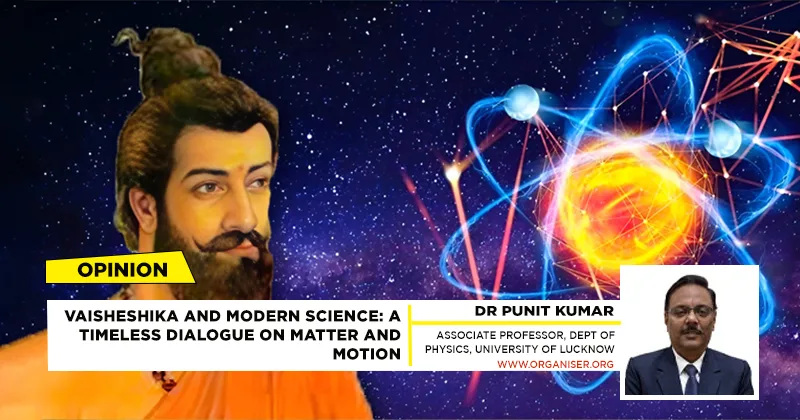
The Vaisheshika school of philosophy, founded by Acharya Kanada nearly in the 6th century BCE, is one of the most remarkable intellectual traditions of ancient India. As one of the six classical schools of Indian philosophy, it focused on the nature of reality, matter, and causation, forming a system that closely parallels modern scientific thought in several ways. This ancient school proposed a highly systematic and logical explanation of the physical world, incorporating ideas that resonate with the fundamental principles of modern physics, chemistry, and epistemology. While modern science has evolved through rigorous empirical methods and mathematical precision, the foundational concepts of Vaisheshika reveal a deep, rational engagement with nature that foreshadowed many scientific discoveries centuries in advance.
At the core of the Vaisheshika system is its atomic theory. Kanada proposed that all matter is composed of indivisible and eternal particles called paramaṇu (atoms). According to him, these atoms combine in various ways to form dravyas (substances), giving rise to the diversity of the physical world. This idea closely mirrors modern atomic theory, which posits that atoms are the fundamental building blocks of matter. According to Vaisheshika, these atoms combine in specific ways to form compounds, much like modern chemistry describes molecular formations.
“परमाणवः कारणानाम् आद्यन्तमस्ति”
Atoms are the fundamental cause of all material existence.
Kaṇada categorized atoms based on the elements, earth (prithvi), water (ap), fire (tejas), and air (vayu), a classification reminiscent of the four classical elements of Greek philosophy. Although modern science has uncovered subatomic particles such as protons, neutrons, and electrons, the essential insight that matter is composed of discrete units aligns with Kanada’s proposition. Modern science identifies atoms as fundamental building blocks of matter, governed by quantum mechanics, which determines how they interact.
The Vaisheshika school also formulated early concepts of motion and force. Kanada described motion (vega) as an effect generated by an external force and stated that objects remain at rest, or in motion until acted upon.
“गत्युत्पत्तिनाशौ निमित्तविशेषात्।”
Motion and cessation arise due to specific causes.
This anticipation of Newton’s first law of motion is remarkable, considering that it was formulated centuries before Newton’s work. The idea that forces are responsible for changes in motion aligns well with Newtonian mechanics, where an external force is required to alter an object’s velocity. The school’s insights into motion indicate an early understanding of dynamical systems, something that later developed into classical mechanics.
One of the most fascinating aspects of Vaisheshika is its principle of causality. Kanada proposed a deterministic universe where every event has a cause, much like the classical scientific perspective that natural phenomena follow causal laws. This deterministic approach closely resembles classical physics, where effects are determined by preceding causes. However, modern quantum mechanics introduces probabilistic elements that challenge strict determinism, showing that while Vaisheshika laid a foundation for scientific thinking, it did not anticipate the non-deterministic nature of quantum phenomena.
Kaṇada classified reality into seven fundamental categories (padarthas) – substance (dravya), quality (guṇa), action (karma), generality (samanya), particularity (viseṣa), inherence (samavaya), and non-existence (abhava). These categories function as a rudimentary form of ontology, forming a structured approach to understanding existence similar to modern taxonomies in physics and metaphysics. For example, the notion of guṇa (quality) includes attributes like colour, taste, and temperature, which can be likened to physical properties studied in material science. The classification of substances (dravya) includes not only physical elements, but also space (akasa), time (kala), and mind (manas), illustrating a comprehensive approach to metaphysical and physical phenomena.
“द्रव्यगुणकर्मणां सतः संयोगविभागौ नित्यौ।”
The combination and separation of substances, qualities, and actions are eternal.
This prefigures the modern scientific notion of conservation laws, where fundamental properties of matter and energy persist through transformations.
Vaisheshika also ventured into cosmological discussions. It posited that the universe undergoes cycles of creation and dissolution, akin to modern cosmological models like the Big Bang and cyclic universe theories. The text describes the transformation of primordial elements through atomic interactions, a concept that resonates with nuclear fusion and stellar formation.
“यथैके परमाणवः संयोगात् जगदुत्पत्तिः।”
Just as atoms combine, the universe originates.
This reflects the fundamental understanding in cosmology that structures emerge through particle interactions over vast timescales.
Vaisheshika emphasizes an empirical approach to knowledge, advocating for direct perception (pratyakṣa), inference (anumana), and testimony (sabda) as valid means of acquiring knowledge. This mirrors the scientific method, which relies on observation, hypothesis, and validation through experimentation. Kaṇada’s emphasis on systematic categorization and logical inference can be compared to the methodologies used in modern scientific disciplines. His philosophy encouraged rigorous inquiry, experimentation, and logical analysis, essential traits in contemporary scientific investigations.
Another fascinating parallel between Vaisheshika and modern physics is its concept of gravity. While Kanada did not articulate a law of universal gravitation like Newton, he proposed that objects fall due to an inherent force in nature. This rudimentary idea of attraction between masses bears resemblance to the gravitational force described in modern physics. Though Kanada’s explanation lacked the mathematical formulation that Newton and Einstein later provided, it nonetheless demonstrates an intuitive grasp of natural laws governing physical interactions.
Further, the Vaisheshika school’s discussions on space (akasa) and time (kala) introduce fundamental ontological questions that continue to be relevant in modern physics. Kanada suggested that space and time exist independently and serve as the framework within which events occur. Classical Newtonian mechanics shared a similar notion of absolute space and time until Einstein’s theory of relativity showed that space and time are interwoven and relative to the observer. While Kanada’s view differs from the relativistic framework of modern physics, the very attempt to conceptualize space and time as fundamental entities reflects an advanced level of abstract thinking.
The Vaisheshika school also influenced Ayurveda, particularly in understanding bodily functions and the effects of matter on health. The classification of substances and their inherent qualities provided a framework for analyzing medicinal compounds, much like pharmacology today. The idea that elemental interactions determine health prefigures biochemical interactions at the molecular level.
“शरीरं द्रव्यसंगतिः।”
The body is an assemblage of substances.
This statement suggests a mechanistic yet holistic view of physiology, aligning with systems biology and medical science.
The Vaisheshika system laid the groundwork for subsequent developments in Indian logic, natural sciences, and philosophy. Its impact extended into Nyaya epistemology, influencing debates on knowledge acquisition and scientific reasoning. Modern scientific advancements in atomic theory, quantum mechanics, and cosmology find intriguing precursors in Kaṇada’s ideas. While the terminology and methodologies differ, the essence of rational inquiry, observation, and logical deduction remains a shared pursuit between Vaisheshika and contemporary science. By revisiting these ancient perspectives, we gain a deeper appreciation of the intellectual traditions that have contributed to human understanding of the cosmos. The Vaisheshika school stands as a testament to the timeless quest for knowledge, bridging the ancient and the modern in the pursuit of scientific truth.












Comments