





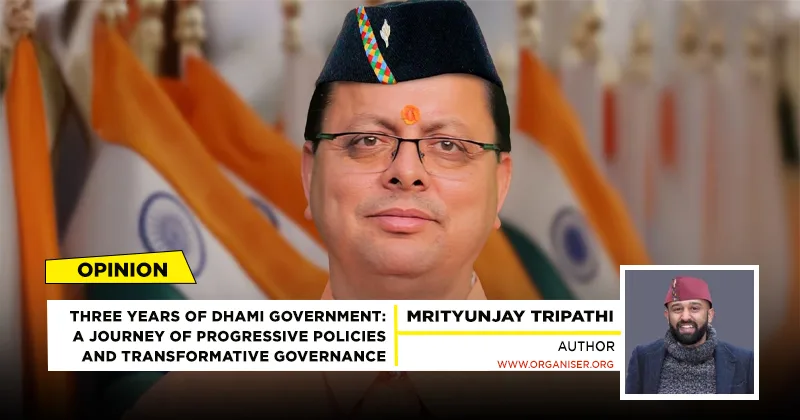
The three-year tenure of Chief Minister Pushkar Singh Dhami in Uttarakhand has been marked by transformative governance, innovative policies, and a commitment to all-round development. Under his leadership, the state has witnessed significant advancements in social justice, disaster management, economic empowerment, and cultural integration. From becoming the first Indian state to implement the Uniform Civil Code (UCC) to hosting the 38th National Games, the Pushkar Singh Dhami`s government has successfully positioned Uttarakhand as a model of progressive governance.
One of the defining moments of this tenure was the government’s response to the Silkyara tunnel disaster. The administration’s swift action in providing relief to affected families and implementing a coordinated rescue strategy demonstrated its dedication to safeguarding lives during crises. Similarly, the enactment of the UCC on January 27, 2025, was a landmark achievement aimed at standardizing personal laws across communities while promoting gender equality and social harmony. By banning discriminatory practices like polygamy and triple talaq, the UCC has empowered women and reinforced constitutional values.
The introduction of the Property Damage Recovery Act (2024) further showcased the government’s commitment to maintaining law and order by holding individuals accountable for damages during protests. In addition, efforts to promote Sanskrit in madrasas have bridged cultural gaps and fostered inclusivity by integrating linguistic heritage into education. The successful hosting of the 38th National Games highlighted Uttarakhand’s sports infrastructure and talent, with local athletes winning over 100 medals—a testament to effective sports policies.
Economic empowerment initiatives such as the Mukhya Mantri Satat Ajivika Yojana have supported women entrepreneurs and self-help groups, while health insurance schemes like Mukhyamantri Swasthya Bima Yojana have ensured access to quality healthcare for citizens. The establishment of SETU (State Institute for Empowering & Transforming Uttarakhand), modeled after NITI Aayog, reflects the government’s focus on strategic planning for sustainable development.
These policies have collectively contributed to Uttarakhand’s remarkable progress in reducing unemployment, boosting GDP growth, and achieving top rankings in India’s Sustainable Development Goals (SDG) Index. The Dhami government’s tenure exemplifies how visionary leadership can drive inclusive development while addressing challenges with resilience and innovation. As Uttarakhand continues its journey toward prosperity, these impactful policies serve as a blueprint for progressive governance in India.
Enhanced Disaster Response and Preparedness
In the wake of the Silkyara tunnel collapse, the government demonstrated its capacity to rapidly respond to crises. Beyond covering immediate expenses such as travel, food, and lodging for the families of trapped workers the state led a detailed rescue operation in close coordination with central agencies. This experience has set a standard for efforts to upgrade emergency response training and equipment, ensuring that future incidents can be managed with even greater efficiency and safety. The initiative underscored the importance of having a all round framework that can seamlessly integrate state and central resources during emergencies.
When the tunnel collapsed, the immediate priority was the safety of the trapped workers and the support of their families. In response, the state government swiftly intervened by shouldering the expenses for essential needs such as travel, food, lodging, mobile recharges, and transportation for the affected families. This prompt financial and logistical support not only alleviated the immediate hardships faced by the victims but also set a precedent for crisis management in challenging situations.
In addition to providing immediate relief, the incident catalyzed a coordinated rescue operation that involved close collaboration with central government agencies. A five-pronged rescue strategy was implemented, incorporating advanced techniques such as vertical drilling and the construction of escape tunnels to reach the affected area. This comprehensive approach demonstrated a commitment to leveraging both local and central resources to manage the crisis effectively.
Pioneering Legal and Social Reform with the Uniform Civil Code (UCC)
Uttarakhand’s implementation of the Uniform Civil Code marks a historic shift in personal law governance. By establishing uniform standards for marriage and inheritance, the UCC aims to eliminate discrepancies that have long existed across different communities. The reform not only sets clear legal age requirements and mandates the registration of marriages but also seeks to enhance women’s rights by ensuring equal treatment in property inheritance. This legislative change has sparked debates and discussions across the state, with proponents emphasizing the potential for greater social cohesion and critics examining the complexities involved in standardizing diverse cultural practices. However, by outlawing discriminatory practices such as polygamy, triple talaq, and halala, the state is clearly moving toward a framework that prioritizes gender justice and equality.
Adopted on January 27, 2025, the UCC sets out to replace a patchwork of personal laws with a standardized framework that applies equally to all citizens. This reform is designed to eliminate different rules and inconsistencies in legal matters such as marriage, divorce, inheritance, and succession, thereby ensuring that everyone is subject to the same legal provisions regardless of their religious or cultural background.
At the heart of the UCC are measures that seek to promote gender equality and protect individual rights. The code clearly stipulates legal age requirements for marriage and mandates the registration of marriages, creating a more accountable and transparent system. By outlawing practices such as polygamy, triple talaq, and halala, the UCC seeks to safeguard the rights of women and ensure they receive equal treatment in matters of inheritance and property rights. This move is widely regarded as a significant step towards dismantling patriarchal structures embedded within traditional personal laws and empowering women with equal legal protection.
The introduction of the UCC has sparked considerable debate and discussion across social and legal circles, with supporters lauding it as a progressive move towards social justice, and critics questioning its implications on cultural diversity. Despite these debates, the reform is seen as an essential stride toward modernizing the legal framework in Uttarakhand. It not only aims towards a more inclusive and harmonious society but also aligns with broader national efforts to modernize personal laws, ensuring that they meet the demands of contemporary society while upholding the rights and dignity of all citizens.
Strengthening Accountability Through the Property Damage Recovery Act
The enactment of the Property Damage Recovery Act in 2024 further illustrates the government’s commitment to maintaining law and order. This legislation ensures that those who cause damage during protests are held financially responsible. By establishing a tribunal system, overseen by retired judges, the act provides a structured process for assessing damage and enforcing recovery orders. This not only serves as a deterrent against vandalism but also reassures property owners and citizens that there is a clear mechanism for redress in the aftermath of civil disturbances. The act has been instrumental in maintaining public order, particularly during times of political and social demonstrations.
Furthermore, the recovery act is seen as a deterrent against potential lawlessness during demonstrations. With clear financial consequences in place, the act reinforces the idea that while the right to protest is protected, it does not extend to actions that damage communal assets or disrupt public order. The dual emphasis on accountability and public safety is intended to maintain social order while still respecting democratic freedoms.
In addition to its punitive aspects, the act also plays a restorative role. By ensuring that property owners are adequately compensated for their losses, it helps to rebuild trust in the state’s ability to manage civil unrest without resorting to excessive punitive measures. This balance of deterrence and restoration is central to the act’s overall objective: to create an environment where civic engagement does not come at the cost of public and private property.
Cultural Integration and Educational Reforms: Sanskrit in Madrasas
In a move that bridges tradition with modernity, the government has mandated the inclusion of Sanskrit in 416 madrasas across the state. This initiative, affecting over 70,000 students, is more than a curricular change—it is an effort to revive and sustain a rich cultural heritage. By integrating Sanskrit, an ancient language that carries the weight of millennia of literature, philosophy, and scientific thought, the state aims to provide students with an enhanced understanding of their cultural roots while equipping them with valuable linguistic skills. The recruitment of qualified Sanskrit teachers is a critical component, ensuring that the language is taught with both academic rigor and cultural sensitivity. This policy not only modernizes madrasa education but also fosters a more diversified educational landscape where traditional knowledge coexists with contemporary learning practices.
Boosting Sports and Sustainable Development Through the 38th National Games
Uttarakhand’s successful hosting of the 38th National Games served as a dual showcase of sporting excellence and sustainable development. With over 10,000 athletes competing in 35 disciplines, the event was a celebration of athletic talent and state-of-the-art sports infrastructure. Under the “Green Games” theme, organizers integrated eco-friendly practices throughout the event—from energy-efficient venues to sustainable waste management and transportation systems. The games provided a significant boost to tourism and local businesses while reinforcing the state’s commitment to environmental stewardship. The impressive medal haul, with athletes winning over 100 medals, not only underscored the competitive spirit of the region but also highlighted how sports events can be leveraged to promote long-term infrastructural and economic growth alongside ecological responsibility.
SETU: A vision for future growth and efficiency
The establishment of the State Institute for Empowering & Transforming Uttarakhand (SETU) represents a strategic leap forward in the realm of governance and policy planning. Drawing inspiration from national institutions like NITI Aayog, SETU is designed to serve as a comprehensive think tank focused on long-term developmental planning and optimal resource utilization. The institute’s mandate encompasses strategic planning, policy analysis, and coordination across various governmental departments, ensuring that developmental initiatives are not only well-conceived but also effectively implemented. By fostering research, capacity building, and interdepartmental collaboration, SETU aims to create a more agile, responsive, and efficient governance model. Its role is pivotal in aligning short-term actions with long-term economic and social objectives, positioning Uttarakhand as a leader in progressive governance.
Social welfare and economic upliftment
On the social front, the government has introduced a range of schemes aimed at enhancing the quality of life and driving economic growth. The Mukhyamantri Swasthya Bima Yojana provides a critical safety net by offering health insurance that reduces the financial strain during medical emergencies, thereby ensuring that all citizens have access to essential healthcare services. Complementing this is the Mukhya Mantri Satat Ajivika Yojana, which is focused on empowering women through financial aid, skill development, and entrepreneurship training. These programs are designed not only to improve immediate economic stability but also to contribute to broader social upliftment. As a result, there has been a noticeable decline in unemployment and a significant increase in per capita income, factors that have contributed to the state’s top ranking on the Sustainable Development Goals Index. Together, these initiatives reflect an integrated approach where social welfare and economic progress reinforce each other, creating a robust foundation for future growth.
In conclusion, the past three years under Chief Minister Pushkar Singh Dhami have ushered in a transformative phase for Uttarakhand, characterized by strategic reforms and a steadfast commitment to both immediate and long-term development. The government’s prompt and organized response to the Silkyara tunnel disaster not only ensured the safety of lives but also established a benchmark for effective disaster management and crisis readiness. The landmark implementation of the Uniform Civil Code (UCC) has standardized personal laws across communities, fostering gender equality and guaranteeing uniform legal rights for all citizens.
Additionally, the introduction of the Property Damage Recovery Act has created a fair framework to hold individuals accountable during civil disturbances, thereby protecting public and private property while encouraging responsible civic engagement. The initiative to include Sanskrit in 416 madrasas reflects a dedication to cultural integration and educational reform, enriching the curriculum for over 70,000 students and reinforcing a connection to the state’s cultural heritage.
Uttarakhand’s successful hosting of the 38th National Games under the “Green Games” theme exemplified its commitment to sustainability, sports excellence, and tourism growth, setting new standards for environmentally conscious large-scale events. Furthermore, the establishment of the State Institute for Empowering & Transforming Uttarakhand (SETU) signifies a forward-thinking approach to governance, enhancing strategic planning and interdepartmental coordination to promote sustainable development.
Robust social welfare schemes such as the Mukhyamantri Swasthya Bima Yojana and Mukhya Mantri Satat Ajivika Yojana have provided essential support in healthcare and economic empowerment, particularly for women. Collectively, these initiatives have contributed to a reduction in unemployment rates, an increase in per capita income, and positioned Uttarakhand as a leader in the Sustainable Development Goals (SDG) Index.
By integrating rapid response strategies, legal innovations, cultural revival efforts, and sustainable economic policies, Puhkar Singh Dhami`s government has effectively addressed both immediate needs and established a solid foundation for future growth. This comprehensive approach serves as an exemplary model of progressive governance, illustrating how an inclusive and forward-looking strategy can transform Uttarakhand into a beacon of development and social justice for years to come.
















Comments