





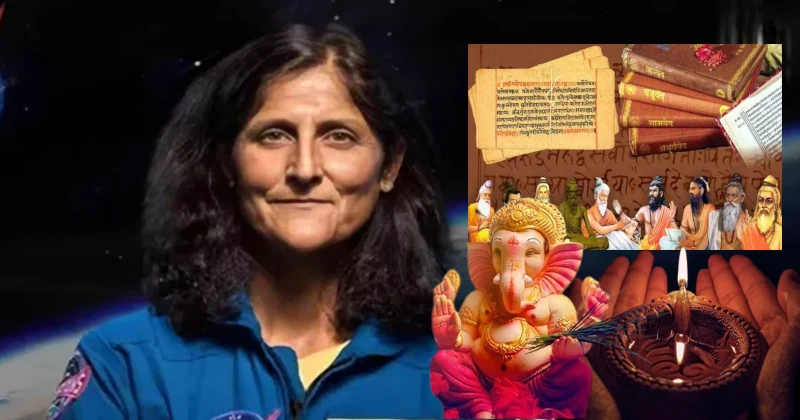
NASA astronaut Sunita Williams has once again proved that no distance is too great to stay connected to her Bharatiya cultural roots. From orbiting the Earth at 260 miles to enduring a grueling nine-month stay in space, Williams has carried the essence of Hindu belief and resilience beyond the stars. Whether it’s celebrating Deepawali in microgravity, taking the Bhagavad Gita and Upanishads on her missions, or bringing Bhagwan Ganesha with her on an extended space journey, her actions speak volumes about her deep-rooted spiritual connection.
Deepawali in space
In October 2024, millions across the world received an unexpected yet heartwarming Deepawali message from space. Williams, stationed aboard the International Space Station (ISS), sent greetings to those celebrating the festival of lights, including those at the White House and beyond.
“I want to extend my warmest wishes for a Happy Deepawali to everyone celebrating the festival of lights today at the White House and around the world,” Williams said in a video message beamed from space. “This year, I have the unique opportunity to celebrate Deepawali from 260 miles above the Earth on the ISS.”
As the backdrop of the vast cosmos enveloped her, Williams reflected on her father’s journey from India to the United States in 1957 and how he ensured that his family stayed connected to their cultural and spiritual heritage. “Deepawali is a time of joy, a moment when goodness prevails over darkness, and hope takes the front seat. No matter how far we go, these traditions bind us to our roots,” she emphasized, her voice carrying a tone of deep reverence.
The Bhagavad Gita and Upanishads: Guiding her through the loneliness of space
Sunita Williams has always carried her Hindu roots with her, quite literally. On multiple space missions, she took the Bhagavad Gita, Upanishads, and sacred Hindu beliefs, finding solace and guidance in their teachings.
“These texts are a source of wisdom, peace, and clarity,” she explained. “When you’re looking at Earth from space, it gives you perspective. The words of the Gita, which teach detachment and duty, make even more sense when you are floating in space, disconnected from everything familiar.” Her choice to bring these spiritual texts into the most advanced technological setting—the ISS—demonstrates the relevance of ancient wisdom even in the age of space exploration.
Taste of Bharat in space: Samosas beyond the stars
Williams didn’t just bring cultural symbolism with her—she also ensured she had the flavors of home. Before every mission, NASA astronauts are given the choice to customize their meals, and for Williams, it was clear what had to be included: Bharatiya food, particularly samosas.
“Bharatiya food! You can never get enough Bharatiya food,” she laughed. “It’s not just about taste. It’s about comfort, about feeling connected to home, even when you’re floating miles above it.” Her decision to carry samosas into space showcases how the simplest of foods can serve as a lifeline to one’s roots, no matter where they are in the universe.
Bhagwan Ganesha kept her going in Space
Williams’ faith was put to the ultimate test during her most recent mission. Originally scheduled to last just eight days, it stretched to over nine months due to technical malfunctions. It was during this period of uncertainty that she found solace in Bhagwan Ganesha, whose idol she had brought along.
“Ganeshji had to come with me to space,” she admitted. “He’s a symbol of overcoming obstacles, of wisdom and patience—qualities you need when you’re stuck in space much longer than expected.”
Her connection to Hindu beliefs has been a recurring theme in her career. In previous missions, she carried a painting of Bhagwan Shiva, an ‘Om’ symbol, and the Bhagavad Gita. This time, it was the idol of Ganesha that became her companion in solitude, a source of divine reassurance as she faced unforeseen challenges in the unforgiving environment of space.
Mahakumbh from Space
Williams’ cultural consciousness was once again evident when she shared an iconic space-view image of the Kumbh Mela. Earlier in 2024, her cousin, Falguni Pandya, had visited the grand religious gathering and sent her a picture from the ground. In response, Williams sent an image of the event from orbit, symbolizing a connection between the cosmic and the earthly.
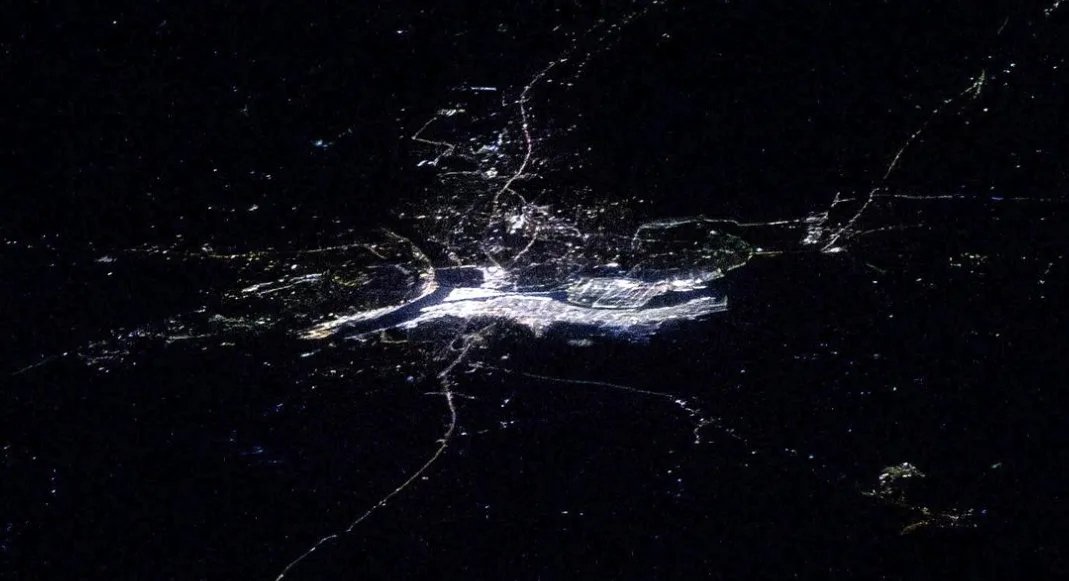
“That moment was surreal. Here I was, looking at one of the world’s biggest spiritual gatherings from space, while my cousin was standing amidst it on Earth. It was a powerful reminder of how traditions, no matter how old, remain relevant even in this age of space travel,” she recounted.
Back on Earth, Williams’ ancestral village, Jhulasan in Gujarat’s Mehsana district, erupted in celebration upon her return. Having met Prime Minister Narendra Modi on multiple occasions—first in 2007 when he was Gujarat’s Chief Minister and later as Bharat’s Prime Minister—Williams has always maintained her ties to the land of her forefathers. “Sunita is a proud daughter of Gujarat, and her village is celebrating her return,” said Pandya, noting that the entire community takes immense pride in her achievements.














Comments