





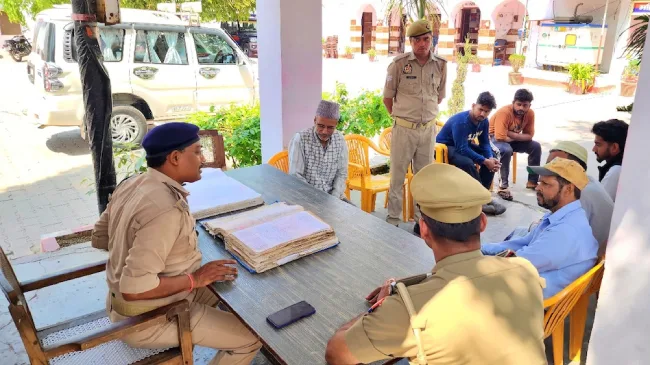
In Uttar Pradesh’s Sambhal, the district administration has denied permission for the “Neja Mela” due to public objections and security concerns. On March 17, members of the Neja Mela Committee met with ASP Shreesh Chandra to discuss the event. During the meeting, officials asked who the fair was dedicated to. When they learned that it honoured Syed Salar Masood Ghazi, a commander under the invader Mahmud Ghazni, ASP Chandra made it clear that permission would not be granted.
The annual fair, which was scheduled to take place from March 25 to 27, has been controversial for years. As Ghazi is considered a controversial figure, where many see him as a symbol of invasions and massacres in India’s history.
ASP Chandra stated that allowing a fair in honour of someone like Ghazi, who looted the Somnath temple and was responsible for large-scale killings, would not be appropriate. He emphasised that even if the tradition has existed for centuries, such an event cannot be permitted.
Calling the event “anti-national,” he warned that it could disturb law and order. He added that anyone attempting to organise it would face strict action and be considered a traitor. “If this is happening due to ignorance, that’s one thing. But if it’s being done deliberately, those involved are traitors,” he said.
The officer also mentioned that local Hindus had strongly opposed the fair, arguing that it was wrong to honour a figure associated with destruction and plunder. Considering these objections, the authorities decided to deny permission for the event.
“If anyone tries to raise the Neja flag, it will be considered an act against the nation’s interest,” ASP Chandra warned.
“Sadbhavna Mela” for social harmony rejected by Neja Committee
In 2023, the Sambhal administration decided to rename the “Neja Mela” as “Sadbhavna Mela” to promote social harmony. The change aimed to remove controversial historical links while preserving the event’s religious significance.
Dr. Vandana Mishra, the Sub-Divisional Magistrate, who had earlier denied permission, reiterated that the fair could not take place in its original form. Despite previously agreeing to the name change, the Neja Mela Committee insisted on holding the event under its traditional title, leading to their request being rejected.
History of Neja Mela
Neja Mela, an annual festival observed on the second Tuesday after Holi, is a long-standing tradition dedicated to Syed Salar Masood, also known as Ghazi Miyan. The festival includes devotees raising the Neja (a ritual flag) and offering Fatihah (prayers for the dead) at his shrine in Bahraich, Uttar Pradesh. While it holds religious significance for many, it remains a subject of controversy due to its historical associations.
Syed Salar Masood was a medieval war commander and the nephew of Mahmud Ghazni, the infamous tyrant-invader who plundered India 17 times between 1000 and 1027 AD. Following in his uncle’s footsteps, Masood led ruthless military campaigns across northern India, attacking Hindu settlements and leaving widespread destruction in his wake. His invasions resulted in forced conversions and the desecration of major Hindu temples, including the Suraj Kund temple in Bahraich and the sacred Somnath Temple.
Masood’s expansion, however, faced fierce resistance from Raja Suheldev of Shravasti. A warrior-king known for his valour, Suheldev united several regional rulers to counter Masood’s aggression. In 1034 AD, during the Battle of Bahraich, Suheldev’s forces decisively defeated Masood’s army, putting an end to his conquests. Masood was killed in combat, ensuring that northern India remained free from further invasions under his command.
According to historians, following Masood’s death in 1034 AD, his grave was established in Bahraich. Over time, locals began visiting the site, and in 1250 AD, Sultan Nasiruddin Mahmud of Delhi constructed a mausoleum over it. With visits from various Muslim rulers and continuous offerings from devotees, the site gained prominence as a “Dargah.”
Despite being an important religious festival for the Muslim community, Neja Mela remains a point of contention due to the figure it commemorates. While some venerate Masood as a martyr and saint, others view him as a symbol of forced occupation and devastation.
In recent years, debates over the festival have intensified, particularly amid efforts to reexamine historical narratives. The legacy of Raja Suheldev’s victory has gained widespread recognition, with him being honoured as a symbol of resistance against foreign invasions. The government has also taken steps to commemorate Suheldev’s contributions, building memorials and incorporating his legacy into historical records.
Committee will fight to ensure continuity of the event
The Neja Mela Committee strongly opposed the administration’s decision to deny permission for the festival, calling it completely unacceptable.
Committee President Shahid Hussain Masudi stated, “We have been organising this mela for generations. It is an essential part of our faith, and we will fight to ensure it continues. If needed, we will take the matter to higher authorities and even approach the court.”
Meanwhile, the police have issued a strict warning against the erection of any memorial, which is traditionally done to signify the beginning of the festival. ASP Shreesh Chandra condemned the practice, labelling it an “evil tradition rather than a cultural legacy.” He warned that any attempt to defy the ban would lead to action against the fair organisers.
Last year, the festival was postponed due to Ramadan.










Comments