





Our western neighbour is suffering from its own dose of terrorism in Balochistan and Khyber Pakhtunkhwa. This type of violence is an overt manifestation of internal turmoil in Pakistan and open persecution of its less privileged citizens. India on the other hand is becoming a victim of covert mechanism to disturb law & order situation in the country. It is surprising considering the fact that minorities in India enjoy equal rights. It may seem strange but the covert machinery that leads to violence, particularly on communal lines is more dangerous to the internal security of India.
In India, the narrative that a minority community which has a population of approximately 20 crores (14.3 % of India’s population) is under threat seems to be gaining traction. India has third largest Muslim population in the world after Indonesia and Pakistan. Such a large population is classically not a minority population because the next minority in India is Christianity, with 2.3 per cent of India’s population, followed by the Sikh community which is just 1.72 per cent of India’s total population. In India, there is seldom a communal violence involving the Christians and Sikhs.
It is the rise of fundamentalism and communalism in the Muslim community that has fuelled the unrest in some parts of the country. Most of the Muslims are law abiding citizens and there is an endeavour to influence them with the imaginary threat of religious discrimination. Yes, the majority community Hindu is more assertive now after decades of subjugation. The knowledge of true history of India and the ill treatment meted to some of the Hindu rulers has also agitated the psyche of millions. There is also an attempt to unite the Hindus, which so far was highly divided on the caste lines. It is possible that such an assertion by the Hindus may have been more vocal but not necessarily violent. Hinduism teaches tolerance and by and large believes in peaceful coexistence. Otherwise, but for the magnanimity of the majority community, it is difficult to imagine equal rights to all minority communities in India.
Since the Muslim community became an attractive vote bank for some political parties, the community received special patronage and support, both at the Centre and in the states in the past. Such privileges have been taken for granted and when they were questioned by the new dispensation, obviously the reaction was swift and violent. The overall aim appears to play the victim card and derail the reform process. One major issue confronting the Muslim community is the review of Waqf Board policy. Therefore, triggering of such communal violence in Sambhal earlier in November last year and now in Nagpur may be part of a larger gameplan to spread unrest in India.
Law & Order is the responsibility of the state police, assisted by paramilitary forces and other uniformed forces, like Rapid Action Force. Police forces have their own deficiency of manpower and are mostly committed in a lot of tasks which cannot be called policing. A large chunk of police personnel is employed in event management and VIP Protection duties. Police forces are not regularly trained or refreshed to deal with new emerging law & order challenges. In addition, at times, police forces do not get the committed leadership, which cares for their well-being, both on and off duty. Therefore, police in India have few pockets of excellence depending on the state and the leadership but in most places, it is just average, in conduct and response.
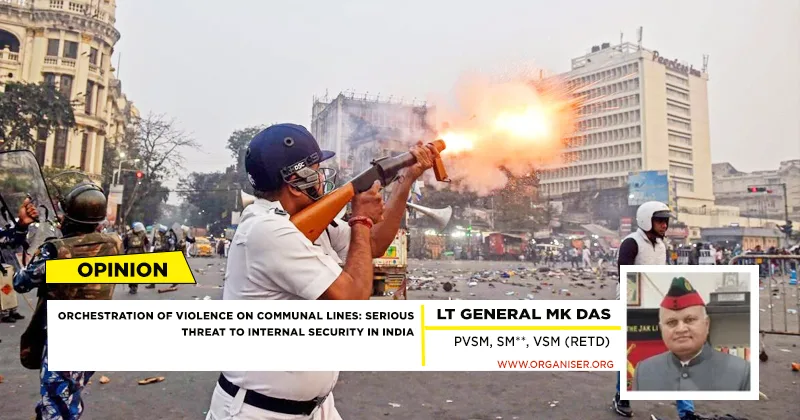
Communal violence and riots are most difficult of the police tasks. It is therefore that sometimes Army is requisitioned to restore law & order by the civil administration, as the last resort. I speak from personal experience of such law & order incidents during my military career. The police do try but at times is ill equipped to deal with riots, particularly those which are pre planned. The main problem in most of the communal violence is lack of actionable intelligence and prior information. The existing intelligence mechanism invariably fails to ascertain the festering communal tension and preparation behind doors happening to orchestrate violence.
On the other hand, the ability to mobilise the irate crowd, armed with lathis, swords, petrol bombs and stones, has improved considerably. The mobile phones and social media act as trigger to rouse the sentiments. It appears that the mob has some training and briefing prior to the violent act. The mob has some self-appointed leaders who coax the roused members to act in the chosen localities. They use masks to hide their identity and now are even breaking CCTV cameras to destroy the evidence. Private TV channels further glorify the violence for assured TRPs. Thus, there are a large number of direct and indirect reasons to fuel communal violence, at a short notice.
Police on the other hand does not seem to be properly equipped in self-protection. Thus, injuries to a large number of police personnel in such riots is not surprising. In Nagpur, the police took the brunt of the irate mob and exhibited tremendous restraint, while sustaining personal injuries. Normally, such a situation would have resulted in opening of fire to quell the mob. But such restraint may be perceived as weakness and the police may have to act tough where necessary. Similarly, killing and injury to police personnel in Bihar recently, should be viewed seriously.
Having said this, law & order problems in a country of India’s size, diversity and population are inevitable. Yes, the riots can be prevented and controlled in most of the cases with swift police action. Therefore, the police have to be strengthened, equipped and trained to deal with complex law & order situations. They need superior leadership which leads from the front and takes responsibility. The intelligence mechanism requires major overhaul and fixing of responsibility in case of failure.
The police also have to regain the confidence of the public as people friendly force. A common man should feel confident to contact the police to share his concerns and any information. At the same time, police have to become more professional in its approach. But the citizens have to be more vigilant and security conscious. One cannot ignore what is happening in your neighbourhood. Thus, keeping the eyes and ears open is the best guarantee towards security.
It is also the responsibility of the political and religious leadership to maintain peace. The communication channels should always remain open in case of difference of opinion and discord. In this regard, shifting the time of Friday Namaz on the day of Holi festival is one good example of accommodating each other’s sentiments.
India, that is Bharat, is evolving as a more confident nation, more sure-footed in development, democracy, faith and spirituality. Maha Kumbh 2025 is the finest living example of a new and resurgent India. Communal violence and riots have no place in a civilised society. The law of the land should sternly deal with the defaulters to set an example. A peaceful co-existence of all Indian citizens, with equal opportunities, should be the mantra for Viksit Bharat @2047.















Comments