





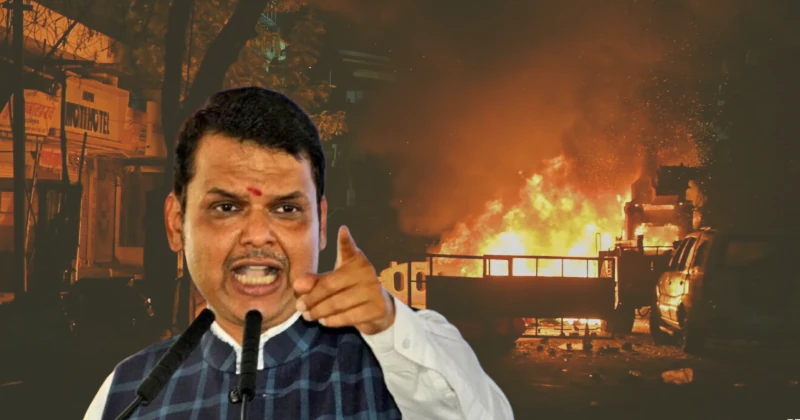
Nagpur plunged into chaos on the evening of March 17, as Islamist mobs carried out large-scale violence following rumours that a copy of the Quran had been burned during a protest by Hindu organisations. The city witnessed brutal rioting, with mobs pelting stones, torching vehicles, and vandalising public property. Over 30 people, including 33 police personnel, were injured in the clashes. Maharashtra Police have now launched an investigation into more than 100 social media accounts that played a key role in spreading inflammatory misinformation, triggering the violence.
The violence stemmed from an agitation by Hindu groups demanding the removal of the tomb of Mughal tyrant Aurangzeb in Chhatrapati Sambhajinagar. During the demonstration, protesters burned an effigy of the despotic ruler wrapped in a chadar. However, malicious claims soon surfaced that a copy of the Quran had been burned as well. These baseless allegations spread like wildfire across social media, inciting Islamist mobs to take to the streets in Nagpur.
Maharashtra Chief Minister Devendra Fadnavis condemned the violence in the state assembly, asserting, “In Nagpur, Vishva Hindu Parishad and Bajrang Dal held protests. Rumours were spread that religious items were burned. It appears to be a well-planned attack. No one has permission to take law and order into their hands.” He confirmed that 33 police officers, including three Deputy Commissioners of Police, were injured in the violence. “Attacks on police will not be tolerated; strict action will be taken,” he warned.
Deputy Chief Minister Eknath Shinde echoed these sentiments, calling the violence a “planned conspiracy.” He criticised those glorifying Aurangzeb, stating, “Even true patriotic Muslims will not support Aurangzeb.” His reference to the movie ‘Chhaava’ urged people to learn the true history of the Maratha-Mughal conflict rather than sympathising with oppressors.
Journalist Harsh Vardhan Tripathi on X, praised the Maharashtra government’s firm action against the rioters. One such statement read: “I have full faith that the government of @Dev_Fadnavis will teach a proper lesson to those who tried to incite violence in #नागपुर by spreading rumours. Now when such people will be punished under the ambit of law, those who lament over it will indirectly stand with the rioters. Whoever it is, there should be no leniency against those who try to incite violence.”
मुझे पूर्ण विश्वास है कि, अफवाह फैलाकर #नागपुर में दंगे करने की कोशिश करने वालों को @Dev_Fadnavis की सरकार ठीक से सबक सिखाएगी। अब जब ऐसे लोगों को कानून के दायरे में सजा मिलेगी, उस पर विलाप करने वाले दंगाइयों के साथ ही अप्रत्यक्ष तौर पर खड़े होंगे। कोई भी हो, दंगे की कोशिश करने… pic.twitter.com/CreW3jP3gp
— हर्ष वर्धन त्रिपाठी 🇮🇳Harsh Vardhan Tripathi (@MediaHarshVT) March 19, 2025
In a significant development, the Maharashtra Police Cyber Cell has now launched a probe into more than 100 social media accounts that propagated the fake Quran-burning claims. Authorities confirmed that several of these accounts used old and doctored videos to fuel the violence. The police have urged the public to ignore such false narratives and assured strict legal action against those inciting communal tensions.
Several prominent Islamist propagandists and radical elements actively spread misinformation online to justify the violence. Among them was Aasif Mujtaba, a so-called journalist and IIT Delhi scholar, who falsely alleged that Hindutva groups had burned a chadar with Quranic verses. Bollywood screenwriter Darab Farooqui, notorious for his jihadist sympathies, also blamed Hindus for the violence through misleading social media posts.
Habitual rumour-monger Harun Khan amplified the fabricated claims, while accounts pretending to be ‘Muslim activists’ falsely accused Bajrang Dal members of burning a religious chadar. One such individual, Amin Saiyed, translated the misinformation into English to ensure its global reach. Another account operated by Arshad Qureshi twisted the narrative further, falsely stating that Hindus had trampled on Quranic verses.
Adding to the orchestrated campaign, Pakistani social media accounts jumped in to feign outrage over ‘Indian Muslim persecution,’ conveniently ignoring the dire state of Hindu minorities in their own country. This exposes a well-coordinated effort to inflame communal tensions while shielding the actual rioters from accountability.
Eyewitnesses recounted that rioters were heavily armed, their faces covered, and wielding swords, petrol bombs, and other weapons. The worst-affected areas included Chitnis Park and Mahal, with the violence later spilling over to Kotwali and other sensitive locations. Decorations for the upcoming Ram Navami Shobha Yatra were specifically targeted, and attackers destroyed materials meant for the Hindu festival.
In the ensuing carnage, three cars and nearly 30 vehicles were set ablaze. A witness described the horror: “We shouted at them not to burn the vehicles. I tried to douse the fire with a hose, but they hit me with a stone. My two vehicles and several others parked nearby were torched.” Another local resident recalled, “I saw a group of at least 500-600 men near Mahal shouting ‘Allahu Akbar’ and ‘Labaik-Ya-Rasool-Allah.’ One of the stones hit my car, and I barely managed to escape.”
BJP MLA Pravin Datke pointed out that the violence was pre-planned and orchestrated to target Hindu-owned businesses. He revealed that rioters selectively torched shops owned by Hindus while Muslim establishments remained untouched. “There were four shops—two Hindu and two Muslim-owned. Only the Hindu shops were torched,” he noted.
Adding to the chaos, rioters strategically destroyed CCTV cameras to erase evidence before engaging in arson. Chandrakant Kawde, a local businessman, confirmed this: “They first broke the cameras and then set the area on fire. The police arrived 30 minutes after the violence ended.” He demanded government compensation for the losses suffered by Hindu shopkeepers and vendors.
The outnumbered police were forced to resort to lathi charges and tear gas to disperse the mob. As the situation worsened, authorities imposed curfew under Section 163 of the Bharatiya Nagarik Suraksha Sanhita (BNSS) in multiple areas, including Kotwali, Ganeshpeth, and Lakadganj, to restore order.










Comments