





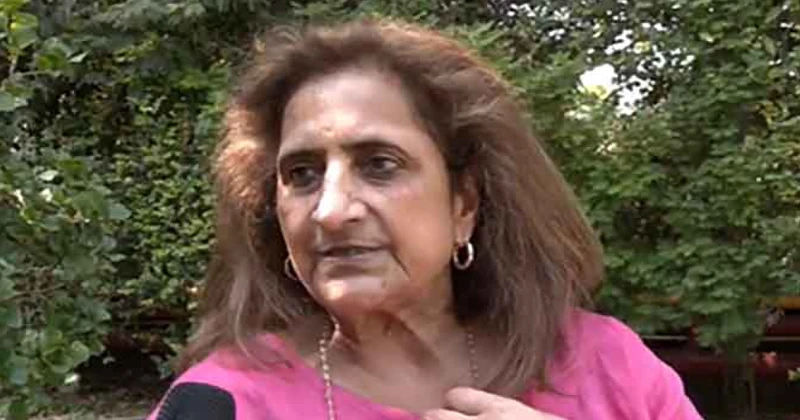
Nearly four decades after it erupted, the Bofors scandal remains an unresolved blot on India’s political and investigative machinery. Despite the existence of crucial documents and witnesses who can help establish the truth, they continue to be ignored and unutilised, said veteran journalist Chitra Subramaniam, whose investigative work exposed the details of the scandal in the 1980s.
In an explosive revelation during an interview with media, Subramaniam lamented how successive governments and investigative agencies, particularly the Central Bureau of Investigation (CBI), have failed to act on available evidence.
“Yes, papers and people. Because people feel safer to speak now. Papers definitely… papers can’t lie, money trails can’t lie…,” Subramaniam stated.
The journalist, whose recently released book Boforsgate: A Journalist’s Pursuit of Truth chronicles her over-a-decade-long probe in Switzerland and Sweden, pointed out that despite the existence of a crucial box of documents handed over to CBI in 1997, nothing has come of it. “The CBI says there are boxes… what boxes? Are there two? I saw only one. It’s very confusing what’s going on…” she said, hinting at deliberate obfuscation of facts.
Subramaniam’s allegations expose a troubling reality—those in power have systematically covered up the truth. She cited the blatant refusal of investigating agencies to speak with key figures in Sweden who were central to the case, including Sten Lindstrom (the former Swedish police chief and whistleblower) and ‘Sting’ (another crucial source).
“Can you imagine that no one from India, no probing agency has spoken to Sten Lindstrom? Nobody. Does it make any sense? (CBI chief in 1987) Mr. Mohan Katre went to Sweden but didn’t meet him. Nobody met him…why don’t you connect with him… he will guide you,” she said, underlining how critical leads were ignored.
The Bofors scam, which surfaced in 1987, exposed allegations of massive kickbacks in a Rs 1,437 crore defense deal between the Indian government and Swedish arms manufacturer Bofors AB. The scandal became the biggest controversy of Rajiv Gandhi’s tenure as Prime Minister, significantly influencing the 1989 general elections, in which the Congress suffered a humiliating defeat.
Subramaniam highlighted how the scandal wasn’t just about financial corruption but also about the destruction of institutions, people, and relationships. “My heart goes out to the army… people in the army who are dying. And then, of course, we won the Kargil war because of the gun. But I am told that the destruction of the morale, the destruction is deep. So yes, there has to be some confidence-building,” she said.
Among the most shocking revelations in Subramaniam’s book is how Bollywood megastar Amitabh Bachchan was falsely implicated in the scandal through a planted story alleging his involvement in a secret Swiss bank account linked to the Bofors kickbacks.
“No, there was absolutely no shred of evidence that he (Amitabh Bachchan) had taken any money. But the water had been muddied so much that by the time the water could be cleaned up, the damage had been done,” she revealed.
Subramaniam detailed how a section of the then-government and media actively pushed for Bachchan’s name to be linked to the scam, despite the lack of any proof. The Bollywood icon, who was also a Congress MP from Allahabad at the time, was targeted as part of a “vicious campaign.”
The false accusations, which originated in Swedish newspapers and were later picked up by Indian media, took a heavy toll on Bachchan’s public image. However, Subramaniam, who refused to report the allegations without independent verification, was eventually vindicated. Despite mounting evidence, successive governments have failed to bring closure to the Bofors scandal. Subramaniam believes that a fresh, independent probe is necessary but stresses that it must be conducted by people genuinely committed to uncovering the truth.
New Delhi: When asked about the alleged involvement of actor Amitabh Bachchan in the Bofors scam, journalist Chitra Subramaniam says, "A gentleman to the core. What could he say if the accusation was so false? Where do you even begin? He came home, and we spoke. I had no… pic.twitter.com/8JQFb2Ol4r
— IANS (@ians_india) March 17, 2025
“So do I think there has to be a probe? There definitely has to be an investigation… what the framework of that will be decided by my country. It’s not for me… As a journalist, I did my bit, now, the government should take it forward… because you can’t let things hang in the air,” she said.
Subramaniam’s investigation into the Bofors scandal was not just a professional challenge but also a personal battle. She faced immense political pressure, threats, and constant scrutiny. Reflecting on the journey, she said, “Would I do it again? Yes. But I would have made sure childcare was better. I would have approached home and childcare differently, but definitely, I would still have gone ahead.”
Speaking about her time at The Hindu, where she worked under editor N. Ram for 18 months, Subramaniam alleged that a crucial source she had cultivated was exposed despite her sharing the information in good faith.
“The worst thing that can happen to a journalist is being let down by an editor, and that happened to me,” she said.
New Delhi: Journalist Chitra Subramaniam says, "The worst thing that can happen to a journalist is being let down by an editor, and that happened to me. At that time, I was working with The Hindu, and Mr. N. Ram was my editor for 18 months. I had cultivated a source, and legally,… pic.twitter.com/4cI6eQXNE1
— IANS (@ians_india) March 17, 2025
She further disclosed that vital documents, including Martin Arbo’s diary—which mentioned “Gandhi trustee lawyer” and contained the name “Gandhi”—were not used for nearly a year. Subramaniam claimed she was told that the “opportune moment” had not arrived. “What opportune moment?” she questioned, highlighting what she saw as deliberate delays in publishing key findings related to the scandal.
She also had a strong message for young journalists, particularly women. “There is no magic wand. You will have to figure out how you want to handle home and your job because one will come into the other… there is no separation.” Despite the passage of time, Subramaniam remains unwavering in her commitment to truth. “If young journalists want to take this forward, I am happy to mentor them. But I have moved on. It is now up to the next generation to carry the baton forward,” she said.













Comments