





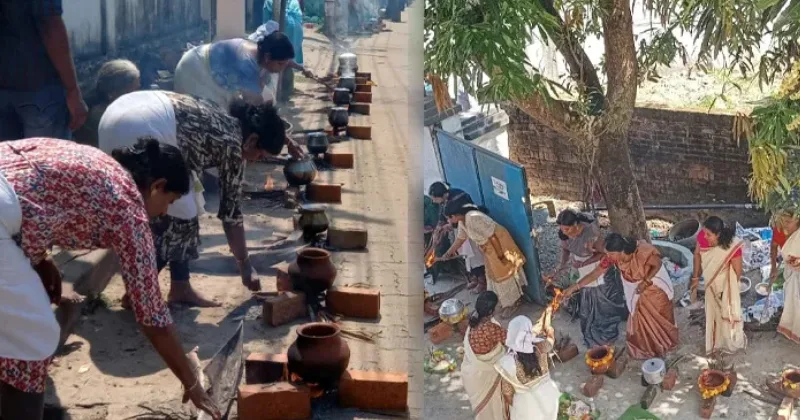
On March 13, the sacred city of Thiruvananthapuram transformed into a vast yajnashala as it hosted the historic Attukal Pongala, one of the largest all-women religious gatherings in Bharat. More than 22 lakh women, driven by deep devotion, came together to participate in this grand annual ritual dedicated to Attukal Devi.
The celebrations began at 09:45 hours, with women occupying every available space within a 10 km radius of the temple. Streets, highways, and alleyways became a sea of devotion as thousands of makeshift wood-burning stoves were lit to prepare Pongala, the sacred offering. As the mixture of jaggery, rice, and spices simmered and boiled, it was consecrated as Attukal Amma’s prasada, embodying the prayers and unwavering faith of the devotees.
Attukal Pongala is a ‘women-only’ ritual; hence, it is called the ‘Women’s Sabarimala’. As everyone knows, women between the ages of 10 and 50 are not allowed to climb the Sabarimala hills and enter the shrine. Therefore, it is sometimes known as the ‘no-women temple’.
The legend of Kannaki Devi from Silapathikaram is the foundation of Attukal Pongala’s history. Silapathikaram is a Tamil epic. The deity in the Attukal Temple is believed to represent Kannaki, who emerged victorious after killing the Pandya king.
Lakhs of women, after completing the Pongala ritual, make it a point to visit the Attukal Devi Temple for worship and prayer. Most of them also visit the legendary Sree Padmanabhaswamy Temple. In short, Thiruvananthapuram becomes a ‘pilgrims’ paradise’. It is a ritual that transcends religion, caste, class, and social status. One can see IAS and IPS officers, sought-after matinee idols, ordinary homemakers, teachers, daily wage earners, professionals, and many others participating. All of them stand under the scorching March sun. The wood-burning stoves add to the heat. However, they endure it, believing that these hardships are part of their devotion to Attukal Amma. They return home with the ardent resolution and hope of coming back again next year.
The Sevabharati organisation supported lakhs of ‘sisters and mothers’ by arranging stoves and providing firewood, drinking water, etc. The police, Fire & Rescue Forces, clubs, and residents’ associations were at the forefront.
This time, several more lakhs turned up for the ritual. Thousands performed Pongala in their own courtyards or those of their neighbours. This year, the spirit of Attukal Pongala spread across all districts in Kerala simultaneously. Moreover, it extended not only to various states of Bharat but also to several foreign countries. Thus, Attukal Pongala has become a festival of unity for all Bharatvasis.














Comments