





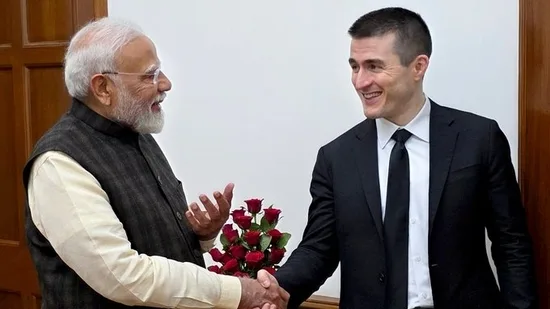
On March 16, Prime Minister Narendra Modi appeared on the podcast of US-based AI researcher Lex Fridman in the national capital. The conversation offered a deep dive into his life, philosophy, political journey, and his formative years as a Rashtriya Swayamsevak Sangh (RSS) swayamsevak, a period he credited for instilling his core values. Fridman hailed it as “one of the most powerful conversations” he has ever had. This marks only the second podcast appearance of PM Modi’s political career, following his discussion earlier this year with entrepreneur and investor Nikhil Kamath.
During the podcast, PM Modi covered an extensive range of topics, reflecting on personal, political, and global issues. He spoke about the significance of fasting in cultivating discipline and self-control, drawing from his own experiences. Recalling his early life, he shared stories of personal struggles and resilience that shaped his worldview. Encouraging young people, he emphasized the value of self-discovery and perseverance. His spiritual journey, including his travels through the Himalayas and aspirations of becoming a monk, provided insights into personal transformation.
On political and ideological fronts, he discussed the RSS, Hindu nationalism, India’s complex identity, and his perspective on Mahatma Gandhi. Addressing global affairs, he explored pathways to peace in Ukraine, India’s relations with Pakistan, and the broader geopolitical landscape, including China under Xi Jinping. He also highlighted the unifying power of sports like cricket and football. Additionally, his views on figures like Donald Trump and historical events such as the 2002 Gujarat riots provided deeper insights into contemporary political discourse.Here are the ten highlights from the podcast:
“RSS Gave Purpose to my Life..”
During the conversation, Prime Minister Modi elaborated on his deep-rooted association with RSS and the organisation’s impact on his life. “Through the RSS, I found a life of purpose. Then I was fortunate to spend some time among the saints, which gave me a strong spiritual foundation. I found discipline and a life of purpose,” he said. He explained that the RSS instils a profound sense of duty, emphasising service to the nation above all else.
Reflecting on his childhood, PM Modi recounted his early engagement with the RSS: PM Modi: “…In our village, there was a branch of the Rashtriya Swayamsevak Sangh, where we played sports and sang patriotic songs. Something about those songs touched me deeply. They stirred something inside me, and that’s how I eventually became part of the RSS. One of the core values that were instilled in us at RSS was, whatever you do, do it with a purpose. Even while studying, study with the goal of learning enough to contribute to the nation. Even when you exercise, do it with the purpose of strengthening your body to serve the nation. This is what we were taught. And today, RSS is a massive organisation. It is now nearing its 100th anniversary. Such a massive volunteer organisation likely doesn’t exist anywhere else in the world. Millions of people are connected to it, but understanding RSS is not that simple. One must make an effort to truly grasp the nature of its work. More than anything, the RSS provides you with a clear direction toward what can truly be called a purpose in life. Secondly, the nation is everything, and serving the people is akin to serving God… I feel blessed to gain life’s values from such a sacred organisation.”
He added, “The volunteers who come from the RSS follow their own interests, nature and inclination, and in doing so, they strengthen and promote these kinds of activities. When you observe these initiatives, you’ll see how over the past 100 years, the RSS has dedicated itself with the discipline and devotion of a seeker staying away from the glare of mainstream attention. I feel blessed to gain life’s values from such a sacred organisation.”
Discussing the RSS’s role in education, PM Modi underscored its commitment to value-based learning. “The RSS follows the teachings of Vedic saints and Swami Vivekananda. Some members founded ‘Vidya Bharati’ to revolutionise education in India. Today, they operate 70,000 schools, educating 30 lakh students.”
“criticism doesn’t shake me…”: PM Modi on Gujarat Riots of 2002
He spoke at lengths about the Gujarat riots of 2002. PM Modi called the discourse surrounding the 2002 riots a deliberate attempt to create a false narrative.
“Before 2002, Gujarat had witnessed over 250 riots, and communal violence was frequent,” Modi explained. “The world was also witnessing a surge in terrorist activities. The Kandahar hijacking had happened in 1999, the Red Fort was attacked in 2000, and our Parliament was attacked in 2001. It was a period of immense security challenges.”
He emphasized that since 2002, Gujarat has not seen a single major riot, crediting his administration’s governance model for ensuring long-term peace.
“The perception that these were the biggest riots ever is actually misinformation,” PM Modi said. “The reality is that Gujarat saw some of the worst communal clashes before 2002. Yet, those never became international headlines the way 2002 did.”
Modi also highlighted how, despite his government’s efforts to bring stability, political opponents and certain sections of the media continued to malign his image.
“There was a systematic attempt to spread falsehoods. But ultimately, justice prevailed, and the courts cleared my name,” he said.
“I stand with peace, I am not neutral”: PM Modi’s message on Russia-Ukraine war
Prime Minister Narendra Modi reiterated that the three-year-old war in Ukraine, which was invaded by Russia, would only stop if both countries came to the negotiating table.
Stressing that he had a “close relationship” with Russia and Ukraine, he said, “I can sit with (Russian) President (Vladimir) Putin and say it’s not the time for war. I can tell (Ukraine) President (Volodymyr) Zelenskyy in a friendly way that brother, regardless of how many people stand with you in the world, there will never be a resolution on the battlefield.”
PM Modi, during the podcast interview, said that Ukraine may hold countless discussions with its allies, but it will not bear any fruit. “Discussions must include both parties instead,” he added.
He added, that this is not the time for war; telling Russian President Vladimir Putin that “this is not the time for war” while advising Ukrainian President Volodymyr Zelensky that battlefield victories will not lead to a lasting resolution.
PM mentions Trump’s assassination bid, lauds his resilience
Prime Minister Narendra Modi appreciated US President Donald Trump’s “unwavering” dedication to America. Referring to the assassination bids on Trump last year, PM Modi lauded the American leader’s resilience and determination.
He said, “When he was shot during the recent campaign, I saw the same resilient and determined President Trump, the one who walked hand-in-hand with me in that stadium. Even after being shot, he remained unwaveringly dedicated to America. His life was for his nation. His reflection showed his America First spirit, just as I believe in nation first. I stand for India first and that’s why we connect so well. These are the things that truly resonate. And I believe that across the world politicians are covered so much by the media that people mostly perceive each other through its lens. People rarely get the chance to truly meet or personally know one another and perhaps third-party intervention is the real cause of tensions.”
He added, “When I visited him in the White House for the first time, there was already a lot written about President Trump in the media. At that time, he was still new to office and the world had a rather different perception of him. Even I had been briefed in many different ways before meeting him, but to my surprise, the very moment I stepped into the White House, he broke all formal protocols right away. And then, he personally took me on a tour of the White House. As he showed me around, I noticed something striking, he wasn’t holding any notes or cue cards, nor was anyone accompanying him to assist. He pointed things out himself. “This is where Abraham Lincoln lived,” he said. He even explained why the courtroom was designed so long. He would point at the table and tell me which President signed here and on what date. I found that incredibly impressive.”
“After my recent meeting With President Xi…”: PM Modi on India-China ties
PM Modi has stressed on strengthening relations with China despite past tensions, insisting on dialogue over discord and cooperation over conflict. PM Modi talked about the “long history” of India-China relations and the importance of mutual understanding.
PM Modi said, “Look, the relationship between India and China isn’t something new. Both nations have ancient cultures and civilizations. Even in the modern world, they play a significant role. If you look at historical records, for centuries, India and China have learned from each other. Together, they have always contributed to the global good in some way.”
He said, “If you look at historical records, for centuries, India and China have learned from each other. Together, they have always contributed to the global good in some way. Old records suggest that at one point India and China alone accounted for more than 50% of the world’s GDP. That’s how massive India’s contribution was. And I believe our ties have been extremely strong, with deep cultural connections. If we look back centuries, there’s no real history of conflict between us. It has always been about learning from each other and understanding one another. At one time, Buddhism had a profound influence in China, and that philosophy originally came from here.”
He further added, “Our relationship should remain just as strong in the future. It should continue to grow. Of course, differences are natural. When two neighboring countries exist, occasional disagreements are bound to happen. Even within a family, not everything is always perfect. But our focus is to ensure that these differences don’t turn into disputes. That’s what we actively work toward. Instead of discord, we emphasize dialogue, because only through dialogue can we build a stable cooperative relationship that serves the best interests of both nations.”
‘Betrayal, hostility’: PM Modi slammed Pakistan
Prime Minister Narendra Modi slammed Pakistan on the podcast, saying India’s every attempt to foster peace was met with hostility and betrayal.
He said, “Time and again, they decided to be at odds with India. They have waged a proxy war against us. Don’t mistake this for ideology. What kind of ideology thrives on bloodshed and the export of terror, and we are not the sole victims of this menace. Wherever terror strikes in the world, the trail somehow leads to Pakistan. Let’s take the September 11th attacks, for example. The main mastermind behind it, Osama bin Laden, where did he eventually emerge from? He had taken refuge in Pakistan. The world has recognized that in a way terrorism and the terrorist mindset are deeply rooted in Pakistan. Today, it stands as an epicenter of turmoil, not just for India but for the world. And we have repeatedly asked them what good can come from this path? We have urged them to abandon the path of state-sponsored terrorism for good, “What do you hope to gain by surrendering your nation to lawless forces?” I even personally traveled to Lahore in the pursuit of peace.”
He added, “When I became Prime Minister, I specially invited Pakistan to my swearing-in ceremony so we could turn over a new leaf. Yet, every noble attempt at fostering peace was met with hostility and betrayal. We sincerely hope that wisdom prevails upon them and they choose the path of peace. I believe even the people of Pakistan long for peace because even they must be weary of living in strife and unrest, they must have grown weary of relentless terror where even innocent children are killed and countless lives are destroyed.”
Journey to Himalayas
PM Said, “From a very young age, I would often experiment with my body, and this became a regular thing for me. For me, going to the library, reading extensively, visiting the pond, washing the family’s clothes, and swimming became part of my routine. Swimming was my main physical activity. All of these things were deeply connected to my life. Later as I read Vivekananda, I became even more drawn to his teachings. One time I read about Swami Vivekananda, his mother was ill. So, he went to Sri Ramakrishna Paramahamsa for guidance. He would argue with him, debate with him. In his early days, he would often argue with him, questioning everything intellectually.”
He said, “I continued on my journey, wandering from place to place. I spent time in the Himalayas embracing the solitude of the mountains. I met many remarkable individuals along the way. Some were great ascetics, people who had renounced everything, but still my mind remained restless. Perhaps it was my age of curiosity, of wanting to learn, to understand. It was a new experience, a world shaped by the mountains, by ice, by the towering snow-covered peaks. But all of this played a huge role in shaping me. It strengthened me from within and enabled me to discover my inner power. Practicing meditation, waking up in the sacred pre-dawn hours, bathing in the cold, serving people with devotion and naturally tending to elderly saints became a seamless part of who I was. Once, a natural calamity struck the region, and I immediately devoted myself to helping the villagers. So, these were the saints and spiritual masters with whom I stayed from time to time. I never remained in one place for long, I kept moving, constantly wandering. That was the kind of life I lived.”
Mahatma Gandhi
He said, “It was Mahatma Gandhi who awakened the nation, leading a mass movement fueled by truth and he wove even a sweeper into the very fabric of the freedom struggle. He told teachers their work was part of the freedom struggle. He told the people spinning thread and weaving clothes, they were freedom fighters. He told those tending to lepers that their service was a step toward India’s freedom. He viewed every task as a vital thread in the fabric of India’s independence movement, and this transformed India’s common man into a soldier in the quest for freedom. Gandhi forged a mass movement so immense that the British could never fully grasp it. The British never imagined that a pinch of salt from the Dandi March could spark a massive revolution, and he made it happen. And his life, presence, style, mannerisms all left a profound impact, and I have seen many of his stories evolve into timeless legends.”
Education
He said, “We have introduced significant changes in our new education policy to address this issue. But until those changes take effect on the ground, I feel another responsibility. If our children face challenges, it’s my duty to listen to them, understand them, and ease their burden. In a way, when I conduct Pariksha Pe Charcha, I get insights directly from the students, understand their parents’ mindset, as well as the perspectives of people in the educational field. So these discussions don’t just benefit the students. They benefit me too.”
Meditation
He said, “The word meditation has been overused to the point that it feels like a cliché. In Indian languages, we usually refer to it as dhyan. If I associate dhyan to meditation, it might seem burdensome to some. One might think, “This is too difficult. I’m not an enlightened being.” But it’s not rocket science. It just means freeing yourself from distraction.”
“For example, even when you’re in class, your mind wanders to recess. All you think about is lunch, not the lesson. Meditation is simply being present in the moment. I recall an incident from my time living in the Himalayas. There I encountered this wise sage. He taught me a simple practical technique. It was nothing spiritual,” he added.











Comments