





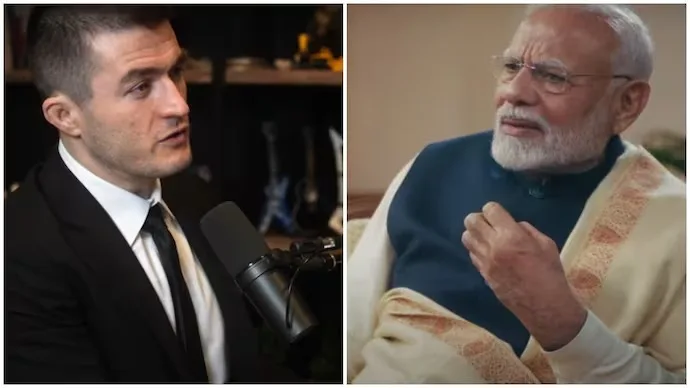
Prime Minister Narendra Modi had been to the podcast of famous US-based AI researcher, Lex Fridman in the national capital on March 16. The detailed discussion spanned around his life, philosophy, political journey to becoming Prime Minister, and his early days as a swayamsevak of the Rashtriya Swayamsevak Sangh (RSS). PM Modi credited the values of his life to the organisation. Fridman described it as “one of the most powerful conversations” he has ever had. This marks only the second podcast appearance of PM Modi’s political career, the first being with entrepreneur and investor Nikhil Kamath earlier this year.
During the conversation, Prime Minister Modi elaborated on his deep-rooted association with RSS and the organisation’s impact on his life. “Through the RSS, I found a life of purpose. Then I was fortunate to spend some time among the saints, which gave me a strong spiritual foundation. I found discipline and a life of purpose,” he said. He explained that the RSS instils a profound sense of duty, emphasising service to the nation above all else.
On the podcast, he spoke extensively on a wide range of topics, delving deep into various aspects of life, philosophy, and global affairs. He began by discussing the significance of fasting and how it shapes discipline and self-control. Reflecting on his early life, he shared personal experiences and the lessons that shaped his journey. Offering guidance to young people, he emphasised the importance of resilience and self-discovery. His travels through the Himalayas and his path to becoming a monk provided profound insights into spirituality and personal transformation.
He also addressed political and ideological topics, sharing his thoughts on the RSS and Hindu nationalism, the complexities of India’s identity, and his perspective on Mahatma Gandhi. Moving to global issues, he explored potential paths to peace in Ukraine, the dynamics between India and Pakistan, and the broader geopolitical landscape, including China under Xi Jinping. He spoke about the role of sports, particularly cricket and football, as unifying forces in society. His views on figures like Donald Trump and historical events like the 2002 Gujarat riots provided a deeper understanding of contemporary political discourse.
Reflecting on his childhood, PM Modi recounted his early engagement with the RSS: PM Modi: “…In our village, there was a branch of the Rashtriya Swayamsevak Sangh, where we played sports and sang patriotic songs. Something about those songs touched me deeply. They stirred something inside me, and that’s how I eventually became part of the RSS. One of the core values that were instilled in us at RSS was, whatever you do, do it with a purpose. Even while studying, study with the goal of learning enough to contribute to the nation. Even when you exercise, do it with the purpose of strengthening your body to serve the nation. This is what we were taught. And today, RSS is a massive organisation. It is now nearing its 100th anniversary. Such a massive volunteer organisation likely doesn’t exist anywhere else in the world. Millions of people are connected to it, but understanding RSS is not that simple. One must make an effort to truly grasp the nature of its work. More than anything, the RSS provides you with a clear direction toward what can truly be called a purpose in life. Secondly, the nation is everything, and serving the people is akin to serving God… I feel blessed to gain life’s values from such a sacred organisation.”
He added, “The volunteers who come from the RSS follow their own interests, nature and inclination, and in doing so, they strengthen and promote these kinds of activities. When you observe these initiatives, you’ll see how over the past 100 years, the RSS has dedicated itself with the discipline and devotion of a seeker staying away from the glare of mainstream attention. I feel blessed to gain life’s values from such a sacred organisation.”
PM Modi also emphasised the extensive social service initiatives undertaken by the RSS beyond its organisational structure. “A true volunteer is not defined by attending meetings or wearing a uniform but by contributions to society,” he remarked.
He cited Seva Bharati as an example—a major initiative by RSS volunteers focusing on slums and underprivileged areas. “Seva Bharati runs approximately 125,000 service projects without government assistance, solely through community support. These initiatives focus on education, healthcare, values, and sanitation.”
Revisiting his journey to leadership, PM Modi recalled his first major governance challenge: assuming the role of Gujarat’s Chief Minister amid a turbulent period. He referenced a series of significant incidents leading up to his appointment, including the 1999 Indian Airlines hijacking to Kandahar, the 2000 Red Fort attack, the 9/11 attacks, and the 2001 Indian Parliament attack. “In just eight to ten months, the world saw major terrorist incidents, leading to immense unrest. Then, on October 7, 2001, I was entrusted with Gujarat’s leadership.”
The Gujarat earthquake in January 2001 had left the state devastated. “My first major task was overseeing rehabilitation efforts,” PM Modi noted. He also mentioned the tragic Godhra train incident on February 27, 2002, just days after entering the Gujarat Assembly. Providing historical context, he highlighted that Gujarat had witnessed over 250 major riots before 2002. “In Gujarat, riots were common. Curfews were frequent, and communal violence could erupt over minor issues. However, in the last 22 years, not a single major riot has occurred in Gujarat.”
Discussing the RSS’s role in education, PM Modi underscored its commitment to value-based learning. “The RSS follows the teachings of Vedic saints and Swami Vivekananda. Some members founded ‘Vidya Bharati’ to revolutionise education in India. Today, they operate 70,000 schools, educating 30 lakh students.”
PM Modi credited his time among sadhus for shaping his moral and philosophical outlook. “Through the RSS, I found a life of purpose. I was also fortunate to spend time with saints, which provided me with spiritual grounding. Swami Atmasthananda and others have been my guiding light,” he shared. He acknowledged the teachings of the Ramakrishna Mission and Swami Vivekananda as central to his leadership approach.
Elaborating on the ideological difference between the RSS and leftist labour movements, PM Modi pointed out, “Globally, leftist ideologies shaped labour movements with the slogan ‘Workers of the world unite.’ But the RSS-affiliated labour unions advocate a different ideology: ‘Workers unite the world.’ This difference may seem subtle, but it represents a major ideological shift.”
This is not the first time that, PM Modi has hailed RSS, in February 2025, while addressing the inaugural function of the 98th Akhil Bharatiya Marathi Sahitya Sammelan, he said, “We take pride in the fact that in the great land of Maharashtra, a remarkable Marathi-speaking individual planted the seeds of the Rashtriya Swayamsevak Sangh 100 years ago. Today, we celebrate its centenary. The organisation has grown and flourished like a banyan tree.”
He said the RSS has inspired lakhs of people like himself to live for the country, and it is because of the Sangh that he got the privilege of connecting with the Marathi language and Marathi traditions.
For the last 100 years, the RSS has been running a Sanskar Yagya to take India’s great traditions and culture to the new generation, the PM asserted.




Comments