





Compared to other events meticulously planned and organised over extended periods, the Kumbh Mela stands apart as a phenomenon of its own. Unlike most gatherings, it is not orchestrated but unfolds naturally or just happens every 12 years.
The Kumbh Mela is observed in a 12-year cycle, guided by a unique alignment of the Sun, the Moon, and Jupiter’s astrological positions. This grand event, evoking memories of the Amrit Manthan of Puranas, rotates among four sacred sites: Haridwar on the banks of the Ganga, Ujjain on the Shipra, Nashik on the Godavari, and Prayagraj at the confluence of the Ganga, Yamuna, and Sarasvati rivers.
Primarily a sacred congregation of sannyasins and Hindu devotees from across the globe, the Kumbh Mela is deeply intertwined with the essence of Bharat in myriad ways. It holds profound historical, cultural, civilisational, sociological and even political significance. While its religious and spiritual dimensions are widely recognised, it has other equally important facets that are discussed rarely.
Kumbh in History
The Kumbh Mela, a timeless civilisational phenomenon, traces its origins to antiquity and finds its earliest historical references during the Maurya and Gupta periods, spanning roughly from the 4th century BCE to the 6th century CE. Over time, the Mahakumbh Mela evolved into a grander spectacle during the medieval era, enriched by royal patronage and the flourishing of cultural traditions, especially in the south, where the Chola and Vijayanagar dynasties played pivotal roles in nurturing and supporting this sacred gathering.
The colonial era brought a new dimension to the Kumbh Mela, as European observers documented its grandeur, providing unique historical perspectives. The British, captivated by the scale and diversity of the pilgrimage, left detailed accounts that offer invaluable insights into the evolution of the Mahakumbh Mela. Among them, James Prinsep, a British colonial administrator, meticulously chronicled the event in the 19th century, vividly describing its ritualistic practices, immense congregations, and the complex socio-religious dynamics that defined the gathering.
Kumbh and Freedom Struggle
Colonial archives reveal that the Prayagwal community, closely associated with the Kumbh Mela, played a significant role in fostering and sustaining resistance against British rule during the 1857 rebellion. The Prayagwals actively opposed the colonial Government’s support for Christian missionaries and their dismissive treatment of Hindu pilgrims as “ignorant co-religionists.” They also campaigned against aggressive attempts to convert Hindu pilgrims to Christianity. During the rebellion, Colonel Neill specifically targeted the Kumbh Mela site, shelling the region inhabited by Prayagwals in what historian Maclean describes as the “notoriously brutal pacification of Allahabad.”
Historical records indicate that plans for the 1857 battle were deliberated during this time, with Rani Lakshmi Bai reportedly staying with a Prayagwal in Prayag. One notable incident involved a Prayagwal breaking a large brass bell of a church near Kotwali during the revolt, an act for which he was subsequently executed by the British. Many Prayagwals were later recognised as freedom fighters, and their names were included in official records. Furthermore, the vast congregations at the Magh and Kumbh Melas in Prayag consistently unnerved British authorities, as these gatherings symbolised collective defiance.
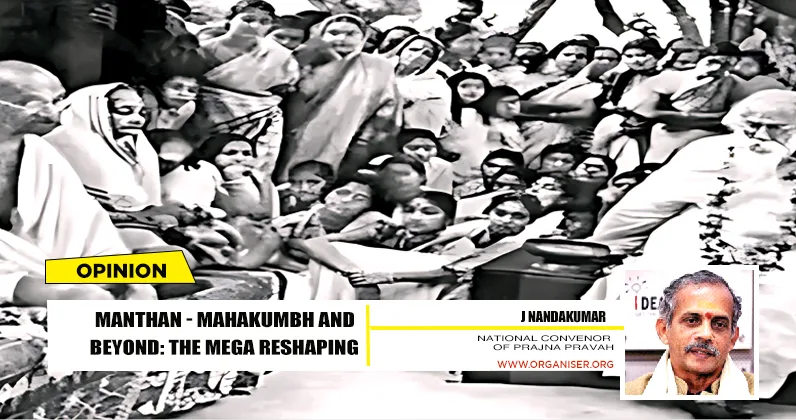
During the 1857 rebellion, Prayagwals and Kumbh Mela pilgrims carried flags symbolising war and racial injustices they endured
After reclaiming control, the British Government subjected the Prayagwals to severe persecution. While some were executed, others, against whom insufficient evidence existed, were harassed relentlessly. Large portions of Kumbh Mela lands near the Ganga-Yamuna confluence were confiscated and incorporated into Government cantonments. In the years following the rebellion, Prayagwals and Kumbh Mela pilgrims carried flags symbolising the war and the racial injustices they endured. British media reports described these pilgrim assemblies at subsequent Kumbh Melas as “hostile” and regarded them with “disbelief,” highlighting the enduring spirit of resistance among the participants.
Maharshi Dayanand Saraswati’s biographies vividly recount his pivotal role in organising the War of Independence in 1857, with significant events unfolding against the backdrop of the Haridwar Kumbh Mela in 1855. Pindidas Jnani’s work, 1857 ke Swatantrya Sangram men Swarajya Pravartak Maharshi Dayananda Saraswati ka Kriyatmak Yogdan, provides detailed insights into how Dayanand met the leaders of the rebellion during the Kumbh Mela and planned the uprising with them. For this reason, Maharshi Dayanand Saraswati is regarded as the chief architect of the 1857 War of Independence.
Another significant and less-known event associated with the Kumbh Mela was the political debut of Mahatma Gandhi in Bharat. Upon his return to Bharat in January 1915, the Haridwar Kumbh Mela became the first major public event where Gandhi made his appearance following a brief visit to Shantiniketan. In his autobiography, Gandhi devoted an entire chapter to recount his experiences at the Haridwar Kumbh Mela. It was here that he first realised the profound impact his work in South Africa had made on the general public across Bharat. “My business was mostly to keep sitting in the tent giving darshan and holding religious and other discussions with numerous pilgrims who called on me. This left me not a minute which I could call my own. I was followed even to the bathing ghat by these darshan-seekers, nor did they leave me alone whilst I was having my meals. Thus it was in Hardvar that I realised what a deep impression my humble services in South Africa had made throughout the whole of India,” Gandhiji wrote in The Story of My Experiments with Truth. Interestingly, Gandhiji’s visit to Haridwar and his political debut also coincided with another historic event at the Kumbh Mela—the formation of the All India Hindu Mahasabha. In April 1915, Gandhi, alongside Swami Shraddhanand, Pandit Madan Mohan Malaviya, and others, participated in the inaugural conference of the Sarvadeshak (All India) Hindu Sabha held during the Haridwar Kumbh Mela. Similarly, it is noteworthy that in 1906, the Sanatan Dharm Sabha convened at the Prayag Kumbh Mela and resolved to establish Banaras Hindu University under the leadership of Pandit Madan Mohan Malaviya. Mahatma Gandhi, recognising the profound influence of the Kumbh Mela in inspiring the masses and attended the Prayag Kumbh Mela in 1918. Records preserved in the Regional State Archives reveal that British officers documented his presence at the event in their intelligence reports. During his visit, Gandhi actively engaged with countless individuals and participated in rituals at the Sangam.
Later, during the Non-Cooperation Movement, in a public meeting in Faizabad on February 10, 1921, Gandhi reflected on his visit to the Kumbh Mela. He explained that while he had initially planned a pilgrimage to Ayodhya, his attendance at the Prayag Kumbh had taken precedence. His references to the Kumbh Mela in the speech were not accidental, as the Non-Cooperation movement was pivotal in challenging British rule in Bharat.
The Kumbh Mela remained a significant catalyst in Bharat’s independence movement until 1947, serving as a gathering ground for Hindutva revolutionaries. A British-era communication from the Director of Central Intelligence, dated February 2, 1920, highlights this pivotal role. Displayed at an archival exhibition in the Allahabad Museum, the document underscores the Mela’s crucial contribution to the freedom struggle. It talks about a memorial adopted in a meeting held at Allahabad during the Kumbh Mela, 1918, stating, “The memorial supported the Congress League scheme of political reforms and made demands such as: “Panchayats to be immediately established in villages to decide civil suits up to Rs 500 and all non-cognisable criminal cases…Introduction of permanent settlement with full transferable and heritable rights…Enhancement of revenue and rent to be subject to enactment of the Imperial Council…Curtailment of zamindar’s privilege and Revision of law of ejectment or non-payment of rent,” the secret letter dated February 17, 1918 says.
In Independent Bharat
Even after Independence, the Kumbh Mela retained its significance as a sacred gathering central to Hindutva movements. Notably, in 1964, the Vishva Hindu Parishad was founded during Haridwar’s Kumbh Mela.The Kumbh Mela also played a pivotal role in shaping post-Independence constitutional democracy in Bharat. Renowned journalist Mark Tully, who extensively documented the Kumbh Mela, highlighted the 1989 Kumbh as a defining moment for the Ram Janmabhoomi movement. Reflecting on his experience, Tully wrote: “I had never been in such a peaceful crowd. There was no frenzy, just the calm certainty of faith; the knowledge that what had to be done had been done.” The Kumbh Mela continues to exert its unique influence on Bharat, defining its socio-political and cultural landscape in profound and enduring ways. More than a religious congregation, it is a civilisational phenomenon that has continuously shaped India’s historical, cultural, and political trajectory. n
















Comments