





As Tamil Nadu gears up for the upcoming state assembly elections in March, the Dravida Munnetra Kazhagam (DMK) finds itself at the center of controversy. Critics argue that DMK’s electoral strategy heavily relies on playing with public emotions and spreading misinformation to divert attention from its alleged failures, rampant corruption, and unfulfilled 2021 poll promises. The ongoing tussle with the central government over the denial of funds, opposition to Hindi imposition, resistance to the National Education Policy (NEP), and a non-existent delimitation exercise all serve as examples substantiating these claims.
Dayanidhi Maran’s Falsehoods: The Sundar Pichai Misrepresentation
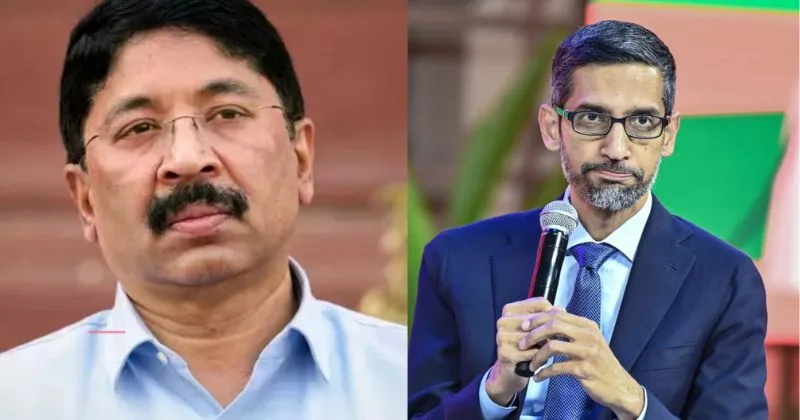
A recent incident involving DMK MP Dayanidhi Maran has added fuel to this debate. While inaugurating a three-day state-level volleyball tournament in Pudukkottai district, Maran claimed that Google CEO Sundar Pichai studied under Tamil Nadu’s two-language policy and that this system contributed to his success.
Maran stated, “We are not against any language, including Hindi. Tamil Nadu’s two-language policy helped students educated in Tamil and English consistently excel. The chairman of Google studied only two languages.” He went on to question why northern states had not adopted a trilingual system, arguing that Tamil Nadu should not be forced to do so if others were not.
However, a closer examination of Sundar Pichai’s academic history contradicts this claim. Born in Madurai on June 10, 1972, Pichai completed his schooling at Jawahar Vidyalaya Senior Secondary School in Chennai—a private CBSE school—and Vana Vani School at IIT Madras. CBSE schools follow a three-language policy, allowing students to choose a third language in addition to English and a second language, which could be Tamil, Hindi, or French.
Pichai later pursued a degree in metallurgical engineering from IIT Kharagpur before moving to the United States for higher education at Stanford University and the Wharton School of Business. His remarkable career trajectory, which led him to head Google, was shaped by his education in institutions that did not adhere to Tamil Nadu’s government school curriculum.
DMK’s Selective Narrative on Language Policy
Critics highlight the irony in DMK’s stance on language policy. While the party vehemently opposes Hindi and Sanskrit in Tamil Nadu, it funds and runs Urdu and Arabic schools. During a heated parliamentary debate, Maran questioned why Sanskrit, spoken by a relatively small population, was allocated funds. Critics argue that this exposes DMK’s bias against the ancient language, despite its vast literary and cultural heritage.
Moreover, DMK’s approach to Hindi remains inconsistent. Former Chief Minister M. Karunanidhi once justified recommending Dayanidhi Maran as a Union Minister because of his proficiency in Hindi, a language DMK publicly opposes. A similar justification was used when his daughter, Kanimozhi, was nominated to the Rajya Sabha.
While DMK leaders champion the success of figures like Sundar Pichai as a testament to Tamil Nadu’s education policy, ground realities paint a different picture. Many government schools in the state are in dire need of renovation, facing severe shortages of qualified teachers. Despite relatively high salaries, teachers often lack modern pedagogical training, leading to declining literacy rates among students. Reports indicate that a significant percentage of government school students struggle with basic Tamil, English, and math.
The CPI’s Tamil Nadu state secretary, R. Mutharasan, recently condemned Tamil Nadu Governor R. N. Ravi’s statement that the two-language policy placed the state’s youth at a disadvantage compared to their peers from neighboring states. Mutharasan countered by citing examples of Tamil-origin global leaders like Sundar Pichai, ISRO’s Dr. V. Narayanan, and former PepsiCo CEO Indira Nooyi as products of the state’s language policy. However, these individuals were largely educated in private schools or institutions that did not follow the government’s curriculum, making such comparisons misleading.
With elections approaching, critics argue that DMK is intensifying its propaganda efforts to distract from governance failures. The party’s historical pattern of spreading misinformation is seen as a calculated attempt to manipulate public sentiment.
In 2015, when Sundar Pichai was appointed CEO of Google, DMK leader Karunanidhi celebrated the achievement, declaring it a proud moment for Tamils. However, some point out that this praise overlooked the fact that Pichai is a Tamil Brahmin, a community often targeted by Dravidian politics.











Comments