Artificial Intelligence in Ancient Indian Texts: A New Perspective
December 6, 2025
  • Read Ecopy
  • Circulation
  • Advertise
  • Careers
  • About Us
  • Contact Us
Android AppiPhone AppArattai
Organiser
  • ‌
  • Bharat
    • Assam
    • Bihar
    • Chhattisgarh
    • Jharkhand
    • Maharashtra
    • View All States
  • World
    • Asia
    • Europe
    • North America
    • South America
    • Africa
    • Australia
  • Editorial
  • International
  • Opinion
  • RSS @ 100
  • More
    • Op Sindoor
    • Analysis
    • Sports
    • Defence
    • Politics
    • Business
    • Economy
    • Culture
    • Special Report
    • Sci & Tech
    • Entertainment
    • G20
    • Azadi Ka Amrit Mahotsav
    • Vocal4Local
    • Web Stories
    • Education
    • Employment
    • Books
    • Interviews
    • Travel
    • Law
    • Health
    • Obituary
  • Subscribe
    • Subscribe Print Edition
    • Subscribe Ecopy
    • Read Ecopy
  • ‌
  • Bharat
    • Assam
    • Bihar
    • Chhattisgarh
    • Jharkhand
    • Maharashtra
    • View All States
  • World
    • Asia
    • Europe
    • North America
    • South America
    • Africa
    • Australia
  • Editorial
  • International
  • Opinion
  • RSS @ 100
  • More
    • Op Sindoor
    • Analysis
    • Sports
    • Defence
    • Politics
    • Business
    • Economy
    • Culture
    • Special Report
    • Sci & Tech
    • Entertainment
    • G20
    • Azadi Ka Amrit Mahotsav
    • Vocal4Local
    • Web Stories
    • Education
    • Employment
    • Books
    • Interviews
    • Travel
    • Law
    • Health
    • Obituary
  • Subscribe
    • Subscribe Print Edition
    • Subscribe Ecopy
    • Read Ecopy
Organiser
  • Home
  • Bharat
  • World
  • Operation Sindoor
  • Editorial
  • Analysis
  • Opinion
  • Culture
  • Defence
  • International Edition
  • RSS @ 100
  • Magazine
  • Read Ecopy
Home Bharat

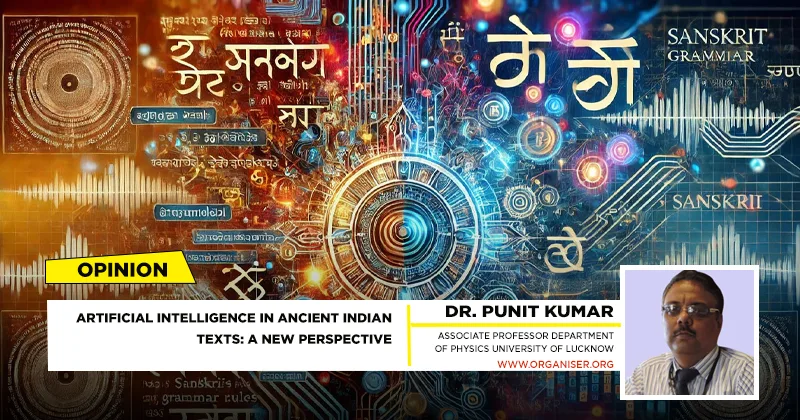
Artificial Intelligence in Ancient Indian Texts: A New Perspective

The concept of Artificial Intelligence (AI), often considered a product of modern technological advancements, finds intriguing parallels in ancient Indian texts. While contemporary AI revolves around machine learning and automation, ancient Indian scriptures, including the Vedas, Upanishads, and epics like the Mahabharata and Ramayana, contain references to sentient machines, automated beings, and self-operating weapons, hinting at a deep understanding of intelligence beyond human cognition

Prof Punit KumarProf Punit Kumar
Mar 9, 2025, 06:00 pm IST
in Bharat, Opinion, Sci & Tech
Follow on Google News
FacebookTwitterWhatsAppTelegramEmail

Artificial Intelligence (AI) is often regarded as a modern technological marvel. However, a deep exploration of ancient Indian texts reveals fascinating insights into automated intelligence, self-operating machines, and cognitive sciences. Ancient Indian scriptures, including the Vedas, Upanishads, and epics like the Ramayana and Mahabharata, contain descriptions that parallel modern AI concepts.

In ancient India, intelligence was not limited to human cognition, but extended to artificial beings and self-operating mechanisms. The Sanskrit term buddhi refers to intellect, while manas denotes the mind, suggesting an advanced understanding of cognitive sciences. Several texts discuss the creation of intelligent and self-operating machines, which can be considered early descriptions of AI.

Ancient Indian knowledge systems were deeply rooted in mantras and sutras, which can be compared to algorithms, systematic sets of instructions designed to achieve a specific outcome. Mantras, when chanted with precise phonetics and rhythm, were believed to produce specific vibrational effects, much like how algorithms generate predictable outputs when executed correctly. Similarly, sutras condensed complex knowledge into brief, structured formulas, ensuring efficient transmission and recall, akin to data compression in computer science. The Paninian grammar system, for example, follows a rule based structure remarkably similar to modern programming languages. The Nyaya and Vaisheshika schools of philosophy laid down logical inference methods, mirroring principles used in artificial intelligence. The algorithmic structuring of knowledge in these traditions showcases early forms of computational thinking, demonstrating how pattern recognition, logic, and precision, key elements of AI and machine learning have long been embedded in India’s intellectual heritage. This historical parallel highlights the deep rooted connection between ancient wisdom and modern computational sciences.

Several instances in ancient Indian literature depict artificial beings endowed with intelligence and decision-making abilities. Some key examples include:

The Mahabharata describes an architectural marvel, the palace of illusions (Maya Sabha), constructed by the demon architect Maya. This palace had self – operating doors and mechanisms that confused visitors, indicating an early vision of automated intelligence and machine learning principles.

Ancient texts mention mechanical warriors (yantras), which were described as self-operating machines, similar to modern robots and AI – driven war machines. The Sukraniti, an ancient treatise, discusses yantra purushas, mechanical beings capable of performing specific tasks, akin to contemporary humanoid robots.

Divine weapons (astras) in the Ramayana and Mahabharata were said to possess decision-making capabilities, striking only the intended targets and sometimes returning to the wielder. These descriptions align with modern AI – driven missiles and guided weaponry.

The Brahmastra, a powerful weapon mentioned in several epics, was believed to be activated only when the wielder possessed the correct knowledge. This resembles modern AI ethics, where access to powerful technology is restricted based on qualifications and intent.

Indian philosophy has extensively explored consciousness and intelligence, concepts that resonate with AI research today. The theory of Chit-Shakti (conscious energy) suggests that intelligence exists beyond biological beings. The Sankhya philosophy speaks of Prakriti (nature) and Purusha (consciousness), a dualistic framework that parallels discussions in AI regarding artificial versus natural intelligence.

The concept of Smriti (memory) and Shruti (intuition-based knowledge) aligns with machine learning, where AI systems rely on stored data (memory) and predictive algorithms (intuition) to function efficiently.

Ancient Indian texts emphasize ethical considerations in deploying intelligence, whether natural, or artificial. The Bhagavad Gita discusses Dharma (righteous duty), a principle that applies to AI ethics today. Questions regarding AI responsibility, consciousness, and self-awareness can be examined through Indian philosophical lenses.

Modern AI shares intriguing parallels with ancient Indian thought, particularly in areas like machine learning, neural networks, and ethics. Machine learning involves continuous learning from data, refining models, and improving intelligence over time, much like the practice of yoga and meditation, where the mind absorbs knowledge, processes experiences, and evolves through self-awareness. Just as deep meditation refines mental clarity and cognitive abilities, deep learning models improve their performance through repeated exposure to data. Similarly, the concept of neural networks in AI, where interconnected nodes process and transmit information, aligns with the Nadi system in Ayurveda, which describes energy channels that connect different parts of the body and regulate life force (prana). This reflects how AI neural networks function, where each node processes signals, enabling complex decision-making. AI ethics also resonates with karma theory, which states that every action has consequences. Just as karma emphasizes moral responsibility, AI accountability requires ensuring that algorithms make ethical decisions, avoid biases, and operate transparently. As AI shapes the future, integrating ancient philosophical insights with technological advancements can foster responsible innovation, ensuring that machines serve humanity in a balanced and ethical manner. This convergence of ancient wisdom and modern AI underscores the timeless relevance of Indian thought.

While modern AI has been built through advancements in computing and engineering, its conceptual roots can be traced back to ancient Indian wisdom. The idea of intelligent, self-operating beings, ethical intelligence, and cognitive systems existed in Indian knowledge traditions long before AI became a scientific field. A deeper study of these texts may provide insights into the future of AI development, particularly in the realm of ethics and consciousness.

 

Topics: RamayanaVedasMahabharatArtificial Intelliegnce
Share7TweetSendShareSend
✮ Subscribe Organiser YouTube Channel. ✮
✮ Join Organiser's WhatsApp channel for Nationalist views beyond the news. ✮
Previous News

Tamil Nadu’s Language Row: DMK’s Dayanidhi Maran exposed for spreading misinformation about Sundar Pichai’s education

Next News

Holi 2025: Happier and healthier celebrations

Related News

RSS Sarsanghchalak Dr Mohan Bhagwat

Fraternity is Bharat’s civilisational strength; dispute is not in our nature: RSS Sarsanghchalak Dr Mohan Bhagwat

Ayodhya to host a Ramayana park featuring a 25-foot Ravana statue

Ayodhya to host a Ramayana park featuring a 25-foot Ravana statue depicting the battle between Bhagwan Ram and Ravana

Representative Image

AI to Enter School Classrooms: Government to introduce artificial intelligence curriculum from Class 3 onwards

School children working on the laptop

From chalkboards to chipsets, SOAR is transforming skilling landscape of Bharat through tech-powered future

Deepotsav in Ayodhya last year

Ayodhya Deepotsav 2025: 28 lakh diyas to light up Saryu Ghats, 30,000 volunteers to create new world record

Sarsanghchalak Dr Mohan Bhagwat

Maharshi Valmiki wrote Ramayan to guide people towards strength & solace through Bhagwan Ram’s ideals: Dr Bhagwat

Load More

Comments

The comments posted here/below/in the given space are not on behalf of Organiser. The person posting the comment will be in sole ownership of its responsibility. According to the central government's IT rules, obscene or offensive statement made against a person, religion, community or nation is a punishable offense, and legal action would be taken against people who indulge in such activities.

Latest News

PM Modi presents Putin with Bhagavad Gita, chess set, and silver horse

Cultural ties strengthened: PM Modi presents Putin with Bhagavad Gita, chess set, and silver horse

Image for representational purpose only, Courtesy Vocal Media

Bihar to get ‘Special Economic Zones’ in Buxar and West Champaran

Thirupparankundram Karthigai Deepam utsav

Andhra Pradesh: AP Dy CM Pawan Kalyan reacts to Thirupparankundram row, flags concern over religious rights of Hindus

23rd India-Russia Annual Summit

India-Russia Summit heralds new chapter in time-tested ties: Inks MoUs in economic, defence, tourism & education

DGCA orders probe into IndiGo flight disruptions; Committee to report in 15 days

BJYM leader Shyamraj with Janaki

Kerala: Widow of BJP worker murdered in 1995 steps into electoral battle after three decades at Valancherry

Russian Sber bank has unveiled access to its retail investors to the Indian stock market by etching its mutual fund to Nifty50

Scripting economic bonhomie: Russian investors gain access to Indian stocks, Sber unveils Nifty50 pegged mutual funds

Petitioner S Vignesh Shishir speaking to the reporters about the Rahul Gandhi UK citizenship case outside the Raebareli court

Rahul Gandhi UK Citizenship Case: Congress supporters create ruckus in court; Foreign visit details shared with judge

(L) Kerala High Court (R) Bouncers in Trippoonithura temple

Kerala: HC slams CPM-controlled Kochi Devaswom Board for deploying bouncers for crowd management during festival

Fact Check: Rahul Gandhi false claim about govt blocking his meet with Russian President Putin exposed; MEA clears air

Load More
  • Privacy
  • Terms
  • Cookie Policy
  • Refund and Cancellation
  • Delivery and Shipping

© Bharat Prakashan (Delhi) Limited.
Tech-enabled by Ananthapuri Technologies

  • Home
  • Search Organiser
  • Bharat
    • Assam
    • Bihar
    • Chhattisgarh
    • Jharkhand
    • Maharashtra
    • View All States
  • World
    • Asia
    • Africa
    • North America
    • South America
    • Europe
    • Australia
  • Editorial
  • Operation Sindoor
  • Opinion
  • Analysis
  • Defence
  • Culture
  • Sports
  • Business
  • RSS @ 100
  • Entertainment
  • More ..
    • Sci & Tech
    • Vocal4Local
    • Special Report
    • Education
    • Employment
    • Books
    • Interviews
    • Travel
    • Health
    • Politics
    • Law
    • Economy
    • Obituary
  • Subscribe Magazine
  • Read Ecopy
  • Advertise
  • Circulation
  • Careers
  • About Us
  • Contact Us
  • Policies & Terms
    • Privacy Policy
    • Cookie Policy
    • Refund and Cancellation
    • Terms of Use

© Bharat Prakashan (Delhi) Limited.
Tech-enabled by Ananthapuri Technologies