





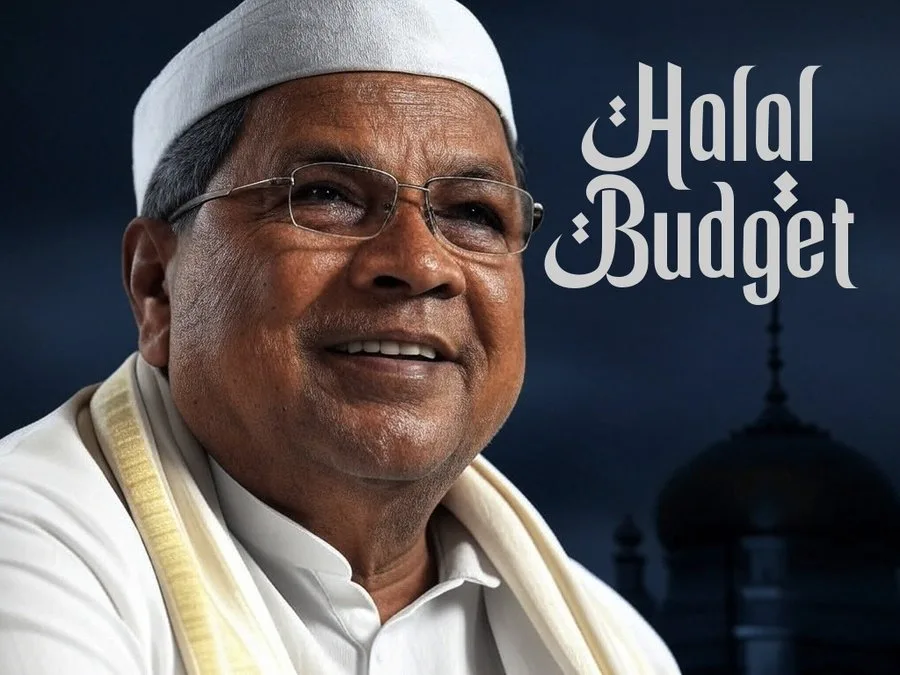
Chief Minister Siddaramaiah has unveiled a monumental budget, marking his 16th fiscal plan with an allocation of Rs 4.09 lakh crore, making it the largest budget in the state’s history. As per Karnataka Congress govt this budget is designed to address various developmental needs while also allocating over Rs 50,000 crore specifically for government guarantee schemes. However, the budget comes against the backdrop of Karnataka’s daunting total debt, which currently stands at Rs 7.64 lakh crore.
This budget presents specific allocations aimed at Muslim, Christian and minority communities, such as modernizing madrasas with essential educational tools, and plans to facilitate startup opportunities for minority youth through the Karnataka Minority Development Corporation. Additionally, funds have been allocated for the repair and renovation of Waqf properties and for developing Muslim burial grounds, amounting to ₹150 crores. An ambitious action plan of Rs 1,000 crores has been outlined under the ‘Chief Minister’s Minority Colony Development Programme’ for implementation in the approaching fiscal year.
The Chief Minister has also focused on constructing an expanded Haj Bhavan in Bengaluru to enhance the experience for Haj pilgrims and their families. Moreover, grants amounting to Rs 100 crores have been earmarked for the development of Jain, Buddhist, and Sikh communities, alongside a substantial Rs 250 crores designated for the welfare of the Christian community.
The Karnataka BJP has unleashed a scathing critique to this budget, characterizing it as a “Halal Budget” aimed specifically at appeasing minority communities rather than promoting balanced development across various segments of society.
According to BJP leaders, this budget prioritizes appeasement politics over equitable growth, drawing a clear line of division within the state’s populace.
In a show of dissent, BJP leaders including R. Ashoka and BY Vijayendra staged protests outside the Vidhana Soudha, highlighting their discontent with the allocations made in the budget. Through social media, the party lambasted the Congress-led government, declaring, “Karnataka presents a Halal Budget—appeasement at its peak!” This statement underscores their claim that fiscal provisions heavily favor the Muslim community while effectively neglecting the interests of Scheduled Castes (SCs), Scheduled Tribes (STs), and Other Backward Classes (OBCs).
“What about SCs, STs, and OBCs? Absolutely nothing!” the BJP asserted, emphasizing that the Congress administration is overlooking minority communities in its budgetary plan. Such accusations have reverberated throughout the state, sowing discontent among various societal groups.
BJP national spokesperson Pradeep Bhandari further escalated the critique by drawing historical parallels, claiming that the Congress-governed Karnataka is mirroring the governance model of Muhammad Ali Jinnah, the founder of Pakistan. “In Karnataka, the Congress party has effectively passed a budget akin to a modern Muslim League Budget. The move to increase the honorarium of Imams to Rs 6,000, along with earmarking Rs 150 crores for Waqf properties, highlights a blatant favoritism towards minority communities,” Bhandari asserted.
Scam CM @siddaramaiah in Karnataka presents a Halal Budget—appeasement at its peak!
🕌 Reservation for Muslims in government contracts
🕌 ₹50,000 assistance for Muslim simple marriages
🕌 ₹150 crore for infrastructure development of Waqf properties & graveyards
🕌 ₹50 lakh… pic.twitter.com/Ts3ZrnYai1— BJP Karnataka (@BJP4Karnataka) March 7, 2025
Bhandari has accused that this budget allocates over Rs 1,000 crores explicitly for benefits directed at the minority community. He further criticized the government for contemplating the withdrawal of legal cases against rioters in Hubballi, suggesting this was another indication that the Congress party is selectively applying justice and governance standards.
The scorn from the BJP extended to Leader of the Opposition in the Legislative Council, Narayana Swamy Chalavadi, who dismissed the budget as merely “debt-based.” Chalavadi accused Chief Minister Siddaramaiah of mismanaging the state’s finances, proclaiming that the current budget represents a rollback of financial discipline and has rendered the government the most indebted in history: “This is a ‘debt-based’ budget! The Chief Minister is presenting his 16th budget while leading the state into unprecedented debt. With a staggering 27% of income dedicated to debt servicing and 18% interest costs, it’s clear that this Congress government has achieved ‘zero’ results,” Chalavadi posted on social media.
In protest, BJP and JD(S) leaders, including R. Ashoka and BY Vijayendra, convened to express their disapproval of the government’s policies. They called for an equitable allocation of funds, urging that the money designated for Scheduled Caste Sub Plan (SCSP) and Tribal Sub Plan (TSP) should not be diverted for political guarantees. Ashoka articulated the demand through a social media post, asserting that each MLA’s constituency should receive a specific sum of ₹150 crores to address pressing local needs.
ಮುಖ್ಯಮಂತ್ರಿ @siddaramaiah ಅವರು ಇಂದು ಮಂಡಿಸಿದ ರಾಜ್ಯ ಬಜೆಟ್ ಅತ್ಯಂತ ನಿರಾಶಾದಾಯಕ, ಅಭಿವೃದ್ಧಿ ಶೂನ್ಯ, ದೂರದೃಷ್ಟಿ ರಹಿತ ಅಡ್ಡಕಸುಬಿ ಬಜೆಟ್.
ಸಿದ್ದರಾಮಯ್ಯನವರು Outgoing CM ಎಂದು ಜನಸಾಮಾನ್ಯರ ಮನಸ್ಸಿನಲ್ಲಿ ಗಟ್ಟಿಯಾದ ಅಭಿಪ್ರಾಯ ಮೂಡಿರುವುದರಿಂದ, ಈ ಬಜೆಟ್ ನಿಂದ ಕನ್ನಡಿಗರಿಗೆ ಹೆಚ್ಚಿನ ನಿರೀಕ್ಷೆಗಳೇನೂ ಇರಲಿಲ್ಲ. ಆದರೂ ತಮ್ಮ… pic.twitter.com/wzu0KQEo3f
— R. Ashoka (@RAshokaBJP) March 7, 2025
The unveiling of the Karnataka budget has ignited an intense backlash from the opposition, centered around allegations of partisanship and ineffective governance.











Comments