





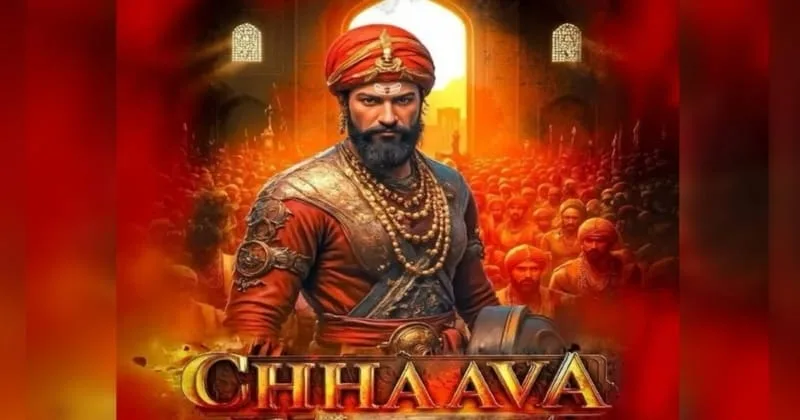
A man with the aura of a god, a warrior like a lion, who was enshrined as a god in the minds of a large sect of people, he is their Chhatrapati, Chatrapathi Sivaji Maharaj. Today’s new generation can witness that they have enshrined their son, who was born with the same qualities as him, and that lion cub, on the throne of the same mind. The same Chhatrapati Sambhaji Maharaj lives on the throne in the hearts of the people of India.
When the title card of the movie Chhaava is shown at the end of the film, we can see people shedding tears; we see them shouting Jai to Sambhaji Raje with respect and tears rolling out. Even the young children of today’s generation place their hands on their chests and shout Jai to the man who was their Bhupati, the Prajapati. It’s evidence that the British education of Lord Meckalay failed in front of the folklore and lullabies fed by the mothers in the form of the history of our heroes and the heroic legends of India triumphing.
If we come to the Chhaava movie, we cannot see the hero named Vicky Kaushal anywhere. Vicky, the prince of biopics, had made a ‘Parakaya Pravesh’ entry into Sambhaji Raja. There is a reason to say that.
When you present a man who has won 127 wars, wields a huge sword, makes the eyes of the person standing in front of you heavy with just a glance, speaks 12 languages, is an expert in military sciences, surpasses his father in guerrilla warfare, challenges poets with his poems, and shines like silver in the forts of the Mughals, the “aura” he brings is not so terrifying, the movie ends there, in the very first scene. Then the movie will be lifeless. Many such situations have happened to many movies. Prithviraj Chauhan, starring Akshay Kumar, is an example of that.
Vicky Kaushal’s walk, gait, speech, body movements, and even a glance were filled with the grandeur of the aforementioned Sambhaji. The truth is that Vicky has managed to create an unprecedented resemblance that sometimes makes us feel as if he has come face to face with the same Shivaji we have seen in Shivaji’s pictures. It can be said that he carried the film on his shoulders alone.
There is another reason why Chhaava stands a weight ahead of cosmic films like Bahubali. While films like Bahubali amaze us with their making and captivate us, Chhawa gives us an extra thrill and, above all, a sense of pride and happiness in remembering the history of our country and remembering Dharma. In the intro scene of Sambhaji Raje, who comes to attack Burhanpur in the first scene, he calls out “Har Har Mahadev” and rides his horse over the barricades. It is a goosebump moment with spiritual weightage and historic legendry. The difference between chanting Jai Mahishmati in Bahubali and chanting “Namah Parvati Pataye – Hara Hara Mahadeva” is that, the first is a call made by a fictional character in the film for his land, while the second is a call made by the character in the film which pumps our mind and heart because it’s my history and bloodline of my ancestors who gave their life while protecting this holy land.
The film Chhaava is a sea of punch dialogues throughout. Similarly, poetry also. Aurangzeb’s son comes to see Sambhaji, asking for help in killing his father. There, Muhammad Akbar praises Sambhaji, who came alone to see him unarmed. Then Sambhaji’s reply is as follows. “I respect my Sword. We kill the tiny snake by taking it with two fingers and squeezing it in our fist, not with a sword.” Sambhaji Raje, who compares his friend and poet Chandogamatya to the sun. But Chandogamatya says that he should be treated as salt and asks Raje to use him as needed. Sambhaji Raje replies that then he will use him as salt to rub in the wounds of his enemies.
As the film progresses, Sambhaji Raje falls prey to the deceit of his stepmother and his family, along with her relatives, to kill him and seize power. There, too, we see the pious king bowing down to the feet of his stepmother, who is conspiring to make her son Ramaraje as the king, while going to war.
The last 40 minutes are the scenes of the battle at Sangameshwar, where Sambhaji is imprisoned and tortured for about 40 days and then killed. These scenes make the viewers cry and make our hearts heavy. Literally, the battle at Sangameshwar is a spectacle of hundreds of people trying to subdue a lion with weapons. The scenes where he prepares his kingdoms and relatives to face the army of Aurangzeb, who is coming with 8 lakh soldiers, are thrilling.
The last scenes are the most emotional. If a mass climax was needed, the film could have been made with Sambhaji’s 127 battle victories. But director Laxman Utekar tried to portray and adapt Sambhaji Maharaj just like in Shivaji Sawant’s book. We can say that he achieved complete success in that. Aurangzeb makes many tempting promises to Sambhaji, who has faced 40 days of severe torture. Aurangzeb is offering him everything to honour him if he extends hands of friendship with him. But Sambjaji Raje has to convert and accept Islam. He must change his Religion. He rejected all offers even after severe torture of 40 days. Sambhaji Raje bids farewell by having his eyes gouged out, his nails torn out, his hair pulled out, his entire body drawn to the sword and rubbing salt in the wound.
Despite being under the rule of Islam, Britain and other foreign powers for 100 years, if the Hindu population in India is still 80 per cent, we should thank heroic legends like these, our ancestors. The belief that we are their descendants is the treasure we should keep for the present generation and the generations to come. For that, Such films should also be an inspiration for that.
Chhaava is the story of the resistance of our lineage. It is the valour of our ancestors. It is a film that we should all watch in cinema halls and watch with our children and families.













Comments