





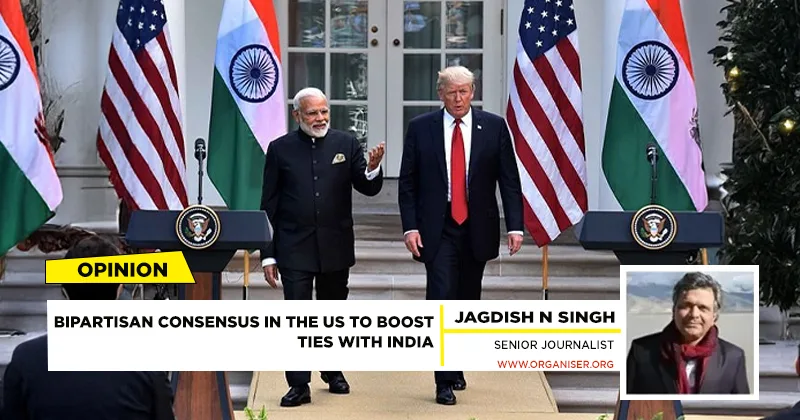
In the wake of Donald J Trump’s return to the US presidency, speculation has been rife in a section of the public opinion that relations between the United States and India might take a beating. Reports go that President Trump’s key slogan today is “Make America Great Again.” As part of this, the issues of trade and illegal immigration are his key foreign policy priorities. His presidency is sure to be tough with India on these issues.
The reports add that the indications of President Trump’s insistence on these issues have been very much there. During his presidential campaign in September last, Trump called New Delhi a “very big abuser” of the bilateral trading relationship. Recently, after he took over the US presidency, Trump threatened the BRICS nations, of which India has been a founding member, with 100 per cent tariffs, if they formed a new currency or replaced the US dollar with a different tender. On January 28, he said that high-tariff countries, such as India (China and Brazil), “harm” America and hence, Washington would impose taxes on them to bring money into the US. He said the US would establish a “very fair system” so that money would “come into our coffers.”
Besides, there are reports that insinuate President Trump might not be favourably inclined to Prime Minister Narendra Modi now, for the latter did not call on him during his visit to the US to attend the fourth Quad Leaders’ summit in September last.
One thinks any assessment of the future of Indo-American ties based on such reports and insinuations would be utterly naïve. Knowledgeable sources say that in the post-Cold War landscape, there has been a near consensus across the US political spectrum to focus on advancing its interests in the Indo-Pacific region, in which democratic India must play a central role. In line with this consensual focus, the previous Democratic administration, led by then President Joe Biden in Washington, reinforced the Indo-Pacific Initiative unveiled during President Trump’s first term only. The Biden presidency elevated the QUAD with India to the summit level. It signed with India the Initiative on Critical and Emerging Technologies(ICET). Besides, the Biden presidency encouraged greater strategic and defence ties between Washington and New Delhi.
The Trump presidency is likely to carry forward this policy consensus and, in the process, Indo-US ties are all set to get better in the coming years . The White House under President Trump is unlikely to make any fuss of the allegation made during the Biden administration that New Delhi has had plots to assassinate anti-India elements in the United States. The Trump administration could rather take serious note of the Indian accusation that the Sikh militant activities have long been going on in the United States.
The sources say Trump has always been friendly to India. During his first presidency, he revived the QUAD with India as its primary focus. Washington and New Delhi signed the foundational agreements, such as the Basic Exchange and Cooperation Agreement (BECA) and the Compatibility and Security Agreement (COMCASA ). His administration also sided with New Delhi on the issues of Doklam, Pulwama, Balakot and Galwan.
The issue of illegal immigration is a non-issue for India today. New Delhi is in agreement with Washington to stop the menace of ’illegal immigrants’ anywhere. It is likely to take back its immigrants if they are identified “illegal.” Of course, an important component of President Trump’s foreign policy framework has been trade. During his first term in the White House, Trump also applied tariffs on India’s steel and aluminium. He stripped India of preferential trade status. But this is unlikely to hurt Indo-US relations much.
Trump’s modus operandi has always been transactional. He is likely to focus on what the overall economic interests of the United States are. Trade between India and the United States favours the former. In 2024, the US imported more than $73 billion from India. It exported just over $35 billion. But India is being an increasingly important manufacturing hub today. The US companies such as Apple seek to build their supply chains outside China.
Trump’s emphasis on overall economic interest has been such that in 2018, his administration gave a waiver to New Delhi over its Chabahar Port project in Iran. Following the reimposition of sanctions on Iran, the US restrictions forced all US companies, foreign firms and “friendly” countries from doing business with Iran. But there was no such insistence in the case of India’s business with Iran.
The sources add President Trump is unlikely to club India with other BRICS nations on the issue of tariffs. Trump and his key aide, Elon Musk, are likely to focus mainly on rebalancing their nation’s highly unequal trade, which is currently in China’s favour. The Trump administration must know fully well that New Delhi has little interest in weakening the US dollar. Unlike BRICS members, such as Russia, China and Brazil, India is not “anti-American in sentiment” today. There is considerable pro-Washington sentiment in the section of the Indian foreign policy community. This section calculates that the US today is on a collision course with China. India has had a history of arguments. New Delhi could use its proximity to Washington to its advantage in this regard.
More importantly, President Trump has had a very warm personal rapport with Prime Minister Modi. In 2019, during his first term, Trump feted Modi at a rally titled “Howdy Modi,” in Texas. In 2020, Modi had over 125,000 people turn out for the “Namaste Trump” rally in Ahmedabad.
Notwithstanding the rumours to the contrary, the Trump-Modi rapport is intact. This was clearly visible when Modi’s representative and our External Affairs Minister, S Jaishankar, attended Trump’s presential inaugural ceremony. During his recent sojourn in Washington, Jaishankar happened to be the first foreign minister to hold a one-on-one meeting with new U.S. Secretary of State Marco Rubio. During this sojourn, Minister Jaishankar met President Trump’s National Security Advisor Michael Walz as well.
Pertinently, the sources add, Prime Minister Modi is likely to visit the US very soon. In his telephonic conversation with President Trump on January 27, Modi had a ‘productive’ discussion on deepening cooperation between the two countries. Both leaders emphasized their commitment for a “ mutually beneficial” relationship. They discussed “ various facets” of the Indo-US Comprehensive Global Strategic Partnership, “including in the areas of technology, trade, investment, energy and defence.”











Comments