





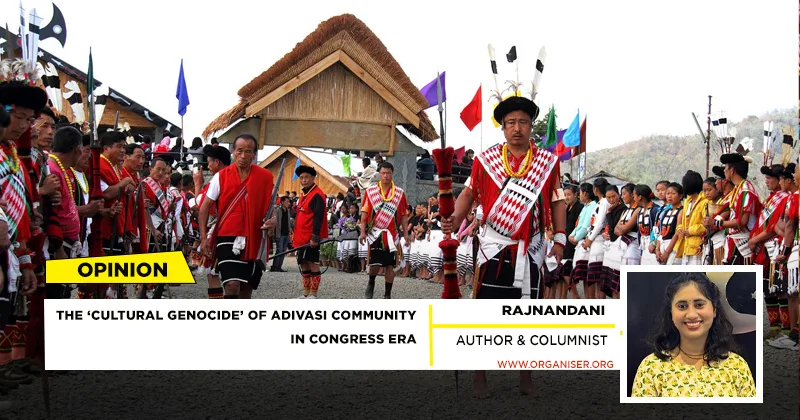
The indigenous Adivasi communities of India play a crucial role in preserving Bharat’s cultural and ecological heritage. Comprising more than 8 per cent of India’s population, they possess distinct linguistic, spiritual, and cultural practices that are intricately linked to their ancestral territories. Nonetheless, despite their significant role in the nation’s diversity, their identity has been gradually diminished through historical indifference and policies that emphasise assimilation rather than inclusion. The Congress party’s stance on Adivasis has frequently faced criticism for maintaining cultural marginalisation, socio-economic exclusion, and neglecting participatory development.
This article examines the idea of cultural genocide within the Indian context, evaluates Congress’s policies, and emphasises how Prime Minister Narendra Modi’s leadership has brought about favourable changes focused on rectifying historical wrongs and uplifting Adivasis.
Understanding Cultural Genocide
Cultural genocide denotes the intentional destruction of a group’s cultural identity via strategies and activities that diminish their customs, languages, and ideologies. In contrast to physical genocide, cultural genocide aims at the essential but non-physical elements of communal identity.
Manifestations in the Indian Context
The policies and actions implemented in post-independence India regarding Adivasis, particularly during the Congress period, have surfaced in various manners, frequently resulting in negative effects on the social, cultural, and economic welfare of these groups. These expressions uncover a trend of systemic disregard and marginalization that did not honor the unique identities of Adivasis. What follows is a detailed explanation of the main expressions:
1. Assimilation Policies: The Loss of Cultural Identity
In its attempts to “modernize” and “uplift” Adivasis, the Indian government often implemented assimilation policies aimed at incorporating them into the prevailing cultural and socio-economic mainstream. Although integration itself is not fundamentally an issue, the approaches employed frequently overlooked the distinct cultural identities of Adivasi communities.
Assimilation policies were founded on the belief that Adivasis were “backward” and required adopting mainstream Hindu or national cultural standards to become “modern.” This approach did not acknowledge the inherent worth of Adivasi traditions, knowledge systems, and lifestyles. Rather than honoring their cultural diversity, the policies aimed to assimilate them into the broader societal structure, diminishing vital elements of their identity in the process.
A notable Instance of this is observable in education policies, where schools in tribal regions prioritized mainstream curricula while overlooking Adivasi languages, folklore, and cultural traditions. As time passed, this resulted in a cultural gap for younger generations of Adivasis, many of whom came to feel embarrassed about their ancestry. Cultural festivals, traditional governance methods, and indigenous insights regarding agriculture, forest preservation, and medicine were frequently regarded as insignificant or old-fashioned.
Furthermore, assimilation policies also covered economic practices. Conventional subsistence techniques, like shifting cultivation and foraging, were frequently prohibited or discouraged in favor of mainstream farming practices, further weakening Adivasi cultural traditions. This method not only deprived Adivasis of their cultural identity but also rendered them poorly prepared to succeed in the economic systems forced upon them.
2.Displacement and Land Alienation: Severing the Bond with Ancestral Lands :
For Adivasis, land represents more than just a resource; it embodies a sacred link that intertwines their spiritual, cultural, and economic existence. Their territories are frequently filled with cultural importance, serving as the location of ancestral residences, hallowed groves, and burial sites. Nonetheless, extensive industrial and infrastructure development projects, especially during the Congress era, often disrupted this connection.
The government, motivated by the aims of swift industrialization and economic growth, seized large areas of tribal land for purposes such as mining, dams, factories, and urban development. Legislation like the Land Acquisition Act of 1894 (which remained in effect after independence) enabled the government to seize tribal lands under the pretext of “public purpose,” frequently without sufficient compensation or engagement with the Impacted communities.
A notable instance is the building of the Hirakud Dam in Odisha during the 1950s, resulting in the displacement of many thousands of Adivasis. They were displaced from their ancestral territories, with minimal consideration for their cultural ties to the region. Many did not receive sufficient compensation or were relocated in a manner that enabled them to uphold their traditional ways of living. Numerous comparable instances exist in the coal-rich areas of Jharkhand and Chhattisgarh, where entire Adivasi villages have been uprooted by mining ventures.
The decrease in land has led to widespread effects. It not only stripped Adivasis of their main source of income but also disrupted their spiritual connections to the land, causing numerous communities to feel isolated and estranged. The social and psychological trauma from displacement has caused the disintegration of conventional social frameworks and cultural traditions, further entrenching Adivasis in marginalisation.
3. Neglect of Indigenous Languages: Marginalising Adivasi Knowledge Systems
Language serves as a foundation of culture, and for Adivasis, their dialects and oral customs constitute the essence of their identity. Nevertheless, education policies after independence emphasized mainstream languages or regional state languages, neglecting Adivasi dialects and knowledge systems.
The education system, intended to foster national unity and progress, frequently regarded tribal languages as hindrances instead of advantages. As a result, Adivasi dialects were omitted from school curricula, textbooks, and administrative procedures. Consequently, generations of Adivasi children were raised in settings where their native languages were undervalued, leading to the slow decline of these languages.
This oversight also included the traditional knowledge systems inherent in Adivasi languages. For example, Adivasis have vast knowledge regarding medicinal plants, farming methods, and forest ecosystems, transmitted orally through narratives, songs, and rituals. The marginalization of their languages in education and governance resulted in this knowledge being neither recorded nor valued, causing its gradual disappearance.
The sidelining of Adivasi languages also established obstacles for these groups in utilizing government services and engaging in democratic activities. When government representatives and legal systems functioned in languages unknown to Adivasis, it estranged them more and hindered their ability to advocate for their rights effectively.
Attempts to protect and promote indigenous languages have been inconsistent and inadequate, as most actions do not tackle the systemic issues confronted by Adivasi communities. This disregard has not only weakened their cultural legacy but also restricted their capacity to succeed in a swiftly evolving environment.
4. Religious Conversions: Undermining Spiritual Traditions
Adivasi culture and identity are profoundly connected to religious traditions. The majority of Adivasis adhere to traditional spiritual beliefs that are animistic and emphasize respect for nature, ancestral spirits, and holy places. Nonetheless, conversion initiatives by Christian groups have frequently aimed to diminish these traditions, weakening Adivasi cultural and their Sanatan spiritual legacy.
In various areas, Christian missionaries were instrumental in delivering education and healthcare to tribal communities, which certainly offered certain advantages. Nonetheless, this frequently involved pressuring Adivasis to embrace Christianity. During this time, numerous Adivasis renounced their age-old beliefs, which were labeled as “pagan” or “superstitious.” This resulted in a disconnection from their spiritual ties to nature and ancestral customs, causing cultural confusion.
The attempts at religious conversion, by Christianity have frequently been accompanied by a disregard for Adivasi spiritual customs as primitive or outdated. This not only reduces the cultural heritage of Adivasis but also encourages divisions both within and between tribal communities.
Congress’s Past Stance on Adivasis
Colonial Heritage and Persistence
The British colonial administration established the exploitation and marginalization of Adivasi communities. After independence, Congress took on and continued this legacy by implementing policies that emphasized industrial development at the expense of indigenous rights.
Key Failures of Congress
1.Land Policies and Displacement
Initiatives such as dams and mining under Congress administrations displaced millions of Adivasis without proper rehabilitation.
Legislation such as the Land Acquisition Act of 1894 (in effect until 2013) emphasized state dominance over communal land entitlements.
2.Tokenism Over True Representation
Policies such as the Fifth Schedule and Tribal Sub-Plan were not fully implemented.
Leaders from Adivasi communities were frequently excluded from decision-making processes, relegating their role to mere symbolism.
3.Homogenized Development
Congress’s perspective on progress overlooked the socio-cultural contexts of Adivasi communities, weakening their sustainable methods and local governance structures.
The Erosion of Multiculturalism
Imposition of Dominant Cultures: Congress’s method of nation-building frequently encouraged a singular cultural identity, compromising India’s rich diversity.
1. Language Policies: The enforcement of Hindi and English sidelined native languages, resulting in their slow deterioration.
2.Religious Bias: Congress’s policies frequently overlooked Adivasi spiritual traditions, fostering divisions among their communities and increasing their alienation.
Centralised Development Approach: Centralised planning by Congress frequently disregarded Adivasi viewpoints, resulting in top-down policies that did not meet their specific needs and knowledge frameworks.
Failures in Participatory Development
Lack of Empowerment: Congress’s development initiatives were mostly top-down, lacking significant attempts to involve local Adivasi leaders or communities in the planning and execution processes. This resulted in: Programs that failed to represent local needs or circumstances. Inefficient resource allocation and bureaucratic corruption.
Exploitation of Resources: Adivasi areas, abundant in natural resources, turned into hotspots of exploitation during Congress governance. Mining and deforestation initiatives uprooted communities and devastated traditional ways of life.
Education and Healthcare Gaps: Congress’s attempts to enhance education and healthcare in Adivasi areas were inadequate and not well-suited to their cultural environments. Educational institutions frequently overlooked Adivasi languages and customs, while medical services stayed unreachable in distant regions.
Positive Changes Under the Leadership of PM Narendra Modi
The Modi administration has made important efforts to tackle the long-standing oversight and strengthen Adivasi communities with inclusive, participatory, and sustainable measures.
Emphasis on Cultural Preservation
1.Recognition of Tribal Culture: Events such as the observance of “Janjatiya Gaurav Divas” on the anniversary of Birsa Munda’s birth pay tribute to Adivasi champions and cultural traditions.
Creation of tribal museums throughout India to safeguard and celebrate Adivasi heritage.
2.Promotion of Indigenous Languages: The New Education Policy (NEP) 2020 highlights the significance of education based on mother tongues, encompassing Adivasi languages.
2. Support for Tribal Art and Handicrafts: Programs such as TRIFED’s “Van Dhan Vikas Kendras” support tribal artisans by creating opportunities to sell their goods.
Empowering Adivasi Leadership
1.Increased Representation: The selection of India’s inaugural tribal President, Droupadi Murmu, signifies a significant milestone in strengthening Adivasi leadership.
2. Strengthening Local Governance: Enabling Gram Sabhas and Panchayati Raj institutions to engage Adivasi communities in decision-making activities.
Land and Resource Rights
1. Implementation of the Forest Rights Act (FRA), 2006: Enhanced recognition of Adivasis’ rights over forest lands.
2. Balancing Development and Rights: Efforts to ensure that development projects in tribal regions are inclusive and environmentally sustainable.
Decentralised and Participatory Development
1. Skill Development and Employment: Initiatives such as “Skill India” and “Stand-Up India” offer focused assistance to Adivasi youth, helping them tap into contemporary opportunities while maintaining their traditional skills.
2.Healthcare and Education: Growth of telehealth services and mobile healthcare units in distant tribal areas. Creation of Eklavya Model Residential Schools (EMRS) aimed at delivering quality education specifically designed for Adivasi students.
Promoting Multiculturalism
1. Revival of Tribal Festivals: Expansion of telehealth services and mobile health units in remote tribal regions.
Establishment of Eklavya Model Residential Schools (EMRS) was intended to provide quality education tailored for Adivasi students.
2. Inclusive Governance: Initiatives to incorporate Adivasi viewpoints into national policies while maintaining their cultural heritage.
Towards an Inclusive Bharat: Creating an inclusive and equitable Bharat necessitates a comprehensive strategy that tackles the historical wrongs endured by Adivasis and enables them to be active contributors to nation-building.
Key Recommendations
1. Recognizing Cultural Rights: Continued efforts to preserve and promote Adivasi languages, traditions, and spiritual practices.
2. Strengthening Local Governance: Enhancing the role of Gram Sabhas and tribal councils in governance and development planning.
3. Ensuring Land and Resource Security: Strict implementation of land and forest rights laws to protect Adivasis from displacement and exploitation.
4. Promoting Education and Healthcare: Scaling up culturally relevant education and accessible healthcare in tribal regions.
5. Inclusive Economic Growth: Encouraging sustainable industries and entrepreneurship in tribal areas to create jobs while preserving natural resources.
India’s path to nation-building is closely linked to its cultural diversity, with Adivasis being a crucial yet frequently neglected segment of this tapestry. Historically, the Congress party’s treatment of Adivasis has been marked by neglect, superficial gestures, and a failure to accept multiculturalism. Policies such as the Tribal Sub-Plan and constitutional safeguards in the Fifth and Sixth Schedules, though intended to tackle tribal concerns, frequently employed a top-down method that overlooked Adivasi perspectives, undermining their cultural legacy and sustaining marginalisation.
A notable change has been witnessed under Prime Minister Narendra Modi’s leadership. The Modi administration has prioritized empowering Adivasis by acknowledging their rights, promoting inclusive governance, and implementing localized development strategies. Efforts such as the Forest Rights Act’s successful execution, TRIFED’s Van Dhan Vikas Yojana, and the landmark election of Droupadi Murmu as the first tribal President of India have highlighted the government’s dedication to ensuring Adivasis are equal participants in the country’s advancement.
Cultural preservation has been emphasized by promoting tribal art, music, festivals, and languages, as well as creating tribal museums and heritage programs. Through promoting sustainable development in tribal areas, the government has aligned economic growth with environmental protection, allowing Adivasis to prosper while preserving their connection to nature.
Even with these advancements, obstacles persist in education, healthcare, and fair economic opportunities. An engaging approach is crucial, making certain that Adivasis actively participate in decisions that affect their lives.
A genuinely inclusive Bharat can be realized only when Adivasis are empowered to thrive while maintaining their distinct identities. The progress achieved under PM Modi’s guidance provides an optimistic pathway ahead, consistent with India’s foundational vision of unity in diversity—vibrant, inclusive, and strongly connected to its cultural legacy.














Comments