





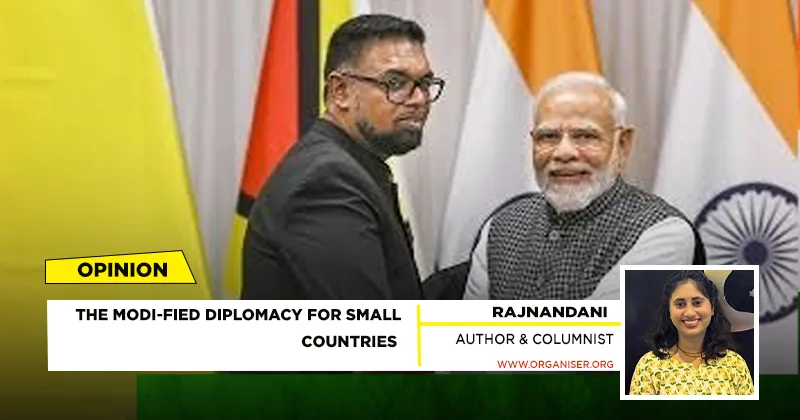
During his time as India’s Prime Minister Narendra Modi has implemented a bold foreign policy that aims to enhance India’s ties with countries of various sizes. Modi’s personal diplomacy, frequently demonstrated through his dynamic and charismatic leadership, has been pivotal in transforming India’s foreign relations. The idea of giving small countries preference in his foreign trips is based on a larger goal of establishing a multipolar world where India holds significant power.
Likewise, Modi’s regular trips to nations such as Sri Lanka and Nepal have played a role in reducing tensions that can arise over matters like border disputes and ethnic differences. Modi’s efforts to directly engage with leadership have contributed to stabilizing relations and laying the foundation for increased cooperation on trade, infrastructure development, and security issues.
Modi’s method of interacting with smaller countries is particularly important in South Asia, where China’s increasing presence often poses a challenge to India’s influence. Modi aims to balance China’s growing Belt and Road Initiative (BRI) and maintain India’s dominance in the region by improving relations with smaller neighboring countries. India’s focus on smaller countries also highlights its commitment to the “Neighborhood First” policy, which gives priority to enhancing ties with neighboring countries.
Enhancing Economic Cooperation and Trade Opportunities
Another important advantage of Modi’s trips to smaller nations is the encouragement of economic collaboration. India frequently engages in initiatives focused on building infrastructure, forming trade alliances, and facilitating investment with smaller nations. These meetings resulted in the establishment of trade deals and partnerships in agriculture, technology, renewable energy, and education, among other areas.
During his trip to Mauritius in 2015, Modi revealed plans for a project connecting the ocean to the sky and investments in infrastructure, such as aiding in the construction of a new Supreme Court building in Port Louis. Likewise, Modi’s involvement with Seychelles, a tiny island nation in the Indian Ocean, led to India offering monetary assistance and technical knowledge to aid in infrastructure initiatives like a new port and a radar station, enhancing the nation’s maritime security.
Modi’s trips to smaller African countries like Tanzania, Mozambique, and Rwanda have also emphasized promoting trade and economic collaboration. India’s economic involvement with Africa has strengthened in recent years, especially in sectors such as energy, technology, and pharmaceuticals, in addition to its existing strong relationship. India has also extended lines of credit to African countries for infrastructure projects, aiding in the growth of transportation networks, power plants, and other essential infrastructure.
Additionally, Modi’s dedication to strengthening trade connections with smaller nations supports India’s overall goal to expand its trade alliances. This is especially crucial as India aims to decrease its reliance on conventional trade allies such as the United States, the European Union, and China, and discover new markets. Although smaller in economic size, smaller countries often offer niche markets and chances for cooperation in new sectors.
Boosting India’s Global Soft Power
Modi’s visits to smaller countries have improved India’s soft power by influencing others through attraction instead of coercion. India’s democratic traditions, diverse cultural heritage, and active diaspora are highly valued by small nations. Modi’s direct engagement with local communities and focus on India’s cultural and historical connections with other nations has significantly enhanced the country’s reputation on a global scale.
Modi’s trip to Fiji in 2014 was a significant occasion, not only for diplomatic purposes, but also for its symbolic value in enhancing connections with the Indian community in the Pacific Islands. The trip emphasized India’s dedication to the Pacific Island nations and reaffirmed the significance of the Indo-Pacific as a strategic region. Modi has reinforced India’s relationship with local communities by highlighting the importance of shared cultural bonds, including the influence of the Indian diaspora on the cultural development of these nations.
India’s involvement in education, healthcare, and disaster relief has boosted its image as a helpful international participant. During his visits to small island nations, Modi promised assistance for disaster management and efforts to combat climate change. India has also been engaging in capacity-building efforts in those nations by providing scholarships and skill development programs, resulting in positive reputation worldwide
Enhancing Regional and Global Security
Modi’s visits to smaller countries also have significant security implications. In a region as strategically sensitive as South Asia, the Indian Ocean, and parts of Africa, India’s influence in shaping security architectures is crucial. Small nations often seek security guarantees and defense cooperation from larger powers, and India, with its growing military capabilities, is well-placed to provide such support.
In the Indian Ocean region, nations like the Maldives, Seychelles, and Mauritius rely on India for maritime security and counterterrorism cooperation. Modi’s personal commitment to strengthening India’s maritime security relationships has had a significant impact on securing the sea lanes of communication that are vital for global trade. His diplomatic visits have also facilitated greater cooperation on issues such as maritime piracy, human trafficking, and countering illegal fishing.
India’s security cooperation with small countries extends beyond the Indian Ocean region. In Africa, where the threat of terrorism and instability in regions like the Sahel is prevalent, Modi’s engagements have emphasized counterterrorism cooperation and peacekeeping efforts. India has been an active contributor to United Nations peacekeeping missions, and its engagements with small African countries have led to increased collaboration in areas such as military training and defense technology.
Furthermore, India’s assistance to countries in the fight against climate-induced natural disasters also serves a strategic purpose. Many small island nations, especially in the Pacific, are vulnerable to rising sea levels and extreme weather events, which can destabilize entire regions. India’s focus on climate diplomacy, especially through initiatives like the International Solar Alliance (ISA), has strengthened India’s role as a leader in global environmental governance, and has helped secure alliances with nations in need of sustainable solutions.
Promoting Multilateralism and Global Governance
Finally, Modi’s trips to smaller nations are included in India’s overall dedication to multilateralism. By building stronger relationships with various nations, India has established itself as a supporter of a more diverse and multilateral global system. Lesser developed nations frequently have a significant impact in global platforms like the United Nations, the World Trade Organization (WTO), and regional groups such as the South Asian Association for Regional Cooperation (SAARC) and the African Union (AU).
By visiting these organizations, Modi aims to enhance India’s influence by pushing for changes that more accurately reflect the needs of developing and small nations. India’s position in the United Nations Security Council has been strengthened by its active participation in conversations regarding worldwide peace and security, thanks to its alliances with smaller nations that provide crucial backing in global talks.
The Modi Doctrine of Diplomacy
Many Countries and International Organisations conferred PM Modi with their Highest Civilian Order and Awards for his contributions towards regional and global peace through a proactive foreign policy with countries around the world under for The Modi Doctrine of Diplomacy.
Here are the list outlines the prestigious international honors and awards conferred upon Indian Prime Minister Narendra Modi during his visits to various countries:
1. Saudi Arabia (April 2016): King Salman bin Abdulaziz awarded King Abdulaziz Sash, the most prestigious civilian award in Saudi Arabia.
2. Afghanistan (2016): Highest civilian award in Afghanistan, State Order of Ghazi Amir Amanullah Khan.
3.Palestine (2018): Grand Collar of the State of Palestine, the most prestigious award for international leaders in Palestine.
4.United Arab Emirates (2019): The highest civilian award in the UAE, the Order of Zayed.
5. Russia: The Order of St. Andrew the Apostle is Russia’s most prestigious civilian award, given in 2019.
6. Maldives (2019): the highest honor for foreign dignitaries in the Maldives was awarded to individuals in the form of the Order of the Distinguished Rule of Nishan Izzuddin.
7.Bahrain (2019): awarded King Hamad with the Order of the Renaissance, the highest honor in the country.
8.USA (2020): Legion of Merit, given for outstanding meritorious service by the U.S. government.
9. Bhutan (December 2021): Awarded the Order of the Druk Gyalpo, the highest civilian honor in Bhutan.
10. Papua New Guinea (2023): Receives the Ebakl Award from President Surangel S. Whipps Jr. of Palau.
11. Fiji : Recipient of the Companion of the Order of Fiji, Fiji’s top honor, in acknowledgement of his worldwide leadership.
12. Papua New Guinea (2023): Papua New Guinea awarded the Grand Companion of the Order of Logohu, the most prestigious recognition in the country.
13. Egypt (2023): In june President Abdel Fattah El-Sisi awarded Egypt’s highest state honor, the Order of Nile, to recipients in Egypt.
14.France (2023): On 13 july President Emmanuel Macron of France presented the Grand Cross of the Legion of Honour, the country’s top honor.
15. Greece (August 25, 2023): President Katerina Sakellaropoulou presents the Grand Cross of the Order of Honour.
16. Dominica (November 2024): Dominica gave the Dominica Award of Honour to PM Modi before his visit to Africa.
17.Nigeria (November 2024): President Bola Ahmed Tinubu awarded the Grand Commander of the Order of the Niger to Nigeria.
Global Recognition for Outstanding Organisations
PM Modi has been honoured with several prestigious international awards from leading global organizations:
1. Seoul Peace Prize (2018): PM Modi received the Seoul Peace Prize for his notable efforts in promoting global peace, fostering reconciliation among nations, and advancing world harmony.
2. United Nations Champions of the Earth Award (2018): Recognized by the UN for his bold environmental leadership, PM Modi was awarded this highest environmental distinction.
3. Philip Kotler Presidential Award (2019): PM Modi was the first recipient of the Philip Kotler Presidential Award, which acknowledged his exceptional leadership for India.
4. Global Goalkeeper Award (2019): Awarded by the Bill and Melinda Gates Foundation for the Swachh Bharat Abhiyan, this honour was dedicated to the people of India who made the initiative a nationwide movement.
5. Global Energy and Environment Leadership Award (2021): Presented by the Cambridge Energy Research Associates (CERA), this award celebrated PM Modi’s commitment to the future of global energy and environmental sustainability.
These honors reflect India’s diplomatic outreach and the recognition of PM Modi’s leadership on the global stage. omoting Multilateralism and Global Governance.
Conclusion
Narendra Modi’s trips to lesser-known nations demonstrate a sophisticated and forward-looking stance on international relations. By interacting with these countries, Modi has not just bolstered India’s one-on-one relationships but has also been instrumental in promoting India’s strategic and economic goals. The numerous benefits of these visits are varied: from increasing India’s influence and improving regional safety to boosting economic partnerships and promoting international collaboration.
In a world with multiple poles, India’s capacity to develop significant connections with both major and minor countries will be essential in defining its position on the global platform. Modi’s efforts to engage with smaller nations showcase India’s aspiration to lead in a more diverse, equitable, and harmonious world. As India grows its presence on the global stage, these partnerships will play a crucial role in its future success in the international realm.






Comments