





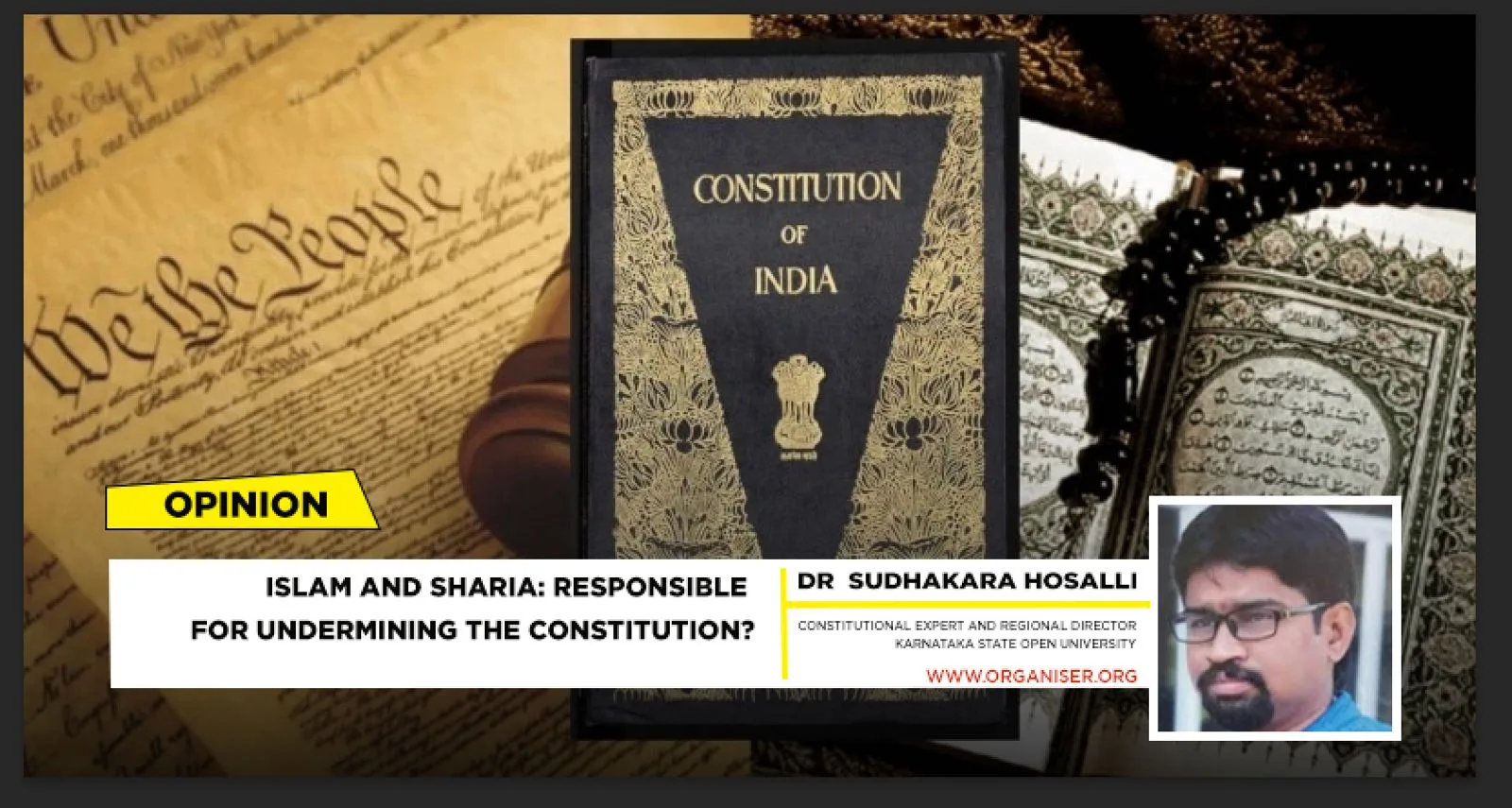
Today, across India, there is an air of reverence and respect as citizens remember the greatness of Constitution-making on November 26, 1949—the day when a newly independent India laid the foundation of its legal framework. In recent years, particularly after Narendra Modi became the prime minister, this day has been celebrated as Constitution Day, emphasising celebrating it meaningfully rather than just as a formality.
Nature and Significance of Constitution Day Celebrations
What is the essence of Constitution Day celebrations? How should they be observed? Are symbolic gestures enough, or is active engagement essential? Naturally, such multifaceted questions arise as we commemorate this day.
On Constitution Day, the primary focus is on reflecting upon the ideals of the Constitution, the rights it guarantees to citizens, and the responsibilities we carry to uphold it. For those who actively participate in these celebrations, there is an additional duty—to safeguard the sovereignty and stability of the Constitution.
Challenges to Constitutional Stability
What are the threats to the Constitution’s stability? Are there forces seeking to undermine it entirely? As we celebrate Constitution Day in 2024, it is crucial to address these pressing questions. One of the most significant challenges, it seems, comes from Islam and Sharia law. These two ideologies often do not align with the Constitution of India, which has been in force since 1950. In many cases, some Muslims hold that Sharia law takes precedence over the Indian Constitution.
Reviewing Current Events
To address the serious challenges posed by the Constitution, let’s consider two recent events:
First:
On October 8, 2024, the election results for Jammu and Kashmir were announced, upending pre-election predictions. Following the abrogation of Article 370, many expected violence, but the elections were largely peaceful, resulting in a government led by the Jammu and Kashmir National Conference (JKNC) and the Congress. In Hindu-majority Jammu, the BJP emerged victorious, while in Muslim-majority Kashmir, the Congress alliance won.
The abrogation of Article 370 was intended to foster development, establish peace, and affirm the supremacy of the Constitution. However, despite these efforts, the BJP, which hoped to gain ground in Kashmir, found its influence limited. The JKNC, which allied with Congress and hoped to secure social justice votes and Muslim support, also faced unexpected challenges.
Key Questions Arising from the Elections
- Has the abrogation of Article 370 fostered greater respect for the Constitution among Muslims in Kashmir
- What does the slogan “Jai Bheem, Jai Meem” signify in this context?
- Do the election results represent a victory for democracy and social justice?
Out of 47 constituencies in Kashmir, the Congress-led alliance won 41, with the JKNC securing two seats and the People’s Democratic Party (PDP) securing three. The BJP, the other hand, failed to win any seats in the region. This raises questions: How did the Constitution and democracy prevail here if, in reality, the influence of Islam and Sharia law remains strong?
In Pulwama, a district that previously witnessed the horrific terror attack, the JKNC and the PDP won two seats each, suggesting that despite constitutional reforms, the influence of extremist ideology remains. The Constitution, in this case, appears to have been sidelined.
Despite efforts by the central government to implement social justice, especially with the reservation of nine Scheduled Tribe (ST) constituencies, the BJP failed to secure a foothold. While Hindu-majority Jammu saw pluralistic voting patterns, where Hindus and other communities supported diverse candidates, Kashmir remained dominated by Muslim-majority parties that often prioritise Sharia law over the Constitution.
Social Justice and Pluralism in India
India’s electoral history demonstrates that there is room for pluralism and inclusivity in Hindu-majority areas. Over the years, India has seen several Muslim Presidents, Chief Ministers, Union Ministers, Vice Presidents, and Supreme Court judges—a testament to its commitment to pluralism.
However, even in reserved constituencies for tribal communities in Kashmir, the elected representatives were overwhelmingly Muslim, often supporting parties that oppose constitutional values. This reflects a worrying trend where adherence to Sharia law overshadows the Constitution.
Second:
Ambedkar’s Vision and the Present Constitutional Crisis
Dr B R Ambedkar, the architect of the Indian Constitution, is often remembered for his pioneering research and unwavering principles on social equality. Today, not just India but the entire world acknowledges his contributions, especially in the context of the current constitutional chaos in Bangladesh. Whenever Ambedkar spoke or wrote on any subject, it was backed by meticulous research.
In 1936, Dr Ambedkar highlighted how religious factors contributed to constitutional instability in various regions, such as today’s Bangladesh and, in the past, Syria, Egypt, and Afghanistan (his observations were published in 1941). He warned about the dangers of religious expansionism, particularly how Islam’s rigid adherence to certain principles could be at odds with constitutional ideals like equality. Ambedkar fearlessly exposed the flaws of the “kafir” system, which he saw as denying non-Muslims the right to live with dignity.
Today, it seems Ambedkar’s foresight was astonishingly accurate. Over 88 years ago, he documented the potential dangers of religious extremism, including acts of cruelty that could degrade society. He spoke of the anarchy that religious fanaticism could bring, such as the recent attacks in Bangladesh. Where radicals have targeted the ISKCON organisation, destroyed Hindu temples, and committed atrocities like murder, rape, and abduction. These acts highlight a fanatic agenda driven by religious expansionism.
No other Indian leader criticised the dangers of religious extremism as sharply as Ambedkar did. He was particularly vocal about the inequality faced by women, the anti-scientific practices of Sharia law, and the disregard for secular principles. Analysing the ongoing turmoil in Bangladesh through Ambedkar’s lens, we see clear parallels with his warnings.
Ambedkar’s Critique of Religious Expansionism in India
Ambedkar argued that Muslims, as a community, historically resisted principles of equality. As part of their imperial ambitions, Muslim invaders launched multiple incursions into India. However, unlike other foreign invaders, these Islamic conquerors had a different agenda: the eradication of Hinduism, the ancient religion of the land, along with its cultural practices. Their writings explicitly recorded intentions to destroy Hindu rituals and replace them with Islamic practices.
For instance, Mahmud of Ghazni believed his repeated invasions of India were a holy war. Historian Al-Utbi, in recounting these invasions, described how Mahmud demolished temples and massacred idol worshippers to establish Islam. He reportedly vowed to wage a holy war against the Hindus every year.
Similarly, Muhammad Ghori’s campaigns were driven by religious zeal. Historian Hasan Nizami recorded that Ghori’s mission was to cleanse India of what he viewed as superstitions and idolatry. The famed conqueror Timur, in his autobiography, claimed that his expeditions were to purify the land from polytheism and establish the “true faith” of Islam. He described how destroying temples and converting Hindus were by the Prophet Muhammad’s teachings.
The invaders’ brutality, like the humiliation of Raja Jayapala and the mass killings during raids on Hindu territories, was not merely for conquest but to instil fear and submission among the native population. Historian Tabaqat-i-Nasiri described how, during Bakhtiyar Khilji’s conquest of Bihar, Hindu monks were slaughtered, and temples were desecrated. The invaders often found satisfaction in material gains and enforcing their religious beliefs on conquered peoples.
The Relevance of Ambedkar’s Warnings Today
Ambedkar’s prescient warnings, made over eight decades ago, have largely been ignored, often due to political and ideological biases. This oversight is evident in the current situation in Bangladesh, where secular principles are under siege. Every conscious Indian must study Ambedkar’s insights on religious expansionism, review the present-day consequences, and seek solutions to uphold constitutional values.
Today, there are two significant threats to Indian citizens and their constitutional rights. The Constitution must be safeguarded from forces that seek to undermine its foundation. The recent call by Bangladesh to abolish secularism and officially declare itself an Islamic state, coupled with efforts by its interim government to realise this goal, is a dire warning. The examples of Kashmir and Bangladesh remind us that Ambedkar’s vision for protecting the Constitution from the challenges posed by Islam and Shariat must not be taken lightly.
Suppose Ambedkar’s call for constitutional vigilance is ignored. In that case, there is a genuine risk that one day, India may lose the very celebration of Constitution Day. This day symbolises the spirit of democracy and secularism in the country.















Comments