





November 24 morning in Uttar Pradesh’s Sambhal turned violent when a seven-member court-appointed team arrived at the Shahi Jama Masjid to conduct a survey. As the team entered the mosque, a mob of hundreds gathered around it from three sides. The situation quickly escalated into chaos, with stones being thrown, vehicles set on fire, and gunshots fired. The violence resulted in the deaths of four people.
The situation in Sambhal remains tense 24 hours after the violence. Schools have been closed, mobile internet services have been suspended, and large gatherings have been banned in Sambhal town in the aftermath of the riots.
The violence in Sambhal stems from a longstanding dispute over the Shahi Jama Masjid and its historical significance. Hindus assert that the mosque was built on the site of the ancient Shri Hari Har Mandir, which was dedicated to Kalki, the 10th and yet-to-arrive incarnation of Bhagwan Vishnu. But what do historians and an 1879 report from the Archaeological Survey of India (ASI) reveal about this claim?
Why the court ordered a survey at Sambhal’s Shahi Jama Masjid
The court-mandated survey of the Shahi Jama Masjid in Sambhal was the second of its kind, following a petition filed on November 19. The petition, filed by Vishnu Jain, an advocate representing the Hindu side, claimed that the mosque was built on the remnants of an ancient Kalki Mandir. According to the petition, the Shri Hari Har Mandir, dedicated to Bhagwan Vishnu’s 10th and yet-to-arrive incarnation, was demolished by Mughal Emperor Babur in 1526. The petitioners argued that the Jama Masjid Committee was unlawfully and forcibly occupying the site of the Kalki Mandir.
Acting on the petition, the court-appointed an advocate commissioner to conduct an initial survey on the same day. The second survey, which took place on November 24, led to the violent chaos in Sambhal. The court has ordered the survey team to submit its report by November 29.
Babur ordered the destruction of a Mandir in Sambhal: Historians
Sambhal, a town in western Uttar Pradesh, is traditionally believed to be the prophesied birthplace of Kalki, the future incarnation of Bhagwan Vishnu, who is destined to appear at the end of Kaliyuga to bring about its conclusion and usher in a new Satyayuga. This significant belief, linked to the end of the current cosmic cycle, may have played a role in the destruction of a temple in Sambhal by Mughal Emperor Babur.
Historians such as Meenakshi Jain and Sri Ram Sharma have documented the destruction of an ancient temple in Sambhal during Babur’s reign (1526-1530). According to historian Meenakshi Jain, Babur, the founder of the Mughal Empire, ordered the demolition of this Mandir, similar to his actions in other places like Ayodhya.
In an interview in 2023, Meenakshi Jain stated, “The second mosque Babur built in India was in Sambhal. He ordered his general to destroy the existing Mandir, and a mosque was constructed in its place.” Jain further emphasised that the inscription on the mosque makes it clear that it was built under Babur’s orders and that pieces of the destroyed Mandir were used in the construction of the mosque. This claim is also elaborated in her book, The Battle for Rama – The Case of the Temple at Ayodhya.
“One of his (Babur’s) officers, Hindu Beg, is said to have converted a Hindu temple at Sambhal into a mosque. His Sadr, Shaikh Zain, was responsible for demolishing many Hindu temples in Chanderi (MP) when he occupied the region,” wrote historian Sri Ram Sharma in his 1940 book The Religious Policy of the Mughal Emperors.
Vishnu Jain, the advocate representing the Hindu side, has referred to Babur’s autobiography Baburnama to support his claim.
According to Jain, Babur ordered the transformation of a Hindu temple into a mosque in Sambhal in 933 Hijri. He further stated that this act is commemorated in an inscription that still exists on the mosque. Jain asserts that the original Mandir was dedicated to Kalki, the future incarnation of Bhagwan Vishnu, and was known as the Shri Hari Har Mandir, which had associations with both Bhagwan Vishnu and Bhagwan Shiva.
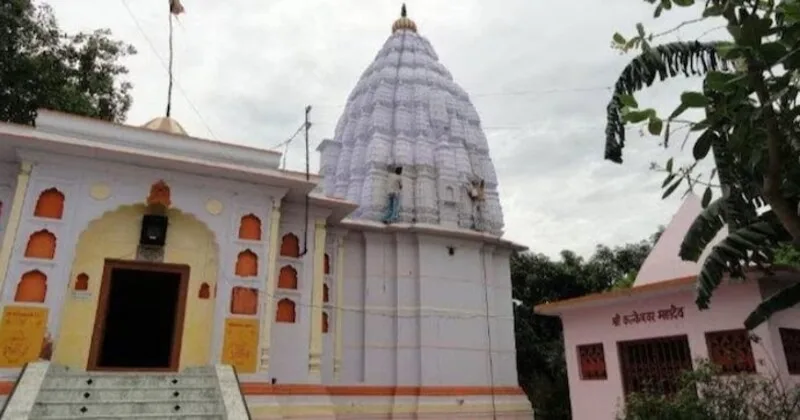
Centuries after the mosque was constructed, it is believed that a new temple dedicated to Kalki was built in the 18th century by the Maratha queen, Ahilyabai Holkar, in Sambhal. This Mandir, known as the Kalki Mandir, stands just 300 meters from the Shahi Jama Masjid.
What the ASI survey of 1879 reveals
In a 1879 report published by the Archaeological Survey of India (ASI), British archaeologist A.C.L. Carlleyle made significant observations about the construction of the Shahi Jama Masjid. He noted that much of the mosque was built using rubble masonry, a technique that involves using irregularly shaped stones from an earlier structure, bound together with mortar, typically for walls or foundations.
Carlleyle wrote: “The dome is built of brick, and it is said to have been rebuilt (as it now is) by the famous Prithvi Raja, who appears to have been a great benefactor to Sambhal.” He further detailed the findings in his Report of Tours in the Central Doab and Gorakhpur in 1874-75 and 1875-76, mentioning that the central square of the mosque was likely constructed over the remains of a Hindu Mandir.
He observed that “the walls of the central square Hindu temple would appear to have been built with large bricks cased with stone, but the plaster with which the Muhammadans have coated the walls conceals the material of which they are made.” Carlleyle also explained that upon inspecting several spots where the plaster had broken away, he found exposed stonework in some areas. He concluded, “I believe that the Muhammadans stripped off most of the stone, especially such as bore traces of Hinduism, and made a pavement of the stones, turning the sculptures downwards.”
This use of rubble masonry, repurposing stones from an earlier structure, is a key point referenced by historians like Meenakshi Jain to suggest the mosque’s construction involved the dismantling of a Hindu Mandir.
Debate over Babur’s inscription in Sambhal Masjid
In his 1879 report, A.C.L. Carlleyle raised questions about the authenticity of the inscription on the Shahi Jama Masjid, which has long been cited as evidence that the mosque was commissioned by Mughal Emperor Babur. Carlleyle noted that many local Muslims in Sambhal admitted to him that the inscription bearing Babur’s name was a forgery. According to these accounts, the mosque did not come under Muslim control until around the time of the 1857 revolt, or roughly 25 years before Carlleyle’s visit.
Carllesyle wrote in his Report of Tours in the Central Doab and Gorakhpur in 1874-75 and 1875-76: “Musalmans of Sambhal confessed to me that the inscription containing Babar’s name was a forgery, and that the Muhammadans did not get possession of the building until about the time of the mutiny [the revolt of 1857], or a little before it.”
One of the main concerns about the inscription was the misspelling of Babur’s name, which fueled doubts about its authenticity. However, this controversy was addressed by Alexander Cunningham, the first Director-General of the Archaeological Survey of India. In a note appended to Carlleyle’s report, Cunningham firmly defended the inscription’s legitimacy. He wrote, “The inscription on the masjid which the Hindus denounce as being forged appears to me to be quite genuine… The full date is given in a very ingenious manner with the last word…”
Additionally, the 1879 ASI report highlighted an interesting detail: while the front of the slab bears Babur’s inscription, local Hindus in Sambhal claimed that the back of the slab features the original Hindu inscription from the temple that once stood on the site. This adds another layer of complexity to the historical debate surrounding the mosque’s origins and the Mandir’s destruction.
PM Modi inaugurated Kalki Dham Mandir in February
Earlier this year, in February, Prime Minister Narendra Modi laid the foundation stone for the Kalki Dham Mandir in Sambhal, Uttar Pradesh, located approximately 20 kilometres from the disputed site of the Shahi Jama Masjid. During the ceremony, Modi expressed his belief that the Shri Kalki Dham would become a significant centre of the Indian faith.
“When Bhagwan Ram ruled, his impact was felt for thousands of years. Similarly, just as Bhagwan Ram left a lasting legacy, Kalki too will influence the world for a thousand years,” Modi remarked during his visit to Sambhal in February.
The Kalki Dham Mandir is being built by the Shri Kalki Dham Nirman Trust, led by Acharya Pramod Krishnam. Krishnam, who had been expelled from the Congress party for his outspoken anti-party remarks earlier this year, is overseeing the Mandir’s construction. Now, months later, a court-mandated survey of Sambhal’s Shahi Jama Masjid, claimed to be built over a centuries-old Kalki temple during Babur’s reign, has triggered violent clashes, leaving four dead. The mosque in Sambhal is an ASI-protected site where Muslims have been praying for many centuries.
















Comments