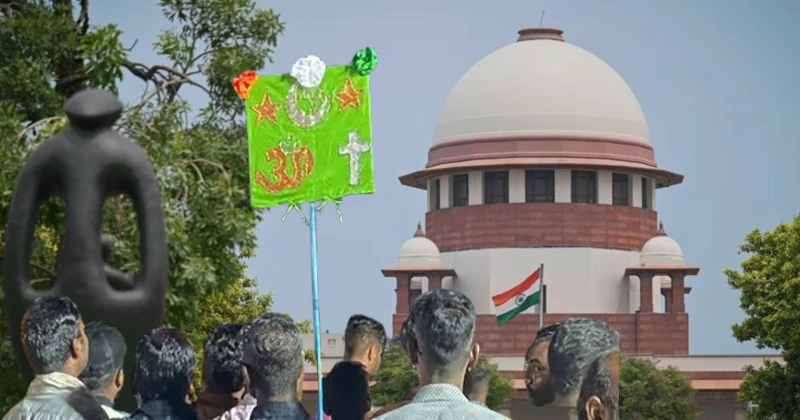
Supreme Court rejects Christian woman's claim for Scheduled Caste reservation, deems it a 'Fraud on the Constitution'
December 5, 2025
  • Read Ecopy
  • Circulation
  • Advertise
  • Careers
  • About Us
  • Contact Us
Android AppiPhone AppArattai
Organiser
  • ‌
  • Bharat
    • Assam
    • Bihar
    • Chhattisgarh
    • Jharkhand
    • Maharashtra
    • View All States
  • World
    • Asia
    • Europe
    • North America
    • South America
    • Africa
    • Australia
  • Editorial
  • International
  • Opinion
  • RSS @ 100
  • More
    • Op Sindoor
    • Analysis
    • Sports
    • Defence
    • Politics
    • Business
    • Economy
    • Culture
    • Special Report
    • Sci & Tech
    • Entertainment
    • G20
    • Azadi Ka Amrit Mahotsav
    • Vocal4Local
    • Web Stories
    • Education
    • Employment
    • Books
    • Interviews
    • Travel
    • Law
    • Health
    • Obituary
  • Subscribe
    • Subscribe Print Edition
    • Subscribe Ecopy
    • Read Ecopy
  • ‌
  • Bharat
    • Assam
    • Bihar
    • Chhattisgarh
    • Jharkhand
    • Maharashtra
    • View All States
  • World
    • Asia
    • Europe
    • North America
    • South America
    • Africa
    • Australia
  • Editorial
  • International
  • Opinion
  • RSS @ 100
  • More
    • Op Sindoor
    • Analysis
    • Sports
    • Defence
    • Politics
    • Business
    • Economy
    • Culture
    • Special Report
    • Sci & Tech
    • Entertainment
    • G20
    • Azadi Ka Amrit Mahotsav
    • Vocal4Local
    • Web Stories
    • Education
    • Employment
    • Books
    • Interviews
    • Travel
    • Law
    • Health
    • Obituary
  • Subscribe
    • Subscribe Print Edition
    • Subscribe Ecopy
    • Read Ecopy
Organiser
  • Home
  • Bharat
  • World
  • Operation Sindoor
  • Editorial
  • Analysis
  • Opinion
  • Culture
  • Defence
  • International Edition
  • RSS @ 100
  • Magazine
  • Read Ecopy
Home Bharat

Supreme Court rejects Christian woman’s claim for Scheduled Caste reservation, deems it a ‘Fraud on the Constitution’

The Supreme Court rejected a Christian woman's claim for Scheduled Caste reservation benefits, ruling that her attempt to exploit the system for job quota purposes amounted to a "fraud on the Constitution." The Court emphasised that religious conversion for reservation benefits undermines the social ethos of affirmative action policies

WEBDESKWEBDESK
Nov 27, 2024, 01:30 pm IST
in Bharat
Follow on Google News
FacebookTwitterWhatsAppTelegramEmail

The Supreme Court of India has rejected the appeal of C Selvarani, a woman who sought Scheduled Caste (SC) benefits in employment by claiming to be Hindu, despite being a baptised Christian. The Court’s decision upholds the ethos of India’s reservation system, emphasising that religious conversions carried out solely to gain reservation benefits undermine the Constitution’s foundational goals of social justice. The Court described such practices as a “fraud on the Constitution” and dismissed the woman’s appeal, affirming that only those who genuinely belong to the Scheduled Castes or Scheduled Tribes can claim such benefits.

The case revolves around the application of C Selvarani, a woman from Tamil Nadu, for an Upper Division Clerk position in the Union Territory of Puducherry. She sought to avail herself of the reservation benefits for Scheduled Caste candidates, claiming she was a Hindu belonging to the Valluvan caste, traditionally classified as Scheduled Caste. However, investigations by the state government revealed that Selvarani had been born into a Christian family. Her father, who was originally Hindu, had converted to Christianity, and she herself had been baptized shortly after birth in 1991.

Selvarani’s application for the SC certificate was based on the claim that her family was from the Valluvan caste, which has historically been part of the Scheduled Caste community in Tamil Nadu. Her father and brother had SC certificates, and she presented her claim for the same, hoping to secure the reservation benefits that are provided to SC communities in government jobs. However, during the verification process, it was discovered that she had been baptised into Christianity shortly after her birth, which raised serious questions about her eligibility for the SC status.

The Tamil Nadu government conducted a thorough verification of Selvarani’s claims. This included reports from the Village Administrative Officer, as well as other documentary evidence, which revealed the following key facts:

  • Religious Background: Selvarani’s father had converted to Christianity before her birth, and her marriage had been registered under the Indian Christian Marriage Act. The documents also confirmed that she had been baptised in January 1991, soon after her brother’s baptism in 1989.
  • Absence of Reconversion Evidence: Despite her claims of reconversion to Hinduism, no formal evidence was provided to support this assertion. There was no documentation of a public or ceremonial reconversion, nor was there any evidence that she or her family had been accepted back into the Valluvan caste after conversion.

The state’s findings, including testimonies and documents, indicated that Selvarani was born a Christian and had not undergone any formal reconversion. In light of this evidence, the State rejected her application for an SC certificate.

In January 2023, the Madras High Court upheld the State’s decision to reject Selvarani’s application, emphasising that a person cannot claim to belong to a Scheduled Caste once they have converted to another religion, such as Christianity. The High Court further noted that the appellant could not be identified with any caste after her conversion to Christianity and that there was insufficient evidence to support her claim of reconversion to Hinduism.

The High Court also pointed out that individuals who convert to Christianity lose their caste status, and there must be clear evidence of reconversion to reclaim their original caste status. As there was no formal evidence of reconversion, the High Court rejected Selvarani’s claim for SC status.

Dissatisfied with the High Court’s verdict, Selvarani approached the Supreme Court. However, in a detailed and robust judgment, the Supreme Court dismissed her appeal, reinforcing the principle that conversion to another religion purely for the purpose of gaining benefits under the reservation system violates the very purpose and social ethos of the reservation policy.

Also Read: 26/11 Terror Attacks: Rahul Gandhi’s insensitive revelry while Mumbai bled and India mourned

The bench, led by Justice Pankaj Mithal and Justice R. Mahadevan, delivered a strong message, stating, “The conferment of Scheduled Caste communal status to the appellant, who is a Christian by religion but claims to be still embracing Hinduism only for the purpose of availing reservation in employment, would go against the very object of reservation and would amount to fraud on the Constitution.” The Court explained that the policy of reservation is intended to uplift socially and economically disadvantaged communities, and allowing individuals to claim benefits under false pretenses defeats this objective.

The Court went on to explain the fundamental principles underlying religious conversion in India. While India is a secular country and citizens have the right to practice and follow any religion of their choice, the Court emphasised that conversion for ulterior motives, such as to gain advantages from affirmative action policies, is impermissible.

The ruling made it clear that religious conversion must be a genuine process, motivated by a belief in the tenets and principles of the adopted religion. Conversion for the sake of exploiting reservation benefits goes against the social ethos of India’s reservation policy. “One converts to a different religion when genuinely inspired by its principles, tenets, and spiritual thoughts. However, if the purpose of conversion is solely to derive the benefits of reservation, that cannot be permitted, as it defeats the social ethos of the policy,” the Court observed.

The Court also stressed that caste is inherently tied to religious identity in India, particularly in Hinduism, and that once an individual converts to another religion, they lose their caste status. As the appellant’s conversion to Christianity was not disputed and there was no compelling evidence of reconversion, her claim to Scheduled Caste status was deemed invalid. The Court ruled that the mere claim of following Hindu practices, without evidence of formal reconversion, was insufficient.


Topics: Supreme CourtReligious ConversionScheduled CasteC SelvaraniSC reservation benefits
Share4TweetSendShareSend
✮ Subscribe Organiser YouTube Channel. ✮
✮ Join Organiser's WhatsApp channel for Nationalist views beyond the news. ✮
Previous News

In Bharat’s biggest maritime drug bust, the role of El Mencho and Chinese El Chapo cartels crop up

Next News

Noida police seizes 185 tons of cow meat labelled ‘Buffalo Meat’; BJP MLA alleges 8,000 cows slaughtered in West Bengal

Related News

The Supreme Court of India

Supreme Court allows extra support for overburdened BLOs, says SIR duties are mandatory for government staff

West Bengal Chief Minister Mamata Banerjee

West Bengal: NCBC delists 35 Muslim castes wrongly included in OBC category; Mamata govt’s appeasement politics exposed

Representation image of a Muslim woman (Tribune)

Supreme Court secures property rights of divorced Muslim women in landmark verdict

Supreme Court tears into Rohingya plea, says ‘Illegal entrants cannot claim rights meant for Indian citizens’

Representative image

No Scheduled Caste reservation for converts; Allahabad High Court orders strict action against fraudulent claims

Supreme Court questions extending rights to illegal Rohingya entrants amid rising security fears

Supreme Court flags security concerns as Rohingya Habeas plea triggers sharp remarks

Load More

Comments

The comments posted here/below/in the given space are not on behalf of Organiser. The person posting the comment will be in sole ownership of its responsibility. According to the central government's IT rules, obscene or offensive statement made against a person, religion, community or nation is a punishable offense, and legal action would be taken against people who indulge in such activities.

Latest News

Union Finance Minister Nirmala Sitharaman

‘TMC is holding Bengal back’: Sitharaman slams Mamata govt over industrial & healthcare setbacks

Karnataka: Muslim youth Mohammed Usman accused of sexual assault, blackmail & forced conversion in Bengaluru

Social Justice Is a cover; Anti-Sanatana dharma is the DMK’s real face at Thirupparankundram

Karnataka: Hindus demand reclaiming of Anjaneya Mandir at the site of Jamia Masjid; Setting wrongs of Tipu Sultan right

Assam govt proscribes all forms of Jihadi literatures in state; Islamic terror groups trying to recruit Muslim youth

Retired Subedar held for leaking Army details to Pak handlers posing as Indians

Gujarat ATS dismantles spy network involving Ex-Army personnel and woman for sharing information with Pakistan

Economic freefall of West Bengal: Mamata’s “Paribartan” turns to crisis; 207 Companies gone in six months

Prime Minister Narendra Modi and Russian President Vladimir Putin

India on the side of “peace” in Russia-Ukraine conflict, PM Modi asserts for swift peaceful solution

Russian Economic Development Minister Maxim Reshetnikov and Commerce and Industry Minister Piyush Goyal

Piyush Goyal holds talks with Russian counterpart, discusses cooperation in textiles, automobiles and agriculture

A representative image

Bihar: Joint team of police, STF arrests wanted Maoist Uttam Ram from Gaya

Load More
  • Privacy
  • Terms
  • Cookie Policy
  • Refund and Cancellation
  • Delivery and Shipping

© Bharat Prakashan (Delhi) Limited.
Tech-enabled by Ananthapuri Technologies

  • Home
  • Search Organiser
  • Bharat
    • Assam
    • Bihar
    • Chhattisgarh
    • Jharkhand
    • Maharashtra
    • View All States
  • World
    • Asia
    • Africa
    • North America
    • South America
    • Europe
    • Australia
  • Editorial
  • Operation Sindoor
  • Opinion
  • Analysis
  • Defence
  • Culture
  • Sports
  • Business
  • RSS @ 100
  • Entertainment
  • More ..
    • Sci & Tech
    • Vocal4Local
    • Special Report
    • Education
    • Employment
    • Books
    • Interviews
    • Travel
    • Health
    • Politics
    • Law
    • Economy
    • Obituary
  • Subscribe Magazine
  • Read Ecopy
  • Advertise
  • Circulation
  • Careers
  • About Us
  • Contact Us
  • Policies & Terms
    • Privacy Policy
    • Cookie Policy
    • Refund and Cancellation
    • Terms of Use

© Bharat Prakashan (Delhi) Limited.
Tech-enabled by Ananthapuri Technologies