Can India balance its foreign relations in a Cold War 2.0?
December 5, 2025
  • Read Ecopy
  • Circulation
  • Advertise
  • Careers
  • About Us
  • Contact Us
Android AppiPhone AppArattai
Organiser
  • ‌
  • Bharat
    • Assam
    • Bihar
    • Chhattisgarh
    • Jharkhand
    • Maharashtra
    • View All States
  • World
    • Asia
    • Europe
    • North America
    • South America
    • Africa
    • Australia
  • Editorial
  • International
  • Opinion
  • RSS @ 100
  • More
    • Op Sindoor
    • Analysis
    • Sports
    • Defence
    • Politics
    • Business
    • Economy
    • Culture
    • Special Report
    • Sci & Tech
    • Entertainment
    • G20
    • Azadi Ka Amrit Mahotsav
    • Vocal4Local
    • Web Stories
    • Education
    • Employment
    • Books
    • Interviews
    • Travel
    • Law
    • Health
    • Obituary
  • Subscribe
    • Subscribe Print Edition
    • Subscribe Ecopy
    • Read Ecopy
  • ‌
  • Bharat
    • Assam
    • Bihar
    • Chhattisgarh
    • Jharkhand
    • Maharashtra
    • View All States
  • World
    • Asia
    • Europe
    • North America
    • South America
    • Africa
    • Australia
  • Editorial
  • International
  • Opinion
  • RSS @ 100
  • More
    • Op Sindoor
    • Analysis
    • Sports
    • Defence
    • Politics
    • Business
    • Economy
    • Culture
    • Special Report
    • Sci & Tech
    • Entertainment
    • G20
    • Azadi Ka Amrit Mahotsav
    • Vocal4Local
    • Web Stories
    • Education
    • Employment
    • Books
    • Interviews
    • Travel
    • Law
    • Health
    • Obituary
  • Subscribe
    • Subscribe Print Edition
    • Subscribe Ecopy
    • Read Ecopy
Organiser
  • Home
  • Bharat
  • World
  • Operation Sindoor
  • Editorial
  • Analysis
  • Opinion
  • Culture
  • Defence
  • International Edition
  • RSS @ 100
  • Magazine
  • Read Ecopy
Home World

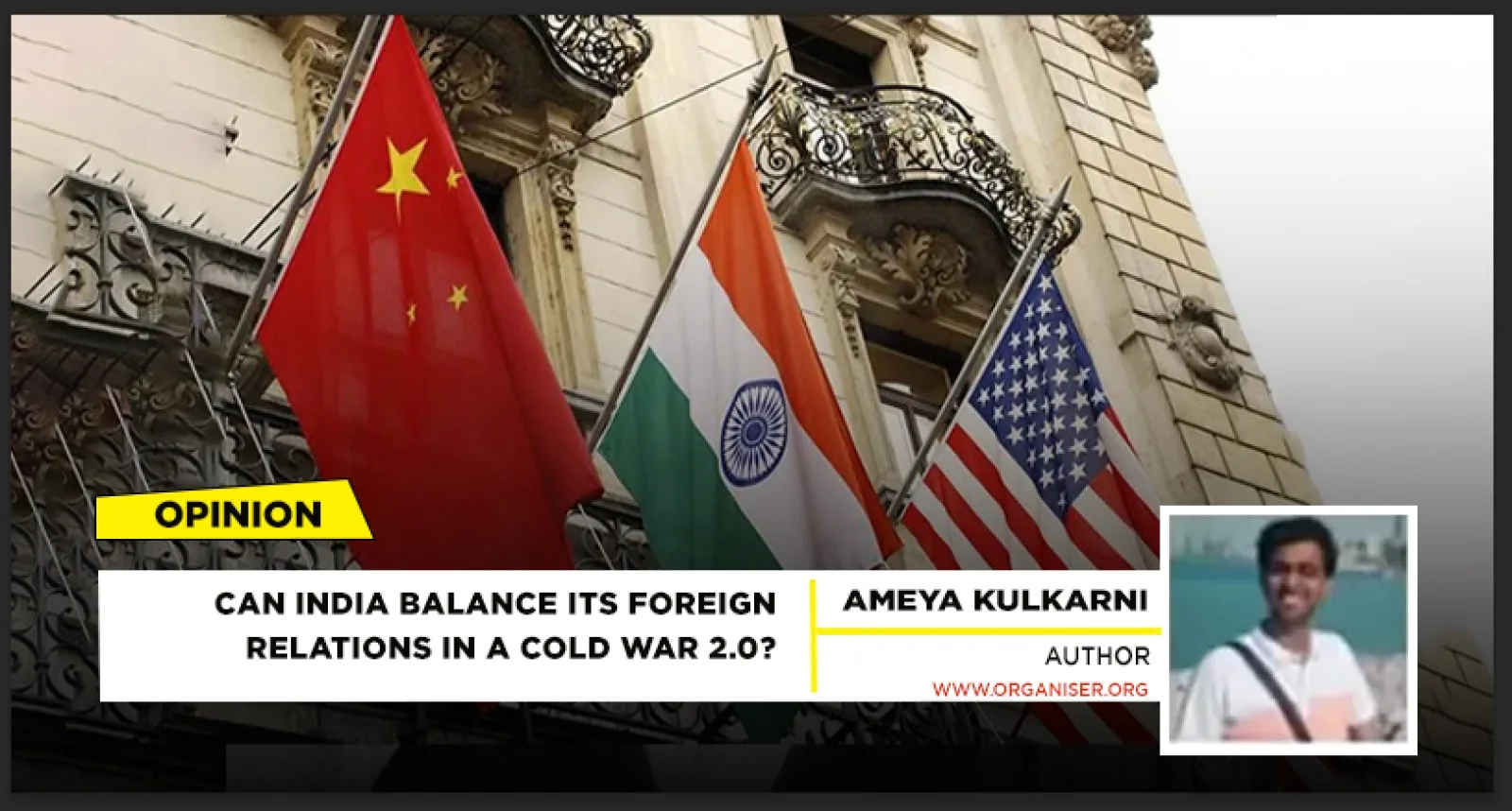
Can India balance its foreign relations in a Cold War 2.0?

As the world grapples with increasing geopolitical tensions, often dubbed as "Cold War 2.0," India faces the challenge of balancing its foreign relations amidst competing global powers

Ameya KulkarniAmeya Kulkarni
Nov 21, 2024, 09:00 pm IST
in World, Opinion
Follow on Google News
FacebookTwitterWhatsAppTelegramEmail

It has now been a decade of Prime Minister Narendra Modi’s dispensation in New Delhi, and during this time almost no observers of international politics can have failed to notice a gradual, though accelerating shift in not only India’s international stature but also in its posture. In foreign policy analysis, one must consider both what a nation does and what its diplomats say. It is always the great powers of the time that define the frameworks and narratives within which all actions and decisions end up being seen. Sometimes great powers explicitly publish their doctrines: The United States had a Monroe Doctrine in the 19th century, and a Wilson Doctrine during and after World War I. In many ways, Henry Kissinger and Ronald Reagan each brought their own doctrines to US foreign policy. On the other hand, we can recall Soviet Union’s Brezhnev Doctrine at the height of the Cold War, and our own “non-alignment” doctrine of the Nehruvian era.

India’s non-alignment was the product, post-Independence, of both our capacities as a nation, and our ideological idealism. We were an impoverished nation with little ability to actively pursue outcomes in geopolitical terms, and didn’t have the sort of ideological clarity during the Cold War to commit to an alliance system. The result, labelled non-alignment, was designed more than anything else to events on our ability to go through the painstaking process of domestic socio-economic and political development. We wanted to keep out of trouble rather than achieve anything in particular.

Non-Alignment has in many ways remained an implicit feature of Indian foreign policy even in the decades since the end of the Cold War. However, with our legacy of security cooperation with the Soviet Union being transferred to the new Russian Federation, while our diaspora and economic linkages with the West continued to strengthen, the logic of India’s relationships on two ends of the geopolitical spectrum has continued to be questioned. Never more so than since the invasion of Ukraine in 2022.

While many have seen more continuity than change in this stance under PM Modi, some of India’s recent geopolitical engagements have displayed perhaps the creation of a new “Jaishankar-Modi Doctrine”. To quote our external affairs minister, “A multi-polar world requires a multi-vector strategy and multi-alignment by India …”, “non-alignment” is being replaced by “multi-alignment”. Especially during his most recent visit to the US, Jaishankar seemed to explicitly lay out a new vision for our engagement with the world. When pressed during a long format interaction on how India could hope to be all things to all people, Jaishankar quipped that we intended to be ourselves to all people. What he meant was, we don’t merely have interests, we also have values, and both will matter in how we deal with countries and situations.

Perhaps the key distinction between non-alignment then and multi-alignment now is not about whether India is absolutely closer to or less close to any particular nation or group of nations, but instead about how India now interacts with all nations. As opposed to wanting to keep our heads down, hoping that no geopolitical event batters us, India now actively formulates a forward-looking view on global engagement, and pursues outcomes in the national interest. It is signalling a new intensity of effort and the availability of capacity to be leveraged to generate such outcomes. It is saying, we are here to play.

Take, for example, the case of the India-Russia-Iran-Israel-United States-Canada equation. India has in the last few years simultaneously taken an anti-war stance in general, while condemning outright neither Russia nor Israel; it has bought Russian crude at beneficial prices while also acquiring advanced US defence equipment; it has been accused of an assassination programme in both Canada and and the US and deals with each entirely differently; it has continued discussions on an Indian port in Iran, while supporting Israel’s right to respond in Gaza. Somehow, India is in a sufficiently favourable geopolitical position in terms of today’s calculus, that all sides seem to tacitly be accepting the practical expression of India’s approach.

The key test here is whether India is using its newfound elbow room to pursue naked interest, or whether there is what the doctrine says there should be — a moral stance as well as a rational one. When pressed, can Indian diplomats and other spokespersons present a narrative that reflects India’s values as much as it reflects India’s interests?

This test might end up being applied when push comes to shove, and the emergent multi-polarity collapses into a new form of bi-polarity, or a Cold War 2.0. Given that the Jaishankar-Modi Doctrine seems to allow for deep partnerships with nations along either common interests, or common values, or both, yet seems to eschew explicit alliances, there may come a time when India’s hand is forced. The current approach may serve India well if Jaishankar’s key assumption of a multi-polar future proves correct. If not, then we have to remember that one cannot have one’s cake and eat it too.


Topics: Henry KissingerCold War 2.0Prime Minister Narendra Modicold war
Share1TweetSendShareSend
✮ Subscribe Organiser YouTube Channel. ✮
✮ Join Organiser's WhatsApp channel for Nationalist views beyond the news. ✮
Previous News

Bihar to host “Khelo India Youth Games 2025,” says Union Minister Mansukh Mandaviya; PM lauds hockey team’s performance

Next News

None except NDA can provide us with stable government: Odisha Deputy CM Kanak Vardhan Singh Deo

Related News

23rd India-Russia Annual Summit

India-Russia Summit heralds new chapter in time-tested ties: Inks MoUs in economic, defence, tourism & education

Chhattisgarh CM Vishnu Deo Sai at Panchjanya Conclave, Nava Raipur, Image Courtesy - Chhattisgarh govt

Panchjanya Conclave: Chhattisgarh CM Sai shares views on development projects in Maoist hotbed, women empowerment

Prime Minister Narendra Modi and Russian President Vladimir Putin

India on the side of “peace” in Russia-Ukraine conflict, PM Modi asserts for swift peaceful solution

Russian Economic Development Minister Maxim Reshetnikov and Commerce and Industry Minister Piyush Goyal

Piyush Goyal holds talks with Russian counterpart, discusses cooperation in textiles, automobiles and agriculture

Prime Minister Narendra Modi and Russian President Vladimir Putin(File Photo)

President Putin hails leadership of PM Modi, says, India has right to buy Russian oil just like the US

Official residence of Chhattisgarh's Governor, Image Courtesy - Patrika

Chhattisgarh Governor house renamed from ‘Raj Bhavan’ to ‘Lok Bhavan’, breaking away from colonial shackles

Load More

Comments

The comments posted here/below/in the given space are not on behalf of Organiser. The person posting the comment will be in sole ownership of its responsibility. According to the central government's IT rules, obscene or offensive statement made against a person, religion, community or nation is a punishable offense, and legal action would be taken against people who indulge in such activities.

Latest News

Image for representational purpose only, Courtesy Vocal Media

Bihar to get ‘Special Economic Zones’ in Buxar and West Champaran

Thirupparankundram Karthigai Deepam utsav

Andhra Pradesh: AP Dy CM Pawan Kalyan reacts to Thirupparankundram row, flags concern over religious rights of Hindus

23rd India-Russia Annual Summit

India-Russia Summit heralds new chapter in time-tested ties: Inks MoUs in economic, defence, tourism & education

DGCA orders probe into IndiGo flight disruptions; Committee to report in 15 days

BJYM leader Shyamraj with Janaki

Kerala: Widow of BJP worker murdered in 1995 steps into electoral battle after three decades at Valancherry

Russian Sber bank has unveiled access to its retail investors to the Indian stock market by etching its mutual fund to Nifty50

Scripting economic bonhomie: Russian investors gain access to Indian stocks, Sber unveils Nifty50 pegged mutual funds

Petitioner S Vignesh Shishir speaking to the reporters about the Rahul Gandhi UK citizenship case outside the Raebareli court

Rahul Gandhi UK Citizenship Case: Congress supporters create ruckus in court; Foreign visit details shared with judge

(L) Kerala High Court (R) Bouncers in Trippoonithura temple

Kerala: HC slams CPM-controlled Kochi Devaswom Board for deploying bouncers for crowd management during festival

Fact Check: Rahul Gandhi false claim about govt blocking his meet with Russian President Putin exposed; MEA clears air

Union Minister for Road Transport and Highways Nitin Gadkari (Right)

India set for highway overhaul as Union Minister Nitin Gadkari unveils nationwide shift to MLFF electronic tolling

Load More
  • Privacy
  • Terms
  • Cookie Policy
  • Refund and Cancellation
  • Delivery and Shipping

© Bharat Prakashan (Delhi) Limited.
Tech-enabled by Ananthapuri Technologies

  • Home
  • Search Organiser
  • Bharat
    • Assam
    • Bihar
    • Chhattisgarh
    • Jharkhand
    • Maharashtra
    • View All States
  • World
    • Asia
    • Africa
    • North America
    • South America
    • Europe
    • Australia
  • Editorial
  • Operation Sindoor
  • Opinion
  • Analysis
  • Defence
  • Culture
  • Sports
  • Business
  • RSS @ 100
  • Entertainment
  • More ..
    • Sci & Tech
    • Vocal4Local
    • Special Report
    • Education
    • Employment
    • Books
    • Interviews
    • Travel
    • Health
    • Politics
    • Law
    • Economy
    • Obituary
  • Subscribe Magazine
  • Read Ecopy
  • Advertise
  • Circulation
  • Careers
  • About Us
  • Contact Us
  • Policies & Terms
    • Privacy Policy
    • Cookie Policy
    • Refund and Cancellation
    • Terms of Use

© Bharat Prakashan (Delhi) Limited.
Tech-enabled by Ananthapuri Technologies