





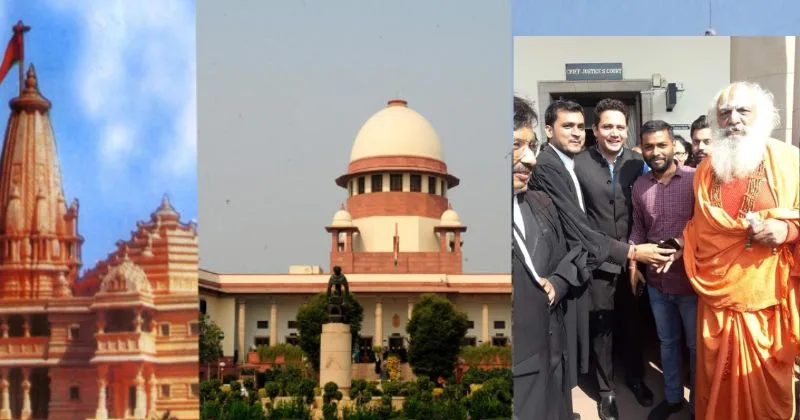
It was the morning of November 9, 2019—a date etched forever in the annals of Bharat’s history. The anticipation outside the Supreme Court of India was palpable, an air thick with the tension of a nation waiting for closure on a centuries-old dispute. As the clock struck 10:30 AM, all eyes were set on Court No. 1, where a constitutional bench was about to pronounce its verdict on one of the most contentious cases in Bhartiya legal history: the Ayodhya Ram Janmabhoomi-Babri Masjid land dispute.
The case had seen an unprecedented 41-day marathon hearing, the second-longest in the Supreme Court’s history, where arguments from both sides were meticulously presented. After decades of litigation and legal wrangling, the verdict day had finally arrived. A historic five-judge bench, headed by then Chief Justice of India Ranjan Gogoi and comprising Justices SA Bobde, DY Chandrachud, Ashok Bhushan, and S. Abdul Nazeer, was set to deliver a judgment that would shape the future discourse of the nation.
A Packed Courtroom and Unprecedented Security
The atmosphere outside the Supreme Court was electric. Hundreds of journalists, legal professionals, and representatives from both Hindu and Muslim communities gathered early in the morning. The apex court premises were under tight security, with heavy police deployment to prevent any untoward incidents. It was a Saturday, an unusual day for such a significant pronouncement, but given the sensitivity and historic importance of the case, the decision was scheduled for a weekend to ensure maximum preparedness.
Inside Court No. 1, it was a different world altogether—brimming with anticipation, emotion, and a sense of history in the making. The courtroom was packed beyond capacity. Not an inch of space was left as lawyers, petitioners, media personnel, and a limited number of onlookers squeezed into the gallery. There was barely any room to move; even the aisles were filled. The weight of the moment was evident on every face present. Everyone knew that they were about to witness something monumental, a moment that would become a defining chapter in Bhartiya legal and cultural history.
The Bench Takes Its Seat: A Sense of Gravity
At precisely 10:30 AM, the bench entered the courtroom, led by Chief Justice Ranjan Gogoi. The room fell silent, a collective hush of anticipation. Chief Justice Gogoi, known for his reserved and measured approach, began by acknowledging the complex and emotive nature of the case. It was clear that the judgment had been crafted with great care, taking into account not just legal arguments but the broader socio-political implications as well.
The bench consisted of a diverse panel of judges, each bringing their unique perspective to the case:
1. Chief Justice Ranjan Gogoi: Known for his firm leadership and integrity, CJI Gogoi had the unenviable task of presiding over one of the most sensitive cases in Bhartiya judicial history.
2. Justice S.A. Bobde: The senior-most judge after CJI Gogoi, Justice Bobde was set to take over as the next Chief Justice. His experience and balanced approach were crucial in the deliberations.
3. Justice D.Y. Chandrachud: Renowned for his intellectual rigor and progressive judgments, Justice Chandrachud brought a sharp legal acumen to the bench, often focusing on constitutional principles and human rights.
4. Justice Ashok Bhushan: With his vast experience and deep understanding of civil law, Justice Bhushan contributed significantly to the case’s discussions, especially on matters related to historical evidence.
5. Justice S. Abdul Nazeer: The presence of Justice Nazeer, a respected Muslim judge on the panel, was symbolic and significant, highlighting the balanced and inclusive approach of the judiciary.
The Verdict: A Landmark Judgment in Open Court
Chief Justice Gogoi began reading the judgment, and the room remained pin-drop silent. The verdict was pronounced in open court, a rare and solemn tradition for cases of this magnitude. The judgment, running into hundreds of pages, had been condensed into key points to be read aloud. It was a unanimous decision, showcasing the judiciary’s effort to present a united front on such a polarizing issue.
The Supreme Court ruled in favor of the construction of a Ram temple on the disputed 2.77-acre land in Ayodhya. The entire disputed site was awarded to the Hindu parties, represented by the deity Ram Lalla Virajman, while an alternate five-acre plot was allocated for the construction of a mosque, acknowledging the claims of the Sunni Waqf Board.
The bench meticulously addressed the archaeological, historical, and legal aspects of the case. The judgment recognized the existence of a pre-existing non-Islamic structure beneath the Babri Masjid, citing the evidence presented by the Archaeological Survey of India (ASI). The court noted that the faith and belief of Hindus in the birthplace of Lord Ram was “undisputed,” but it also underscored the need for reconciliation and justice for all communities involved.
The decision emphasized that the demolition of the Babri Masjid in 1992 was a violation of the rule of law, a moment of profound regret for the nation. However, the judgment balanced this by affirming the right of the Hindu community to construct a temple on the site, based on historical and archaeological evidence. The allocation of land for a mosque aimed to provide a just remedy to the Muslim community, ensuring that the verdict did not alienate any group.
Emotional Reactions and the Significance of the Verdict
As the judgment was read, a wave of emotion swept through the packed courtroom. There were tears of relief, sighs of disbelief, and a palpable sense of closure among the Hindu petitioners who had fought the legal battle for decades. For the Muslim litigants, the decision was a mix of disappointment and resignation, but the court’s order for an alternate land allocation was seen as a gesture towards healing.
Outside the court, the nation held its breath. Television screens across Bharat flashed breaking news, while people gathered in homes, temples, mosques, and public spaces, glued to their screens for updates. The reaction was largely peaceful, a testament to the maturity of the Bhartiya public and the meticulous preparation by law enforcement agencies.
A Landmark Day in Bharatiya Legal History
The verdict on November 9, 2019, marked the culmination of a long and arduous journey, a path fraught with legal complexities, political turmoil, and deep-seated emotions. The unanimous decision by the Supreme Court was a rare display of judicial unity and wisdom, offering a balanced solution to one of the most divisive issues in Bharat’s history.
The case was not just about a piece of land; it was about the collective consciousness of a nation, the right to faith, the preservation of heritage, and the rule of law. It was a case that tested the fabric of Bharat’s secular democracy, and the verdict, while not without its critics, was widely seen as a step towards reconciliation and national healing.
The Legacy of November 9
As we commemorate the fifth anniversary of the Supreme Court verdict, it is essential to reflect on its broader impact. The construction of the Ram Mandir in Ayodhya is now well underway, becoming a symbol of renewed cultural pride and unity for millions of Bhartiyas. The judgment serves as a reminder of the power of the judiciary to resolve even the most complex and sensitive issues with fairness and integrity.
The legacy of the Ram Mandir verdict will endure for generations, not only as a legal precedent but as a testament to the resilience of the Bhartiya people, their deep-rooted faith, and their commitment to the principles of justice.











Comments