


Decolonising Justice: How Chief Justice of India DY Chandrachud has redefined the judiciary
December 5, 2025
  • Read Ecopy
  • Circulation
  • Advertise
  • Careers
  • About Us
  • Contact Us
Android AppiPhone AppArattai
Organiser
  • ‌
  • Bharat
    • Assam
    • Bihar
    • Chhattisgarh
    • Jharkhand
    • Maharashtra
    • View All States
  • World
    • Asia
    • Europe
    • North America
    • South America
    • Africa
    • Australia
  • Editorial
  • International
  • Opinion
  • RSS @ 100
  • More
    • Op Sindoor
    • Analysis
    • Sports
    • Defence
    • Politics
    • Business
    • Economy
    • Culture
    • Special Report
    • Sci & Tech
    • Entertainment
    • G20
    • Azadi Ka Amrit Mahotsav
    • Vocal4Local
    • Web Stories
    • Education
    • Employment
    • Books
    • Interviews
    • Travel
    • Law
    • Health
    • Obituary
  • Subscribe
    • Subscribe Print Edition
    • Subscribe Ecopy
    • Read Ecopy
  • ‌
  • Bharat
    • Assam
    • Bihar
    • Chhattisgarh
    • Jharkhand
    • Maharashtra
    • View All States
  • World
    • Asia
    • Europe
    • North America
    • South America
    • Africa
    • Australia
  • Editorial
  • International
  • Opinion
  • RSS @ 100
  • More
    • Op Sindoor
    • Analysis
    • Sports
    • Defence
    • Politics
    • Business
    • Economy
    • Culture
    • Special Report
    • Sci & Tech
    • Entertainment
    • G20
    • Azadi Ka Amrit Mahotsav
    • Vocal4Local
    • Web Stories
    • Education
    • Employment
    • Books
    • Interviews
    • Travel
    • Law
    • Health
    • Obituary
  • Subscribe
    • Subscribe Print Edition
    • Subscribe Ecopy
    • Read Ecopy
Organiser
  • Home
  • Bharat
  • World
  • Operation Sindoor
  • Editorial
  • Analysis
  • Opinion
  • Culture
  • Defence
  • International Edition
  • RSS @ 100
  • Magazine
  • Read Ecopy
Home Bharat

Decolonising Justice: How Chief Justice of India DY Chandrachud has redefined the judiciary

India’s judiciary has evolved under Chief Justice DY Chandrachud as it embraced cultural identity and modern values to make justice more relatable and accessible

Adv Karan ThakurAdv Karan Thakur
Nov 8, 2024, 09:00 pm IST
in Bharat, Opinion, Law
Follow on Google News
FacebookTwitterWhatsAppTelegramEmail

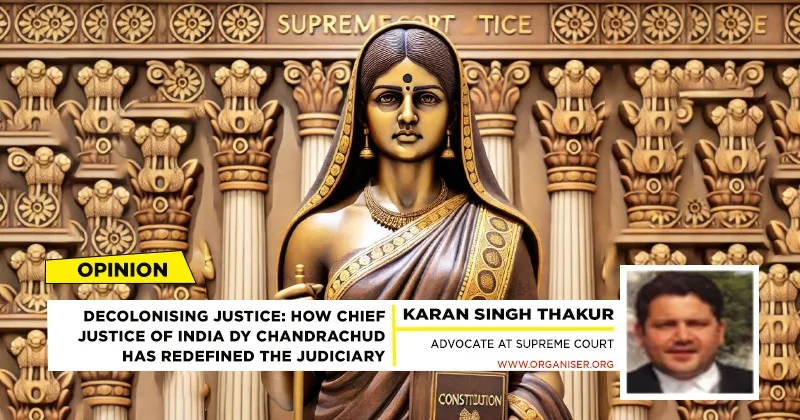
The recent unveiling of the new statue of Lady Justice at the Supreme Court marks a significant milestone in the journey towards the decolonization of the Indian judiciary, led by Chief Justice DY Chandrachud. This initiative not only represents a symbolic departure from colonial legacies but also aims to reshape the judicial landscape of Bharat in a manner that resonates with contemporary Indian society.

Embracing Cultural Identity

One of the most striking changes is the replacement of the traditional Western robe with a saree, reflecting India’s rich cultural heritage. This shift symbolizes a broader commitment to integrating Indian traditions and values into the judicial system. By embracing cultural identity, the judiciary can become more relatable to the public, fostering trust and engagement. When citizens see their customs and heritage represented in the judiciary, they are more likely to feel that the legal system serves their interests and needs.

Strengthening Constitutional Supremacy

The new statue’s design features the Indian Constitution replacing the traditional sword, emphasizing the supremacy of constitutional law in the administration of justice. This move reinforces the idea that the judiciary exists to uphold democratic principles and protect individual rights rather than to serve as an instrument of colonial power. By prioritizing constitutional values, Chief Justice Chandrachud is advocating for a judicial system that not only respects the law but also aligns with the aspirations of a diverse and democratic society.

Advocating for Sensitivity and Awareness

The removal of Lady Justice’s blindfold conveys a crucial message: justice must be sensitive to the various contexts in which individuals find themselves. This principle encourages judges and legal practitioners to consider the socio-economic and cultural backgrounds of the parties involved in legal proceedings. Such sensitivity can lead to fairer, more empathetic judgments, ensuring that the outcomes reflect the complexities of individual cases. By fostering a more nuanced understanding of justice, the judiciary can address the needs of marginalized communities more effectively.

Modernising Legal Frameworks

Chief Justice Chandrachud’s vision includes moving away from colonial-era laws, such as the Indian Penal Code, towards more contemporary legal frameworks like the Bharatiya Nyaya Sanhita. This modernization is essential for ensuring that the legal system keeps pace with the rapidly evolving social landscape of India. By updating laws to address contemporary issues—such as digital rights, environmental justice, and gender equality—the judiciary can provide relevant and effective solutions to the pressing challenges faced by society.

Enhancing Judicial Accountability

Decolonisation under Chief Justice Chandrachud also emphasizes the importance of judicial accountability and transparency. By promoting a culture of responsibility within the judiciary, he aims to build public trust and confidence in legal institutions. This can be achieved through improved oversight mechanisms, public engagement initiatives, and educational programs that demystify the judicial process. A more accountable judiciary not only strengthens the rule of law but also empowers citizens to assert their rights.

Fostering Inclusivity and Representation

Another critical aspect of this decolonization effort is the commitment to inclusivity and representation within the legal profession. By encouraging diversity among judges and legal practitioners, the judiciary can ensure that a wide range of perspectives is considered in the administration of justice. This inclusivity will lead to a more equitable legal system that effectively represents the interests of all citizens, particularly those from marginalized backgrounds. A judiciary that reflects India’s demographic diversity will resonate more deeply with the public, enhancing its legitimacy and effectiveness.

Criticism from the Left Ecosystem

Despite Chief Justice DY Chandrachud’s efforts to reshape the judiciary to better align with India’s cultural identity and contemporary values, the left-wing ecosystem has expressed skepticism and criticism of these initiatives. Critics argue that these changes risk shifting focus away from established legal traditions, interpreting the decolonization effort as an attempt to redefine the judiciary in a manner that may compromise its objectivity. They contend that symbols such as the saree-clad Lady Justice and the removal of the blindfold could erode the principles of impartiality and equality, arguing that the emphasis on cultural representation may overshadow the judiciary’s commitment to universal justice standards. Furthermore, they suggest that decolonization could pave the way for selective legal reforms that prioritize cultural identity over universal principles of human rights, especially when conservative values might shape new interpretations. However, proponents of the Chief Justice’s vision see these changes as necessary steps to make the judiciary more accessible and relevant to Indian society, countering colonial residues with an institution that resonates with the public and is attuned to modern societal needs.

Chief Justice of India DY Chandrachud’s efforts to redefine the judiciary through the lens of decolonization have the potential to profoundly transform the Bharat judicial system. By embracing cultural identity, strengthening constitutional supremacy, advocating for sensitivity and awareness, modernizing legal frameworks, enhancing accountability, and fostering inclusivity, the judiciary can evolve into a more responsive, equitable, and representative institution. This transformation not only enhances public trust but also ensures that the legal system aligns with the values and aspirations of contemporary India. Through these initiatives, the judiciary can emerge as a beacon of hope and justice, reinforcing the commitment to a fair and just society for all its citizens.


 

Topics: Supreme CourtDY Chandrachud
Share8TweetSendShareSend
✮ Subscribe Organiser YouTube Channel. ✮
✮ Join Organiser's WhatsApp channel for Nationalist views beyond the news. ✮
Previous News

Mizoram: Security forces foil seize huge cache of explosives, plot to smuggle them arms to Myanmar insurgents foiled 

Next News

Karnataka: State government fails to distribute eggs to students despite the donor giving them money to purchase 

Related News

The Supreme Court of India

Supreme Court allows extra support for overburdened BLOs, says SIR duties are mandatory for government staff

West Bengal Chief Minister Mamata Banerjee

West Bengal: NCBC delists 35 Muslim castes wrongly included in OBC category; Mamata govt’s appeasement politics exposed

Representation image of a Muslim woman (Tribune)

Supreme Court secures property rights of divorced Muslim women in landmark verdict

Supreme Court tears into Rohingya plea, says ‘Illegal entrants cannot claim rights meant for Indian citizens’

Supreme Court questions extending rights to illegal Rohingya entrants amid rising security fears

Supreme Court flags security concerns as Rohingya Habeas plea triggers sharp remarks

SC to Waqf Boards: Fix your own mess; UMEED portal deadline remains December 6

Load More

Comments

The comments posted here/below/in the given space are not on behalf of Organiser. The person posting the comment will be in sole ownership of its responsibility. According to the central government's IT rules, obscene or offensive statement made against a person, religion, community or nation is a punishable offense, and legal action would be taken against people who indulge in such activities.

Latest News

PM Modi presents Putin with Bhagavad Gita, chess set, and silver horse

Cultural ties strengthened: PM Modi presents Putin with Bhagavad Gita, chess set, and silver horse

Image for representational purpose only, Courtesy Vocal Media

Bihar to get ‘Special Economic Zones’ in Buxar and West Champaran

Thirupparankundram Karthigai Deepam utsav

Andhra Pradesh: AP Dy CM Pawan Kalyan reacts to Thirupparankundram row, flags concern over religious rights of Hindus

23rd India-Russia Annual Summit

India-Russia Summit heralds new chapter in time-tested ties: Inks MoUs in economic, defence, tourism & education

DGCA orders probe into IndiGo flight disruptions; Committee to report in 15 days

BJYM leader Shyamraj with Janaki

Kerala: Widow of BJP worker murdered in 1995 steps into electoral battle after three decades at Valancherry

Russian Sber bank has unveiled access to its retail investors to the Indian stock market by etching its mutual fund to Nifty50

Scripting economic bonhomie: Russian investors gain access to Indian stocks, Sber unveils Nifty50 pegged mutual funds

Petitioner S Vignesh Shishir speaking to the reporters about the Rahul Gandhi UK citizenship case outside the Raebareli court

Rahul Gandhi UK Citizenship Case: Congress supporters create ruckus in court; Foreign visit details shared with judge

(L) Kerala High Court (R) Bouncers in Trippoonithura temple

Kerala: HC slams CPM-controlled Kochi Devaswom Board for deploying bouncers for crowd management during festival

Fact Check: Rahul Gandhi false claim about govt blocking his meet with Russian President Putin exposed; MEA clears air

Load More
  • Privacy
  • Terms
  • Cookie Policy
  • Refund and Cancellation
  • Delivery and Shipping

© Bharat Prakashan (Delhi) Limited.
Tech-enabled by Ananthapuri Technologies

  • Home
  • Search Organiser
  • Bharat
    • Assam
    • Bihar
    • Chhattisgarh
    • Jharkhand
    • Maharashtra
    • View All States
  • World
    • Asia
    • Africa
    • North America
    • South America
    • Europe
    • Australia
  • Editorial
  • Operation Sindoor
  • Opinion
  • Analysis
  • Defence
  • Culture
  • Sports
  • Business
  • RSS @ 100
  • Entertainment
  • More ..
    • Sci & Tech
    • Vocal4Local
    • Special Report
    • Education
    • Employment
    • Books
    • Interviews
    • Travel
    • Health
    • Politics
    • Law
    • Economy
    • Obituary
  • Subscribe Magazine
  • Read Ecopy
  • Advertise
  • Circulation
  • Careers
  • About Us
  • Contact Us
  • Policies & Terms
    • Privacy Policy
    • Cookie Policy
    • Refund and Cancellation
    • Terms of Use

© Bharat Prakashan (Delhi) Limited.
Tech-enabled by Ananthapuri Technologies