Supreme Court upholds Uttar Pradesh Board of Madarsa Education Act, 2004, reverses High Court’s ruling
December 5, 2025
  • Read Ecopy
  • Circulation
  • Advertise
  • Careers
  • About Us
  • Contact Us
Android AppiPhone AppArattai
Organiser
  • ‌
  • Bharat
    • Assam
    • Bihar
    • Chhattisgarh
    • Jharkhand
    • Maharashtra
    • View All States
  • World
    • Asia
    • Europe
    • North America
    • South America
    • Africa
    • Australia
  • Editorial
  • International
  • Opinion
  • RSS @ 100
  • More
    • Op Sindoor
    • Analysis
    • Sports
    • Defence
    • Politics
    • Business
    • Economy
    • Culture
    • Special Report
    • Sci & Tech
    • Entertainment
    • G20
    • Azadi Ka Amrit Mahotsav
    • Vocal4Local
    • Web Stories
    • Education
    • Employment
    • Books
    • Interviews
    • Travel
    • Law
    • Health
    • Obituary
  • Subscribe
    • Subscribe Print Edition
    • Subscribe Ecopy
    • Read Ecopy
  • ‌
  • Bharat
    • Assam
    • Bihar
    • Chhattisgarh
    • Jharkhand
    • Maharashtra
    • View All States
  • World
    • Asia
    • Europe
    • North America
    • South America
    • Africa
    • Australia
  • Editorial
  • International
  • Opinion
  • RSS @ 100
  • More
    • Op Sindoor
    • Analysis
    • Sports
    • Defence
    • Politics
    • Business
    • Economy
    • Culture
    • Special Report
    • Sci & Tech
    • Entertainment
    • G20
    • Azadi Ka Amrit Mahotsav
    • Vocal4Local
    • Web Stories
    • Education
    • Employment
    • Books
    • Interviews
    • Travel
    • Law
    • Health
    • Obituary
  • Subscribe
    • Subscribe Print Edition
    • Subscribe Ecopy
    • Read Ecopy
Organiser
  • Home
  • Bharat
  • World
  • Operation Sindoor
  • Editorial
  • Analysis
  • Opinion
  • Culture
  • Defence
  • International Edition
  • RSS @ 100
  • Magazine
  • Read Ecopy
Home Bharat

Supreme Court upholds Uttar Pradesh Board of Madarsa Education Act, 2004, reverses High Court’s ruling

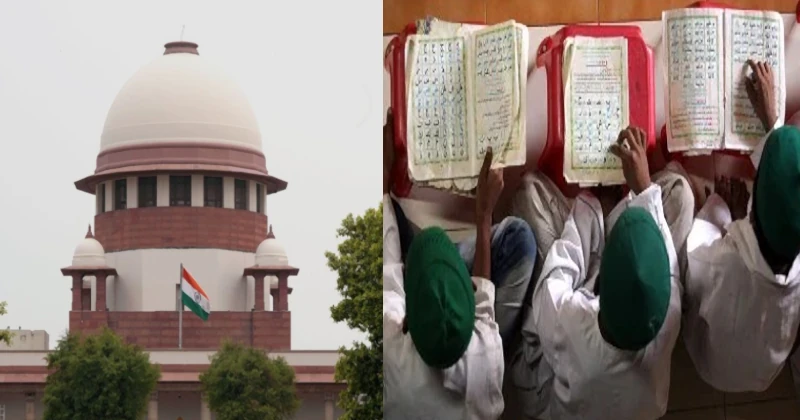
The Supreme Court of India upheld the constitutional validity of the Uttar Pradesh Board of Madarsa Education Act, 2004, emphasizing its role in regulating madarsa education while protecting minority rights. The ruling reverses an earlier judgment by the Allahabad High Court, which had deemed the Act unconstitutional for violating secular principles

WEBDESKWEBDESK
Nov 5, 2024, 01:30 pm IST
in Bharat
Follow on Google News
FacebookTwitterWhatsAppTelegramEmail

The Supreme Court of India has upheld the constitutional validity of the Uttar Pradesh Board of Madarsa Education Act, 2004, in a significant ruling delivered on November 5. This decision reverses the Allahabad High Court’s earlier judgment, which had declared the Act unconstitutional on the grounds that it violated the principles of secularism.

The three-judge bench, led by Chief Justice of India (CJI) DY Chandrachud, stated that the Act serves a vital role in regulating madarsa education in Uttar Pradesh, where religious education is imparted alongside the curriculum of the National Council of Educational Research and Training (NCERT). This framework, the Court noted, is essential for ensuring educational standards while respecting the rights of minority communities.

The Uttar Pradesh Board of Madarsa Education Act was enacted in 2004 to establish a formal regulatory framework for madarsa education across the state. Madrasas are Islamic educational institutions that provide a blend of religious and secular education, and the Act aimed to standardise this education while ensuring adherence to the curriculum set by the National Council of Educational Research and Training (NCERT).

The Act led to the formation of the Uttar Pradesh Board of Madarsa Education, which is predominantly composed of members from the Muslim community. The board is tasked with developing curriculum materials, conducting examinations, and overseeing the quality of education provided at madrasas. It regulates various educational qualifications, ranging from ‘Maulvi’ (which is equivalent to Class 10) to ‘Fazil’ (equivalent to a Master’s degree).

The validity of the Madarsa Act came under scrutiny when the Allahabad High Court struck it down in March 2024. The court’s ruling was based on the argument that the Act violated the principle of secularism, a fundamental aspect of the Indian Constitution. The High Court asserted that establishing a board for religious education contradicted the secular nature of the state’s educational policies.

In its judgment, the Allahabad High Court stated that the state had the authority to regulate education but must ensure that such education is secular in nature. It highlighted that the Madarsa Act failed to provide universal and quality education, as mandated under Article 21A of the Constitution, which guarantees the right to free and compulsory education for children up to the age of 14. The court argued that the education imparted in madrasas was neither universal nor of the same quality as that provided by regular educational institutions, thus violating the fundamental rights of students.

Moreover, the High Court contended that the Act conferred powers on the Madarsa Board that encroached upon the Union Government’s legislative domain regarding higher education, further deeming the Act unconstitutional.

Following the High Court’s ruling, the Uttar Pradesh government sought redress from the Supreme Court, which issued a stay on the High Court’s verdict in April 2024, halting its enforcement while the apex court reviewed the matter. The government defended the Act by arguing that it was constitutional and that only specific provisions needed examination rather than the entire Act.

During the hearings, the Supreme Court justices examined the implications of the Madarsa Act and its alignment with constitutional provisions. Chief Justice Chandrachud emphasised that the state has a legitimate interest in regulating educational standards within religious institutions. He articulated that regulatory measures concerning educational quality do not inherently interfere with the administration of madrasas, noting that the Act aimed to enhance the educational experience for students rather than diminish religious instruction.

The Supreme Court’s Ruling

In its judgment, the Supreme Court clarified several critical points:

Constitutional Validity: The Court held that the Madarsa Act did not violate the basic structure of the Constitution, as the High Court had suggested. It clarified that a law could only be invalidated for violating fundamental rights as outlined in Part III of the Constitution or for issues related to legislative competence.

Balancing Secularism and Minority Rights: The judgment reinforced that the state has a positive obligation to protect minority rights while ensuring that educational standards are maintained. The Court noted, “The Madarsa Act does not interfere with the day-to-day working of the madrasas. It is to protect the rights of minorities in the State of Uttar Pradesh and is consistent with the positive obligation of the State, ensuring that students can pass out and earn a decent living.”

Legislative Competence: The Supreme Court affirmed that the Uttar Pradesh government had the legislative competence to enact the Madarsa Act, focusing on its role in standardizing the educational framework for madrasas without infringing upon the secular fabric of the educational system.

Conflict with the UGC Act: While upholding the majority of the Madarsa Act, the Court identified specific provisions that were unconstitutional. In particular, the provisions that allowed the Madarsa Board to confer degrees such as ‘Kamil’ and ‘Fazil’ were found to be in conflict with the University Grants Commission (UGC) Act of 1956. The Supreme Court ruled that only recognized universities have the authority to grant degrees, thus invalidating the relevant sections of the Madarsa Act.

Education Standards: The Court emphasised the need for religious and linguistic minority institutions to be allowed to impart education while adhering to national standards. It noted that the Act’s provisions must be interpreted in a way that aligns with Article 21A, which guarantees the right to education.
Topics: Supreme CourtNCERTDY ChandrachudMadarsa ActMadarsa Education ActMadarsa Education Act 2004
ShareTweetSendShareSend
✮ Subscribe Organiser YouTube Channel. ✮
✮ Join Organiser's WhatsApp channel for Nationalist views beyond the news. ✮
Previous News

Chhath Puja festivities begin: Thousands gather at Patliputra Ghat for ‘Nahaye Khaye’ rituals

Next News

Tamil Nadu: Teenage domestic worker dies under mysterious circumstances, employers Mohammed Nishad & wife arrested 

Related News

The Supreme Court of India

Supreme Court allows extra support for overburdened BLOs, says SIR duties are mandatory for government staff

West Bengal Chief Minister Mamata Banerjee

West Bengal: NCBC delists 35 Muslim castes wrongly included in OBC category; Mamata govt’s appeasement politics exposed

Representation image of a Muslim woman (Tribune)

Supreme Court secures property rights of divorced Muslim women in landmark verdict

Supreme Court tears into Rohingya plea, says ‘Illegal entrants cannot claim rights meant for Indian citizens’

Supreme Court questions extending rights to illegal Rohingya entrants amid rising security fears

Supreme Court flags security concerns as Rohingya Habeas plea triggers sharp remarks

SC to Waqf Boards: Fix your own mess; UMEED portal deadline remains December 6

Load More

Comments

The comments posted here/below/in the given space are not on behalf of Organiser. The person posting the comment will be in sole ownership of its responsibility. According to the central government's IT rules, obscene or offensive statement made against a person, religion, community or nation is a punishable offense, and legal action would be taken against people who indulge in such activities.

Latest News

Image for representational purpose only, Courtesy Vocal Media

Bihar to get ‘Special Economic Zones’ in Buxar and West Champaran

Thirupparankundram Karthigai Deepam utsav

Andhra Pradesh: AP Dy CM Pawan Kalyan reacts to Thirupparankundram row, flags concern over religious rights of Hindus

23rd India-Russia Annual Summit

India-Russia Summit heralds new chapter in time-tested ties: Inks MoUs in economic, defence, tourism & education

DGCA orders probe into IndiGo flight disruptions; Committee to report in 15 days

BJYM leader Shyamraj with Janaki

Kerala: Widow of BJP worker murdered in 1995 steps into electoral battle after three decades at Valancherry

Russian Sber bank has unveiled access to its retail investors to the Indian stock market by etching its mutual fund to Nifty50

Scripting economic bonhomie: Russian investors gain access to Indian stocks, Sber unveils Nifty50 pegged mutual funds

Petitioner S Vignesh Shishir speaking to the reporters about the Rahul Gandhi UK citizenship case outside the Raebareli court

Rahul Gandhi UK Citizenship Case: Congress supporters create ruckus in court; Foreign visit details shared with judge

(L) Kerala High Court (R) Bouncers in Trippoonithura temple

Kerala: HC slams CPM-controlled Kochi Devaswom Board for deploying bouncers for crowd management during festival

Fact Check: Rahul Gandhi false claim about govt blocking his meet with Russian President Putin exposed; MEA clears air

Union Minister for Road Transport and Highways Nitin Gadkari (Right)

India set for highway overhaul as Union Minister Nitin Gadkari unveils nationwide shift to MLFF electronic tolling

Load More
  • Privacy
  • Terms
  • Cookie Policy
  • Refund and Cancellation
  • Delivery and Shipping

© Bharat Prakashan (Delhi) Limited.
Tech-enabled by Ananthapuri Technologies

  • Home
  • Search Organiser
  • Bharat
    • Assam
    • Bihar
    • Chhattisgarh
    • Jharkhand
    • Maharashtra
    • View All States
  • World
    • Asia
    • Africa
    • North America
    • South America
    • Europe
    • Australia
  • Editorial
  • Operation Sindoor
  • Opinion
  • Analysis
  • Defence
  • Culture
  • Sports
  • Business
  • RSS @ 100
  • Entertainment
  • More ..
    • Sci & Tech
    • Vocal4Local
    • Special Report
    • Education
    • Employment
    • Books
    • Interviews
    • Travel
    • Health
    • Politics
    • Law
    • Economy
    • Obituary
  • Subscribe Magazine
  • Read Ecopy
  • Advertise
  • Circulation
  • Careers
  • About Us
  • Contact Us
  • Policies & Terms
    • Privacy Policy
    • Cookie Policy
    • Refund and Cancellation
    • Terms of Use

© Bharat Prakashan (Delhi) Limited.
Tech-enabled by Ananthapuri Technologies