





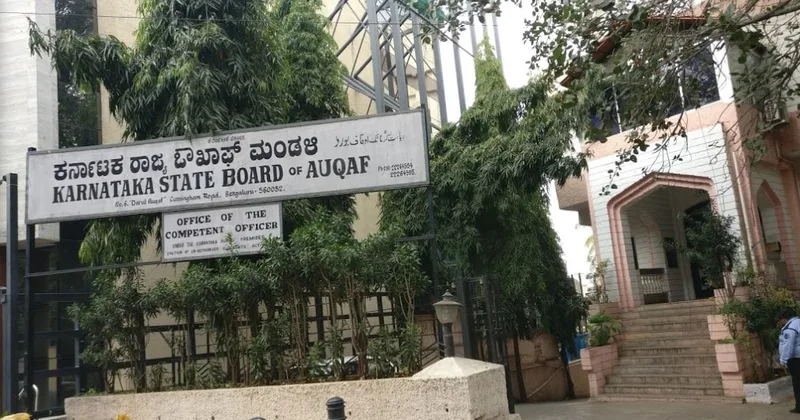
VIJAYAPURA: The ongoing controversy over Waqf property in Vijaypur has set off a national debate, with serious allegations against the government. Concerns have been raised that the government is attempting to designate farmers’ land as Waqf property, which would effectively transfer ownership to the Waqf Board. Farmers, who have tilled this land for generations, are now fearful of losing their livelihoods. In response, Minister MB Patil has come under fire after BJP representatives vowed to legally back the farmers.
During a press conference on Sunday, October 28, Minister MB Patil addressed the escalating Waqf dispute involving farmers’ land in Vijaypur district. He acknowledged the confusion surrounding Waqf properties and insisted that the issue had been misrepresented in the media, which reported that 1,200 acres of land in Honwada village had been transferred to the Waqf Board. Patil clarified that no notices had been issued to farmers in Honwada, dismissing such claims as misinformation.
The minister stated, “No farmer in the district has been issued any notice. This confusion is due to errors in the gazette. Only 10 acres of land in Honawada are registered as Waqf, and notices were given to 124 farmers accordingly. The matter is being looked into, and Chadchan-3, Ind Tehsildar issued a rectification without proper notification, which will be investigated.”
Patil further explained that notifications regarding Waqf properties were released in 1974, 1978, and 2016, listing properties in Mahalabagayat, Vijayapuranagar. According to the 1974 gazette, the name “Honawada” was placed next to Mahalabagayat in brackets, suggesting these lands belong to the farmers and are not entirely Waqf properties.
The issue of ownership is complex, with Patil stating that Vijayapur district has 14,201 acres of land listed as Waqf property. Of this, 12,083 acres are claimed as 70 per cent Muslim-owned, while the remaining 30% has been sold to non-Muslims. He claimed that the task force led by the District Collector is verifying the status of these lands, especially regarding changes made before 1974. Patil’s statements suggest that all such properties have historically been Muslim-owned, citing 13 acres in Yaragal village as gazetted Waqf property since 1974. However, disputes have arisen over properties like those claimed by Gurulinga Viraktamatha, which the minister attributes to clerical errors.
In sharp contrast, Vijayapur MLA Basan Gowda Patil Yatnal accused the government, particularly Minister Jamir Ahmed, of exploiting the situation to create communal tensions and gain minority votes. “By designating everything as Waqf property, where do Hindus go?” he questioned. Yatnal alleged, “You’re sacrificing farmers’ lands to secure votes from minorities. This is nothing short of selling out our farmers who have worked on this land for generations. We will not stand by; we are ready to join farmers in a legal battle against this injustice.”
Yatnal further declared that any farmer in Karnataka whose land is threatened by Waqf claims could approach their office. “We will provide legal support, and we are committed to fighting this battle alongside the farmers. This isn’t just about Vijayapur; it’s about protecting farmers’ rights across the state. We will create awareness and resist any attempts to use the Waqf law to encroach on farmers’ land.”
The controversy has intensified with accusations that the Waqf Board is issuing notices to temples, challenging the ownership of land historically belonging to Hindu religious institutions. “When did the Waqf Board come into existence, and when did these Hindu temples become Waqf properties? Temples have been here for centuries. If this misuse continues, we will see a movement against the Waqf law across the country,” Yatnal warned.
Yatnal assured farmers that the BJP would take this issue across Karnataka. “We will set up a team of lawyers to fight this in court. Wherever Minister Jamir goes, we will hold programs to counter his agenda. This battle is not just legal; it is a fight for justice against a system that is being manipulated to undermine farmers,” he declared.
In his final statement, Yatnal criticised the Waqf law, which he believes is being misused to create division. “The biggest mistake Nehru made was enacting the Waqf Law. It is now being used to create another Pakistan within Karnataka. If these actions are allowed to continue unchecked, we will witness significant unrest,” he said, hinting at the potential for widespread protests.
As the controversy over the Waqf property dispute escalates, the government finds itself on the defensive. Accusations of vote-bank politics, legal battles, and farmers’ protests signal that this issue is far from resolved. The opposition has vowed to take this fight to the highest levels, framing it as a struggle to protect farmers’ rights against an allegedly corrupt system.














Comments