






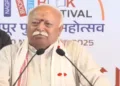
In his Vijayadashmi Utsav sambhashan, Sarsanghachalak Dr Mohan Bhagwat remembered Dr Bhimrao Ambedkar’s famous and historic pronouncement of “Grammar of Anarchy”. He stated that there may be dissatisfaction in the mind of a few people about different events or national policies in the country. These few groups and communities haven’t approached the openness and easy access to the democratic ways of expressing those dissatisfactions and opposing the policies. On contrary, they are resorting to violence, attacking a particular section of the society and trying to create fear. Why are they doing so? In a particular context Dr Ambedkar called this attitude “GANGSTERISM”.
The question that the Sarsaghachalak-ji seems to have posed is both a simple and yet a serious one. “We can all see the erosion of values and the tactics of divisive elements to break the society across Bharat today,” as he suggested. However, what are we doing to counter the attempts of those who are creating conflict by creating separation on the basis of caste, language, province etc.? Before we delve into this question, we can start examining a pattern that has been created in the last one decade.
Whose Government? Who Governs?
It all started in 2014. Writing for a national daily, Gopalkrishna Gandhi in “An Open Letter to Narendra Modi” (The Hindu, May 19, 2014) declared, “The BJP has won the seats it has because you (Modi) captured the imagination of 31 per cent of our people (your vote share) as the nation’s best guardian, in fact, as its saviour. It has also to be noted that 69 per cent of the voters did not see you as their rakhvala.” It was perhaps for the first time in the contemporary history that established intellectuals started enumerating “vote share” in a democracy modelled on Westminster system. Last time, such a gimmick was played when Atal Behari Vajpayee became the Prime Minister. The idea that “69 per cent of the voters did not see you as their rakhvala… They also disagreed on what, actually, constitutes our desh,” soon became the common wisdom for a majority of intelligentsia. Calls of “Preserve the Idea of India” became widespread. A grand lie in the Goebbelsian way was spread that the whole India is not with Narendra Modi!
What soon followed was a series of extra-constitutional and anarchist protests masquerading as civil society discontent. Whether the protestors were poets and writers, farmers, Muslim senior citizens, or university students, the persistent presence of the political other in their voices exposed their true intentions. If the protests were autonomous, what were the well-known activists who have made their careers abusing PM Narendra Modi and RSS doing there? They will say it was a “united front” against the Government. Very well. But why does that “united front” always appear when a certain political formation comes to power? Nobody who wields power through pen and words reminded Sonia Gandhi in 2004 that with a meagre 26.53 per cent vote share, INC cannot assume to represent the desh. And certainly not CPM with 5.66 per cent that was given lots of muscles by the Gandhi family under the garb of National Advisory Council.
While Narendra Modi Government dedicated one of its first flagship programmes to the legacy of Mahatma Gandhi, it has certainly failed to look the other side. The other side is the story of how Mahatma Gandhi’s Satyagraha has been abused by practitioners of Duragraha to never leave a stone unturned to challenge the legitimacy of an elected Government in the largest democracy of the world.
Gandhi and Anarchy
In his speech on November 25, 1949, Dr Ambedkar also warned that when “Constitutional methods are open there can be no justification for these unconstitutional methods.” The undying Gandhian legacy for all its merits is also an unfortunate tale of its abuse. As we discuss the issue, activist Sonam Wangchuk has been leading an indefinite hunger strike since October 6, 2024 to press for their demand to include Ladakh in the Sixth Schedule of the Constitution. Whether “an indefinite strike” is the only way to press for a demand?
The Sixth Schedule of Indian Constitution contains provisions related to the Administration of Tribal Areas in the States of Assam, Meghalaya, Tripura and Mizoram. It provides for the administration of certain tribal areas as autonomous entities. Home Minister Amit Shah is learnt to have told the Leh Apex Body (ABL) and the Kargil Democratic Alliance (KDA) that their concerns related to jobs, land, and culture would be taken care of, but the Government would not go as far as to include Ladakh in the Sixth Schedule of the Constitution. But the persistent activist with surely more invisible powers behind him would still press for an unprecedented constitutional change because he thinks his protest is “Gandhian”.
The other site for legitimate protests in a democracy is the Parliament. Right? In 2022, when the present Leader of Opposition was on his Bharat Jodo Yatra, a vital statistics came out. In the 17th Lok Sabha, the Congress leader’s parliamentary attendance stood at 53 per cent, as per PRS Legislative Research. This was way below the 79 per cent national average of MPs’ attendance when the report got published. Moving on, when the new Parliament Building was inaugurated in May 2023, 20 Opposition parties, including Congress, boycotted it while only 5 Opposition parties attended. Rationale?
Dr Mohan Bhagwat mentioned the stone pelters, the attackers on visarjan and shobha yatras, and many other fault lines that seems to just keep broadening. Those troublemakers expose themselves easily. However, let us also examine those who have pretended to be non-violent, peaceful, and Gandhian, and still stir greater troubles in a vibrant democracy than stone pelters. Be it the Award Wapsi clique, Shaheen Bagh women, or the intellectuals who went on to teach Nationalism to the country while radically compromising it, they seem to be a far greater problem.
Finally think about a historian who used to take pride in the fact that he criticises both the Congress and the BJP with objectivity. When this historian published a bestseller in 2007, he subtitled it as “The History of World’s Largest Democracy”. When the third edition of the book appeared in 2023 the subtitle was just changed to “A History”. When did exactly Bharat cease to be the largest democracy? May be for the grammarians of anarchy, but for “We, the People” it is alive and kicking.










Comments