





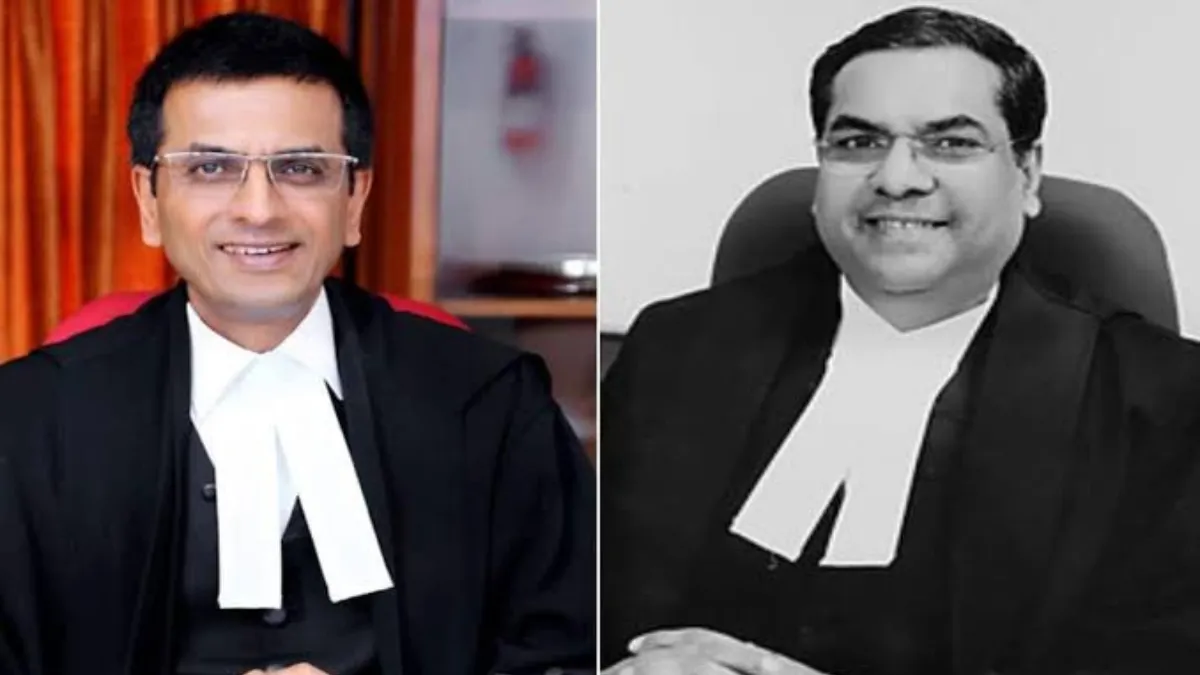
Chief Justice of India (CJI) D.Y. Chandrachud, in a formal recommendation to the Union Law Ministry, has proposed Justice Sanjiv Khanna as his successor. Upon the government’s approval, Justice Khanna will assume the role of the 51st Chief Justice of India, serving a brief yet critical term of six months, concluding with his retirement on May 13, 2025.
As CJI Chandrachud prepares to retire on November 10, 2024, this recommendation signals an important moment in the judicial landscape. The government, in anticipation of Chandrachud’s retirement, had written to him last week seeking the name of his successor, a formality that aligns with the convention of ensuring the smooth functioning of the judiciary.
Justice Sanjiv Khanna’s career began in 1983 when he enrolled as a lawyer with the Bar Council of Delhi. Starting his practice at the district courts in Tis Hazari, one of the busiest courts in the capital, Justice Khanna gradually built his reputation as a skilled advocate before moving on to represent clients in the Delhi High Court and various tribunals.
Notably, Justice Khanna’s early legal career saw him take on key public roles, including serving as Senior Standing Counsel for the Income Tax Department. His expertise in civil law was further demonstrated when he was appointed Standing Counsel (Civil) for the National Capital Territory (NCT) of Delhi in 2004. According to reports from The Indian Express, Justice Khanna also gained experience in criminal law, acting as an Additional Public Prosecutor at the Delhi High Court—a testament to his versatility across various domains of the law.
His judicial career took a pivotal turn in 2005 when he was appointed as an additional judge of the Delhi High Court, and a year later, he became a permanent judge. During his tenure at the Delhi High Court, Justice Khanna made substantial contributions to the judiciary beyond his courtroom responsibilities. He chaired several important judicial institutions, including the Delhi Judicial Academy, the Delhi International Arbitration Centre, and the District Court Mediation Centres, reflecting his commitment to enhancing the infrastructure and processes of the judicial system.
Justice Khanna’s ascent to the Supreme Court on January 18, 2019, marked a significant chapter in his judicial career. Notably, he achieved this elevation without first serving as Chief Justice of a High Court, a distinction few judges hold. His appointment to the highest court came with the weight of expectations, and Justice Khanna soon found himself adjudicating on some of the country’s most critical cases.
One of the landmark cases Justice Khanna presided over concerned the limits of free speech, an issue that has long been debated in Indian society. The bench, which he was a part of, ruled on the need for balance between the constitutional rights guaranteed under Article 19(1)(a) (freedom of speech) and the equally important rights enshrined in Article 21 (right to life and personal liberty). The judgment underscored that the right to free speech does not extend to infringing upon the fundamental rights of others, particularly the right of individuals to listen or not to listen. This interpretation of free speech reaffirmed the importance of respecting boundaries even within the broad freedoms guaranteed by the Constitution.
Justice Khanna was also involved in several key constitutional bench rulings, including deliberations on the abrogation of Article 370, which revoked Jammu and Kashmir’s special status. Additionally, he played a pivotal role in adjudicating the contentious 2018 electoral bonds scheme, which dealt with the transparency and legality of political funding. These cases placed Justice Khanna at the heart of significant legal and political debates in India, and his judgments in these matters have had far-reaching implications.
As Chairman of the Supreme Court Legal Services Committee and Executive Chairman of the National Legal Services Authority, he has worked to expand access to justice, particularly for marginalised sections of society. His role in the National Judicial Academy, Bhopal, as a member of its Governing Council, underscores his commitment to improving judicial training and education—a critical aspect of ensuring that the Indian judiciary remains robust and effective.
As Justice D.Y. Chandrachud steps down after a distinguished tenure, Justice Sanjiv Khanna will step into his shoes to lead the Supreme Court of India, bringing with him decades of experience, a record of landmark judgments, and a legacy of public service. His elevation marks yet another chapter in the continuing story of India’s judiciary, one that plays a crucial role in maintaining the checks and balances of the world’s largest democracy.
















Comments