





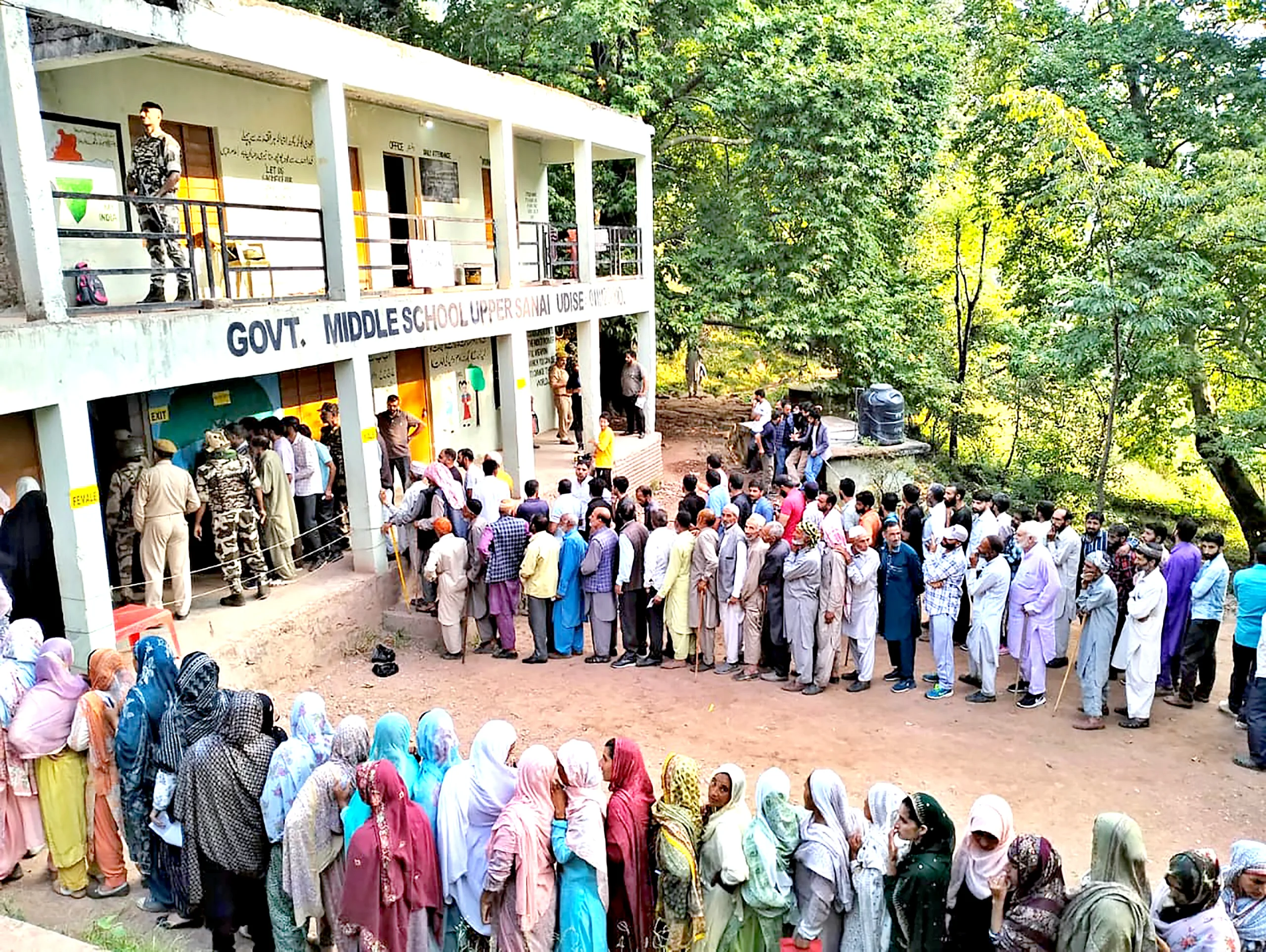
In the bustling queue at a polling booth in Jammu & Kashmir’s Ganderbal, a man in his 60s stood patiently, his eyes reflecting a quiet resolve. As he waited for his turn to vote, the weight of the moment seemed to rest gently on his shoulders. His words, spoken in Kashmiri, carried a deep wisdom that resonated with those around him, “Majboot Jamuriyat chaa amanich ta tarakki henz wath — zeentan kanhte” (A strong democracy paves the way for peace and progress — no matter who wins the election).
His voice was calm, yet filled with the conviction of someone who had seen much, someone who understood that democracy wasn’t just about who held power but about the path it would carve out for peace. It didn’t matter to him which candidate emerged victorious. What mattered was that the people’s voices were heard, that the foundation of a stronger, more peaceful future was being laid with each ballot cast.
In Jammu & Kashmir (J&K), particularly in the Valley, long lines outside polling stations had never been a common sight. Voting day often passed quietly, with people staying away from the booths. But this time, things seemed different. A sense of change was in the air.
Youths, determined to make their voices heard, were not only showing up in numbers but also bringing their elders along. It was a touching scene—young men and women holding the hands of their grandparents, guiding them to the polling stations. For the first time, these long queues symbolised hope and a desire for a better future, reflecting a newfound engagement with democracy
The election on the 90 Assembly seats—43 in Jammu and 47 in Kashmir—is being held in three phases from September 18 to October 1. The results will be out on October 8, alongside those of Haryana.
Following a delimitation exercise in 2022, the number of Assembly seats has also risen from the earlier 87 to 90.
Historic voter turnout with zero violence
Voter turnout in J&K, particularly in the Valley, has had an interesting trajectory in the recent decades since the outbreak of insurgency. The recent Assembly Elections have marked a significant turning point, with over 55 per cent voter turnout recorded in the first and second phases—a historic feat. After a decade-long gap, the winds of change are sweeping through J&K.
Among those witnessing this transformation was Manzoor Dar, a voter of Lal Chowk constituency who marvelled at the peaceful atmosphere during the polls. “Wadi ka mausam badal raha hai. Shayad aisa pehli bar hoga jab chunav me kisi ki jaan nahin jaa rahi. J&K is writing a new chapter in history,” he said, capturing the sentiment of a region once shadowed by the conflict.
Manzoor told Organiser, “ The record voter turnout in J&K, especially in the Valley, is a true victory for democracy. We are blessed to have PM Modi, who promised peace and prosperity in J&K—and he delivered, not by purchasing peace, but by restoring it as promised. Today, the people of J&K are living in peace, free from the threat and brutality of terrorists and their paid agents.”
The election in two phases held in a calm and secure environment, with no threats from terrorist groups or incidents of violence will mark an extraordinary shift for the region. People from all walks of life, including women, the elderly, and first-time voters, turned up in large numbers, casting their ballots with confidence. Even in districts like Pulwama, Anantnag, Kulgam, and Shopian—once hotbeds of militancy—voters defied the past and exercised their democratic rights.
Pulwama saw a voter turnout of 50.78 per cent, up from 38.31 per cent in 2014. Tral witnessed 43.56 per cent compared to 37.68 per cent in 2014. Anantnag recorded 45.62 per cent, up from 38.67 per cent in 2014, while Kulgam saw 63.44 per cent compared to 58.44 per cent in 2014. Shopian also recorded a significantly higher turnout of 58.51 per cent, up from 52.06 per cent in 2014.
A New Beginning
This election is unlike any other, marking a pivotal moment not just for the political and security landscape of the region but also for its social fabric. For the first time since their ancestors were forced to migrate from Pakistan during the tumultuous Partition of 1947, the West Pakistan Refugees (WPRs) are stepping into the Assembly Elections in J&K. These refugees, whose families were forced to live in makeshift camps near Jammu for decades, had been denied land ownership and other Fundamental Rights due to the undemocratic provisions created through Article 35A. But now, after years of being sidelined, they are finally asserting themselves.
The shift began in August 2019, when Article 370 was amended and all the provisions of the Constitution of India were extended to J&K. Soon after, in the 2020 District Development Council (DDC) elections, the WPRs cast their votes for the first time in the local elections. Earlier they could vote for the Parliamentary elections but not for the Assembly.
For Labha Ram, president of the West Pakistan Refugee Action Committee, this newfound right is nothing short of a celebration. “We are mainstream now. Voting day will be a festival for us,” he said, reflecting on decades spent as second-class citizens, deprived of the power to choose their representatives. “Now, this fundamental democratic right has been given to us. Jo Modi sahib ne humare lie kia hai wo shayad dusra aadmi nahi kar pata (Only Prime Minister Narendra Modi could have made this possible),” he added.
Labha Ram’s words capture a long and painful history. “Now that we have domicile certificates, we’re finally receiving the benefits of Government schemes. Today, everyone is reaching out to us, asking for our votes and talking about our welfare. In the past, hardly anyone cared about our well-being or our future, except for a few.But now they all come to us, with a promise to take care of us in exchange for our votes.”
Numbering over 22,000, with around 70 per cent belonging to Scheduled Castes, 20 per cent from OBC, and 10 per cent from the General category, they lived without many of the basic rights that other residents enjoyed.
Joining the WPRs in their historic voting rights are about 10,000 members of the Valmiki community, who were long barred from participating in the democratic process. The Valmikis were brought to Jammu in 1957 from Punjab by the then-Government to serve as sanitation workers, but despite their critical role, they were never granted permanent resident status. For decades, they lived on the margins, unable to vote or access many of the rights that others took for granted.
The amendment of Article 370 finally brought long-awaited change for the Valmiki community. By 2020, months after the abrogation of Article 35A, they began receiving domicile certificates, allowing them to vote for the first time.
Talking to Organiser, Gharu Bhatti, President of the Valmiki Samaj, expressed his community’s profound gratitude to Prime Minister Narendra Modi for the changes that have allowed them to be part of the democratic set up. “Humein August 5, 2019 ko sahi mamle me azaadi mili (We got Independence on August 5, 2019 in real sense). We are thankful to Narendra Modi ji for abrogating Article 370. If he had not become Prime Minister, this would not have been possible. We have always wanted to be part of the democratic set up, and after 67 years that dream is coming true,” Bhatti said.
Yet, the right to vote is just one facet of a broader transformation for the Valmiki community.
“Under the old laws, our children were barred from applying for Government jobs due to the lack of a Permanent Resident Certificate (PRC). With the new changes, doors that were long shut are now opening, allowing us to dream of a better future where our children can achieve their aspirations without the barriers of outdated laws. My sister Meena Gill is studying LLB at Jammu University under the SC category—a chance made possible only after the abrogation of Article 370,” Bhatti added.
For the WPRs and the Valmikis, this election is more than just a political event; it is a long-awaited recognition of their place in the region’s democratic fabric, and a chance to shape their destiny after almost seven decades of exclusion.
From Boycott to Ballots
In the lead-up to the 2014 Assembly elections in Jammu & Kashmir, the then Jamaat-e-Islami chief, Mohammad Abdullah Wani, made a firm announcement, urging his followers to avoid participating in the electoral process. This stance aligned with Jamaat’s longstanding policy of boycotting elections, a decision rooted in the aftermath of the controversial 1987 polls. Widely perceived as rigged in favour of the National Conference under New Delhi’s influence, the 1987 elections became a flashpoint, igniting the militancy that erupted in Kashmir in 1989.
Jamaat’s history in the electoral arena is marked by ups and downs. The organisation first participated in the 1972 Assembly elections, securing five seats from the Valley while in the 1977 elections, they only managed to win just one seat. Following the 2014 polls, a seismic political and territorial shift occurred when the BJP Government amendment Article 370, further altering the landscape.
For many voters, this election marks a turning point. Those who turned 18 this year, alongside those who had been boycotting elections for the past 34 years in response to separatist or Jamaat calls, headed to the polls to cast their first votes
This shift also challenged Jamaat’s boycott stance. Despite being banned in 2019 following the Pulwama attack, the organisation evinced interest in participating in the 2024 Lok Sabha elections if the ban was to be lifted. However, when the UAPA tribunal upheld the ban on August 23, Jamaat decided to field its candidates independently. Now, Jamaat-backed candidates are contesting in just 10 of the 47 Assembly constituencies in Kashmir, having struck a pre-poll alliance with Engineer Rashid, the head of the Awami Ittehad Party and Member of Parliament from Baramulla.
For many voters, this election marks a turning point. Those who turned 18 this year, alongside those who had been boycotting elections for the past 34 years in response to separatist or Jamaat calls, headed to the polls to cast their first votes. Majeed, a voter from Baramulla (name changed), voiced the sentiment of many in the region. “I will vote for the first time. All these years, Jamaat has been preaching us to boycott elections, and now they are themselves contesting. They are taking out rallies. We just want our problems to be addressed.”
A Jamaat sympathiser and voter from Baramulla described participation of Jamaat leaders in the elections as “a new beginning.” Baramulla is set to vote on October 1, the last phase of the elections.
When asked about the amendment of Article 370, he noted, “We are witnessing development in terms of infrastructure, but only time will tell whether the abrogation was good or bad.”
Free Media Coverage
The recent Assembly polls have witnessed unprecedented media coverage, signalling a notable shift in how elections are reported in J&K, particularly in the Valley. Although some agenda-driven media outlets have falsely claimed that the Government is restricting independent voices and there is no media freedom in the Valley.
Historically, the media in J&K was dominated by a select group of journalists under the influence of a few political dynasties and separatist groups. While the Chinese bureau operated freely in Srinagar, journalists from other parts of India were often restricted. This time, however, not only are prominent media houses actively reporting, but individual YouTubers and social media influencers are also exploring the interiors of the Valley, including areas previously affected by terrorism.
A senior valley-based journalist said, “The participation in the media coverage is something that I have not witnessed in the past three decades here. It is really surprising to see people so enthusiastic about elections. I am seeing how people are not hesitant in talking to the media. I won’t say everybody but a lot of people out there are speaking fearlessly on camera. That is something one can’t ignore at all.”
Another important thing to note is that for the first time, elections in J&K are being held under global spotlight, with senior diplomats from 16 countries invited to observe voting at polling stations in the Union Territory. The international observers voiced their validation of the polls, with the US diplomat describing them as “very healthy and very democratic”.
US Deputy Chief of the Mission in Delhi, Jorgan K Andrews said, “It is great to see the enthusiasm… to see Kashmiris voting after a pause of 10 years. We are very excited to see the results… It looks very healthy and very democratic.”
Amidst the cacophony of ‘democracy in danger’, vibrant campaign, enthusiastic candidature, high voter turnout, zero violence, and participation of all stakeholders demonstrate that the real democracy is returning to J& K. Irrespective of the electoral outcome, peace and progress should sustain is the general spirit of common people while celebrating the festival of democracy.




Comments