





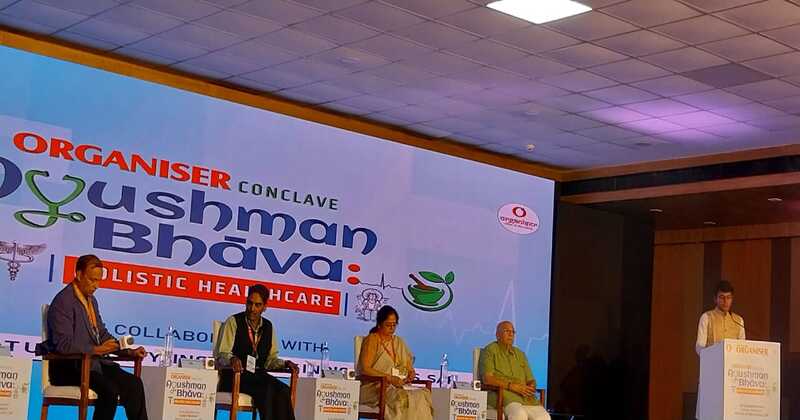
AHMEDABAD: The integration of Ayurveda with modern allopathy was a key focus of a recent session on holistic and integrated healthcare at the Ayushman Conclave, where experts discussed the biases, challenges, and potential of merging different medical systems. The session highlighted the importance of collaboration and overcoming prejudice between practitioners of traditional and modern medicine for the benefit of patients.
V D Tapan Kumar, MD in Ayurvedic Medicine and fourth-generation practitioner, opened the discussion by asserting that Ayurveda has long been integrated into the Indian healthcare system. “We are already integrated,” he said, emphasising that the perceived division between Ayurveda and allopathy stems from a “colonial mindset” that needs to be overcome. According to him, Ayurveda is not competing with allopathy but has its own established role in treating patients.
However, D Dr Chetna Desai, Professor and Head of Pharmacology at B J Medical College, Ahmedabad, acknowledged that bias does exist, especially among allopathic doctors. “Some may think Ayurveda is only for those who couldn’t get into institutions like AIIMS,” she said, referring to India’s premier medical institutes. This bias, she argued, often leads to a siloed approach where practitioners from different medical fields fail to collaborate, thereby limiting the effectiveness of patient care.
Lt Gen Ajit Nilakantan, PVSM (Retd), Executive Director & Principal of the Medical College and Hospital pointed out that Ayurveda is often marginalised by some allopathic practitioners who feel their sphere of influence should not be encroached upon. “Ayurveda doctors are not yet fully part of the mainstream,” he said, stressing the need for greater integration and mutual respect between the two systems. He added that while Kerala has a strong Ayurveda setup, many other parts of India still struggle to integrate Ayurveda into the healthcare system.
Amit Srivastava also raised concerns about the biases present in the field of holistic healthcare. He emphasized the need to break down barriers between different types of medical practice to ensure patients benefit from a wider range of treatment options.
Mixed therapy, or “mixopathy,” was another topic of debate during the session. Dr. Desai remarked that there is evidence supporting the benefits of combining Ayurveda and allopathic treatments, but cautioned that drug interactions must be carefully studied. She warned that when allopathic doctors prescribe Ayurvedic medicines without full knowledge, it can lead to unintended side effects. “Every drug has some side effect,” she said, advocating for a well-rounded understanding of both systems by all healthcare providers.
One of the key takeaways from the session was the need to update the medical curriculum to reflect a more integrated approach. Dr. Desai noted that the National Medical Commission has introduced some changes, including courses on yoga and meditation, and a vertical and horizontal integration of different medical systems. These changes aim to treat the patient as a whole and foster scientific research to better support mixed therapy.
Lt Gen Ajit Nilakantan added that patients often feel reluctant to share their use of Ayurvedic remedies with their allopathic doctors out of fear of being ridiculed. He emphasized the need for a more open dialogue and the inclusion of substantial portions of Ayurveda in the main syllabus to develop well-rounded specialists in holistic healthcare.
In conclusion, the session underscored the need for healthcare systems to work collaboratively and avoid functioning in silos. With mutual respect and integration, both Ayurveda and allopathy can contribute to a more effective and patient-centered healthcare model.














Comments