





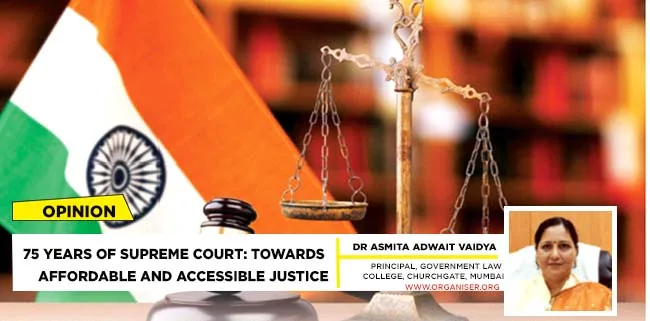
Inordinate delay, cost of legal processes and inaccessibility are impeding the effective delivery of justice to the common man” This is an observation noted by the Vice President of India recently, which shows the concern over the making of the legal system easier and acceptable for the common man.
The judiciary’s role is to provide amenities for access to justice. Our Constitution has specifically enshrined in Directive Principles of State Policy under Article 39(A) guarantees that give equal justice and free legal aid to all citizens. It was added to the Constitution by the Constitution (Forty-Second Amendment) Act, 1976. The article’s main provisions include and focus on equal opportunity, free and impartial judicial system and full opportunity for women, children, elderly and persons with disabilities. Though the Constitution established the system for giving justice to all, practically we find that there are a number of impediments which hinders the path of affordable and accessible justice. Therefore, it is the need of the hour to take the holistic responsibility to cater to the faith of the common man by breaking barriers of affordability and accessibility.
Concept of Justice
An access to justice is the constitutional guarantee given to the citizens of India. The constitutional idea of justice is not unidirectional but it is multi dimensional. It is expected that with the help of the justice delivery system there will be transformation of the unjust social reality into a just social order with the strong support of the Constitution. This is the only aim and objective of the Constitution. All the efforts must merge to achieve its vision of justice. The Constitution recognises and guarantees various Fundamental Rights which are aimed at protecting and promoting political justice, social and economic justice.
Independence of Supreme Court
One of the characteristics of our Constitution is the independence of the Supreme Court. The Constitution preserves this independence by adopting certain basic modus operendi. A Supreme Court judge cannot be removed from the office except by an order of the President passed after an address in each house of Parliament supported by a majority vote of two third of members present and voting on grounds of proven misbehaviour or incapacity.
Similarly, a judge of the Supreme Court cannot practise in the court of law or before any authority in India. The Supreme Court rules 1966 and Supreme Court rules 2013 are framed under Article 145 to conduct the policy, actions and to govern the practice and procedure of the Supreme Court. Further, fixed service conditions, immunity to discuss ‘judges’ conduct in Parliament and State legislature ( Art 121), authority to punish contempt of court (Art 129), appointment of staff without executive interference protection and separation of judiciary from executive, with no influence, of executive authority (Art 50), preserve the independence of judiciary.
The Supreme Court, being the guardian of the Constitution, has to ensure its authority and simultaneously on primary footing has to protect the Fundamental Rights by issuing writs under Article 32. The Supreme Court has been vested with its supreme power and it is the final arbiter of legal disputes. It has the power of judicial review. It has to go with the fundamental principles enshrined in the Preamble of the Constitution and promote and protect human rights, the rights of marginalised communities and promote social justice. Not only this but always keep watch on the executive actions ensuring rule of law.
After completion of 75 years of the working of Supreme Court, being the apex judicial authority, the overview of the working of Supreme Court has been discussed and naturally questions peeped into the minds of the people, whether justice in real sense is reaching to the common man and whether common man is easily accessible to ‘justice’. Similarly, is it the responsibility of the Supreme Court to make the legal system easier and accessible for the common man. After having appraisal, it can be said that the Constitution has enshrined inordinate powers in the Supreme Court with the objective to achieve justice – social, economics and political. The independence of the judiciary is also assured. With a lot of expectations, all these constitutional provisions are framed. The high pendency of cases, less number of judges, recruitment delay, procedural delay, tremendous increase in number of cases, complex legal language, less use of technology in the discourse of working, are some of the reasons for inordinate delay in justice dispensation. In the coming 25 years, the Supreme Court is expected to take the responsibility to ensure affordable and accessible justice by implementing innovative techniques in the justice delivery system. The schemes are like- out of the court settlement, recruitment of judges, increase in the number of benches, implementation of arbitration, mediation and alternative dispute resolution system all over the country, use of technology, frequent organisation of Lok Adalats, involvement of legal services authorities at taluka, district, State and national level, collaborations with law colleges, establishing legal aid and counselling centre at every college with the appointment of lawyer in the centre, creating posts like ‘Client counsellor’ and ‘court observer’ in every district Court for effective implementation of justice delivery system and responsible interaction with the various stakeholders etc.
Shaping Justice Delivery System
The Supreme Court being apex body and parental in behaviour having binding nature (Art 141) ipso facto, the responsibility of shaping the justice delivery system in India lies on it. It settles disputes between various Government authorities, between State Governments and between the Centre and any State Government. It also hears the matter which the President refers to, in its advisory role. The Supreme Court can also take up the case Suo Moto. It is the highest appellate court. It has judicial review power. Thus it has original, appellate, advisory and review jurisdiction. With these powers, Supreme Court can bring miraculous changes in the justice delivery system resulting in ‘justice’ as expected and enumerated in the Constitution. In a nutshell, it can be said that, it becomes incumbent upon the apex body to cater to the faith of the vast population who place reliance and pin their hopes on the highest decision making body. The role of the Supreme Court has at many instances revived this hope and thus left the citizens of the country pinning their faith even more. The justice delivery system thus ought to become more user friendly to take justice to the remote corners, making it not just accessible but also effectively accessible. This can be achieved by incorporating technological advances that the court has already adapted to but the responsibility does not end there as this technological advancement also has to seep into the various strata. A holistic dispensation of function is what the highest body needs to undertake to cater to the ultimate threshold of justice. As the Constitution is for the people and the Supreme Court has an inherent responsibility of upholding the principles of the Constitution, this nexus of safeguarding the people’s right thus becomes a direct responsibility of the apex body.













Comments