





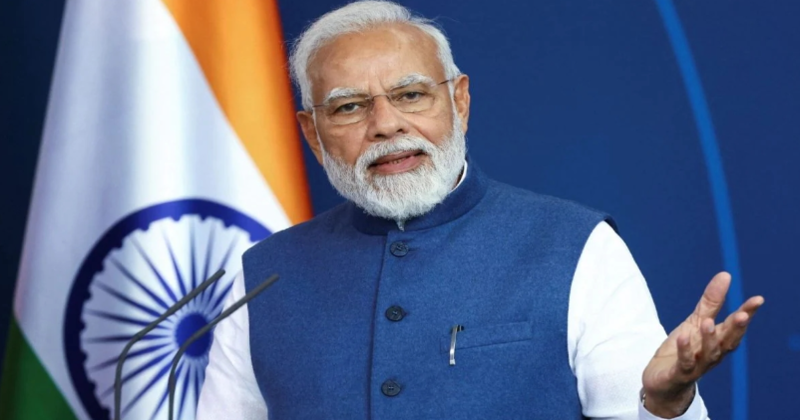
NEW DELHI: Since taking office in 2014, Prime Minister Narendra Modi has been at the helm of a transformative period in Indian governance. His administration has introduced sweeping legislative and executive measures, reshaping the nation’s political and economic landscape. These decisions reflect both the ideological foundation of his Bharatiya Janata Party (BJP) and his broader policy agenda aimed at modernising India.
As the National Democratic Alliance (NDA) returned to power for the third time in 2024, concerns over the future of India’s Constitution resurfaced. Some politicians and social media influencers are raising alarms, that the BJP, might alter the very framework of India’s democracy. But are these fears well-founded?
In the decade that the BJP has been at the helm, the party has shown little appetite for radical constitutional changes. Despite the anxieties expressed by some, the BJP has not engaged in prolific amendments to the Constitution. As Prime Minister Narendra Modi leads the party into a new term, the likelihood of drastic changes seems minimal, especially given Modi’s own vested interest in the preservation of India’s constitutional democracy.
Prime Minister Narendra Modi’s rise to power is a testament to the strength of India’s electoral system. This achievement would have been unimaginable without the democratic electoral process. The BJP’s decision to field Modi as its prime ministerial candidate was rooted in his ability to resonate with voters. Without this democratic platform, Modi’s political career would likely have been a mere footnote, and the BJP’s leadership landscape would have looked entirely different.
Some critics argue that a third consecutive term for any party might strain the health of democracy. However, historical precedents suggest otherwise. The Congress party governed India without interruption from 1952 to 1972, yet no serious claims of dictatorship were made during the Nehru-Indira era. Similarly, the Left Front’s 34-year rule in West Bengal did not lead to authoritarianism.
India’s closest encounter with dictatorship occurred during the Emergency (1975-77) when Indira Gandhi suspended civil liberties and postponed elections. This dark chapter was an exception, not the norm, and democracy was quickly restored when Gandhi was voted out in 1977. Her subsequent return to power in 1980 was achieved through democratic means, reaffirming the resilience of India’s electoral process.
The Indian Constitution is designed to evolve, with provisions for amendments enshrined in Article 368. The framers of the Constitution foresaw the need for adaptability, allowing future generations to amend the document to meet changing circumstances. While Parliament has the power to amend the Constitution, the judiciary’s basic structure doctrine ensures that certain fundamental principles remain inviolable.
India’s Constitution has withstood numerous challenges over the decades and is likely to continue serving as the bedrock of the nation’s democracy, regardless of the party in power. The NDA’s reduced majority may even serve as a check, ensuring that any proposed amendments are carefully scrutinised and debated. Now let’s take a look at the 10 major policy decisions of the Modi government since 2014:
1. Demonetisation: A Bold Gamble
On November 8, 2016, Prime Minister Modi made a surprise announcement that shook the Indian economy: the demonetisation of Rs 500 and Rs 1,000 notes. Overnight, these notes, which constituted 86 per cent of the currency in circulation, were rendered obsolete. The move was touted as a strike against black money, counterfeit currency, and corruption. While it was lauded by some as a courageous step toward economic reform, critics argued that it caused significant disruption, particularly to small businesses and the informal sector. The long-term effects of demonetisation remain a subject of debate, with its success in achieving its stated goals questioned by many.
2. GST: A Unified Tax Regime
In July 2017, India saw the implementation of the Goods and Services Tax (GST), a monumental tax reform that subsumed a plethora of central and state taxes into a single, unified tax. The GST was hailed as a step towards creating a ‘one nation, one tax’ system, simplifying the tax structure, and fostering ease of doing business. However, the rollout faced criticism due to its complex multi-tiered tax rates and the initial challenges businesses faced in complying with the new system. The opposition, particularly the Congress party, vehemently opposed the GST in its current form, dubbing it the ‘Gabbar Singh Tax’ after a notorious Bollywood villain, symbolizing their view that the tax was oppressive and burdensome.
3. Triple Talaq Ban: A Victory for Women’s Rights
In a significant move towards gender justice, the Modi government in 2019 succeeded in passing the law that criminalized the practice of triple talaq, a form of instant divorce used by Muslim men. This legislative action followed a 2018 Supreme Court ruling that declared the practice unconstitutional. The law was seen as a critical step in empowering Muslim women and ensuring their rights within marriage, marking a stark departure from the Congress government’s handling of the Shah Bano case in the 1980s, where political appeasement overruled judicial progress.
4. Abrogation of Article 370: Rewriting History
On August 5, 2019, the Modi government made a historic decision to abrogate Article 370 of the Indian Constitution, which granted special status to the state of Jammu and Kashmir. The state was subsequently bifurcated into two Union Territories: Jammu and Kashmir, and Ladakh. This move was aimed at fully integrating the region with India, bringing it under the full ambit of the Indian Constitution.
5. Ram Mandir Trust: Fulfilling a Long-Standing Promise
The construction of the Ram Mandir in Ayodhya has been a cornerstone of the BJP’s political agenda. Following the Supreme Court’s 2019 verdict that paved the way for the temple’s construction, the Modi government established the ‘Sri Ramjanambhoomi Tirath Kshetra’ trust in 2020 to oversee the building of the temple. The temple, inaugurated in January 2024, represents the culmination of a decades-long legal and political struggle, fulfilling a key promise of the BJP and resonating deeply with its core supporters.
6. New Criminal Code: Overhauling Colonial Legacies
In December 2023, the Modi government introduced a comprehensive overhaul of India’s criminal justice system by replacing the British-era Indian Penal Code (IPC), Code of Criminal Procedure (CrPC), and the Indian Evidence Act. The new laws—Bharatiya Nyaya Sanhita, Bharatiya Nagarik Suraksha Sanhita, and Bharatiya Sakshya Bill—represent the most significant reform in Indian criminal law history.
7. EWS Reservation: Expanding Affirmative Action
In a landmark move, the Modi government introduced a 10% reservation for the Economically Weaker Sections (EWS) through the 103rd Constitutional Amendment in 2019. This was the first time that economic criteria were used for reservation in education and government jobs, expanding the scope of affirmative action beyond caste-based considerations.
8. Agnipath Scheme: Redefining Military Recruitment
In 2022, the Modi government launched the Agnipath scheme, a radical new approach to military recruitment. Under this scheme, soldiers, known as Agniveers, would be recruited for a four-year term, with only 25 per cent retained for long-term service. This initiative aimed to modernize the Indian military and reduce the pension burden.
9. Ayushman Bharat: A Healthcare Revolution
Launched in 2018, Ayushman Bharat is touted as the world’s largest government-funded healthcare program. It aims to provide health coverage of Rs 5 lakh per family per year to over 12 crore families, covering nearly 40 per cent of India’s population. This ambitious scheme is a cornerstone of Modi’s efforts to improve healthcare access and reduce the financial burden of medical expenses on the poor.
10. Aatmanirbhar Bharat: A Vision of Self-Reliance
Amid the global economic downturn caused by the COVID-19 pandemic, Prime Minister Modi unveiled the Aatmanirbhar Bharat initiative in 2020, aimed at making India self-reliant in various sectors. This initiative has been accompanied by Production Linked Incentive (PLI) schemes to boost domestic manufacturing, particularly in electronics and pharmaceuticals. The goal is to reduce India’s dependence on imports and strengthen its position as a global manufacturing hub. The initiative has seen some success, with significant investments in domestic production, but it also faces challenges related to global supply chains and technological advancements.
As Modi’s government completed more than a decade in power, these policy decisions highlight the administration’s dual focus on economic reform and cultural nationalism. Each of these actions has left a profound impact on India’s political and social fabric, with ongoing debates about their long-term effects.















Comments