





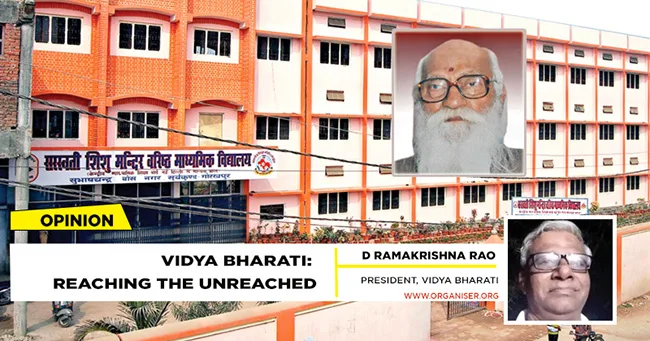
The first Saraswati Shishu Mandir was started in Gorakhpur way back in 1952. At present, Vidya Bharati runs 12,094 formal schools in 682 districts of India. More than 100 of these schools are residential. More than 200 are affiliated to the CBSE and the rest with their respective State boards. Fulfilling its social responsibility, Vidya Bharati is running more than 8,000 non-formal education centres, free of cost in urban slums, remote areas, tribal areas, and in the North East region. A new experiment of ‘School on Wheels’ has also been started for the students living in sensitive and disturbed areas, providing education to the wards of 480 refugee families living in camps in Manipur. As an important dimension, Vidya Bharati has been making special efforts in the field of girl education for the last four decades. Generally speaking, there are more than 34 lakh students currently studying in all these schools. Currently, Vidya Bharati is imparting education in 20 languages of the 22 languages of the 8th Schedule of the Constitution. Vidya Bharati is trying to instill educational skills and moral values among students through the efforts of about 1 lakh 37 thousand teachers. Besides school education, Vidya Bharati also runs 54 colleges and a university in the field of higher education. Additionally, Vidya Bharati is continuously contributing to the programmes of mass education and development through ITI, Krishi Vigyan Kendra and Skill Development Centers at the school level.
With the motto of Sa Vidya Ya Vimuktaye, Vidya Bharati is constantly striving to contribute to the development of education and teaching. With time, there is a need for continuous improvement in the quality of education and educational institutions. For this purpose, Vidya Bharati has been sharing its detailed and comprehensive working experiences with various Governments on their invitation.
Billed as a society-centric and society-nurtured institution, Vidya Bharati is committed to creating a new generation with modern thoughts and centered on Indian life values in education. The educational institutions run by Vidya Bharati are also centres of social consciousness.
The ability of Vidya Bharati’s students in academic and other fields of society is reflected in the fact that 2,755 students secured place in the High School Merit List of the year 2024 and 3,922 students secured place in the Higher Secondary Merit List across the country. Sixteen alumni secured a place in the Civil Services Examination 2023.
Vidya Bharati has been making continuous efforts to encourage important dimensions of education such as scientific understanding, interest and innovation in children. The Atal Tinkering Lab Project has been established in 507 schools. Alumni of Vidya Bharati have not only made the institution but the entire country proud by their participation in various fields of society. Relevant achievements like the participation of nine alumni of Vidya Bharati in the lead team of Mission- Chandrayaan are examples of this. At present, 9,33,209 alumni are registered on the alumni portal. It would not be an exaggeration to say that Vidya Bharati alumni are working in almost
every field of society.
Innovative Practices
Some special institutions have also been set-up by Vidya Bharati for the development of educational quality. The main ones being Vidvat Parishad, which works as the Academic Council of Vidya Bharati. Problem-solving and future strategies are discussed through various seminars and discussions on various educational subjects. Research on new subjects of education is implemented and conducted by the Bharatiya Shiksha Shodh Sansthan, Lucknow. Manak Parishad System on School Enrichment and Quality (SESQ) sets the standards for the quality of schools and ‘Prashikshan’ – in which teachers are given training on teaching style and other subjects before and after appointment. Other important innovations include Science Fair, Mathematics Fair, and All India Cultural Festival etc.
Implementation of NEP 2020
Vidya Bharati is already working on the suggestion of starting education from childhood through Balvatika as per the format of 5-3-3-4 of the National Education Policy 2020. Shishu Vatika, run by Vidya Bharati, has been incorporating a school-based education system without bags, examination, homework and stress. As per the National Education Policy, appropriate steps are being taken for the development of curriculum in accordance with the National Curriculum for early childhood care and school education.
The Way Ahead
In the coming years, the focus of Vidya Bharati will be on intensification of its working in the areas where there is a need of education – the hilly regions, the tribal areas, the coastal belts and along the international border lines, so that the people living in such remote areas may also come forward to join the national mainstream.















Comments