





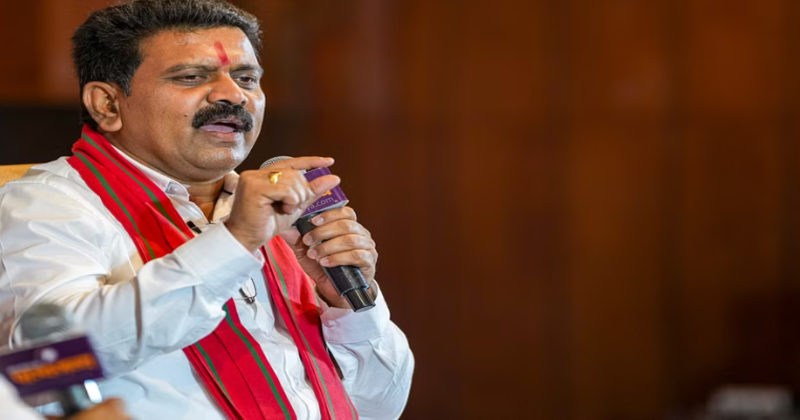
NEW DELHI: At the Panchajanya “Good Governance Dialogue: Chhattisgarh” event, Home Minister Vijay Sharma expressed the state government’s willingness to engage in unconditional dialogue with the Maoists. Sharma emphasized that the issue of Maoism cannot be resolved solely through armed conflict.
“Let me unequivocally state that Maoism cannot be eradicated just by the gun,” Sharma said, addressing the audience. He further stressed the importance of addressing the root causes and involving all stakeholders in the solution, including those who have surrendered, victims of Maoist violence, young recruits, and the forces combating the insurgency.
With regards to tackling the problem of Maoism in the next few years, Sharma outlined a multi-faceted approach, emphasizing the need for collaboration across various fronts. “We are working on all aspects simultaneously,” he said, “including rehabilitation for those who have surrendered and ensuring development reaches the affected areas.”
The Home Minister revealed that he has already initiated steps to facilitate dialogue, such as issuing a Google form for suggestions and promoting communication via normal and video calls. “We are prepared for discussions without preconditions,” Sharma affirmed, emphasizing the futility of armed struggle in the current context. He questioned the logic behind continued violence, noting that the presence of welfare-oriented governments should negate the need for such insurgency.
Sharma shared insights from his visits to remote villages like Tekguda, Puarti, and Silger, areas previously inaccessible to armed forces. He recounted the story of a 25-year-old boy from this region who saw television for the first time when brought to Raipur. “What is the point of this violence?” Sharma asked, highlighting the destruction of schools, health centers, and infrastructure by Maoists.
He also addressed issues of extortion and illegal activities, citing feedback received through his Google form initiative. “Teachers and tendu leaf traders are being extorted,” he reported, noting that millions of rupees have been forcibly collected from these communities.
When asked about the potential risks for those filling out his Google form to suggest solutions, Sharma assured that the government is committed to their safety. “I have already stated that I am just a worker. Our leaders, Honorable Amit Shah and Chief Minister Vishnudev Sai, guide us. We understand that Chhattisgarh is different from Jammu and Kashmir. Here, a person who surrenders can become your bodyguard within a week because of the trust they inspire,” he explained.
Sharma also highlighted the economic opportunities available in Chhattisgarh, particularly in the Bastar region. “Maoists claim to fight for ‘jal, jungle, and zameen’ (water, forest, and land), but we have always said that Bastar belongs to its people. The District Mineral Foundation (DMF) scheme introduced by PM Modi ensures that half of the mining revenue is spent locally,” he said. Sharma noted that Bastar is rich in minor forest produce, eliminating the need to exploit underground resources.
Addressing the issue of religious conversions, Sharma acknowledged it as a challenge but emphasized that the primary focus remains on tackling Naxalism. “This department operates 24/7. While we have a comprehensive force and system in place, we must remain vigilant at all times. Many reforms are needed, but our main focus is on eradicating Naxalism from Chhattisgarh. I assure you that in three years, you will be able to sit by the Indravati River in the evening and enjoy the peace,” Sharma promised.
In response to questions about the previous government’s handling of the Naxal issue, Sharma attributed the current positive outlook to the leadership of Amit Shah and Vishnudev Sai. “Under previous governments, Amit Shah was not the Home Minister, and Vishnudev Sai was not the Chief Minister. This unique combination offers immense possibilities,” he stated.
Sharma also spoke about the aspirations of Bastar’s residents. “In Bastar, children aspire to become SPs and collectors. If villages in Bastar receive electricity, the residents are willing to do anything to support progress. Unfortunately, some individuals are conspiring against the indigenous people of Bastar,” he lamented.
When questioned about the pervasive ecosystem of ‘Urban Naxals,’ Sharma acknowledged it as a significant challenge for the state government. “Breaking this ecosystem is indeed a major challenge, but we are committed to dismantling it and ensuring justice for the people of Bastar,” he affirmed.
Sharma highlighted the need for societal involvement in breaking the nexus between the Maoists and their urban supporters. “Society must understand the pain of those who have lost limbs to IED blasts. These are not just statistics; they are human lives,” he asserted.
Sharma also criticised the ideological support for Maoists, drawing parallels to the Tiananmen Square crackdown in China. “Maoism has not brought prosperity to China. We believe in ideological freedom, which is true progress. We do not want a monarchy or Maoism; we want democracy,” he declared.
On the question of implemntation of Uniform Civil Code, Sharma said that it would be implemented in the state without any difficulty.
Sharma also stated that if any foreign power will try to disrupt peace in the state, then stringent action will be taken against them.
Concluding his remarks, Sharma emphasized the government’s commitment to eradicating Naxalism and fostering peace and development in Chhattisgarh. “Our goal is not just to end Naxalism but to integrate Naxalites into the mainstream and ensure a peaceful life for everyone,” he affirmed.
















Comments