





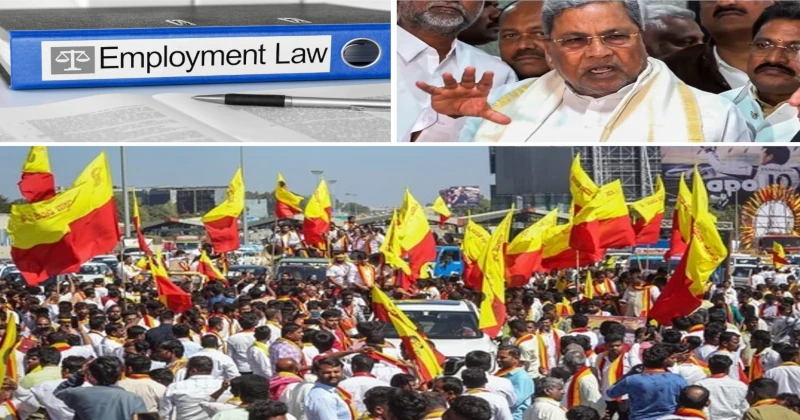
The Karnataka cabinet has stirred controversy after they approved a bill aimed at providing employment reservations to Kannadigas in the private sector. The ‘Karnataka State Employment Bill 2024,’ which seeks to give preference to local candidates in industries, factories, and other business establishments, will be tabled in the Legislative Assembly on July 18. Chief Minister Siddaramaiah and Labour Minister Santosh Lad provided details about the bill.
The proposed legislation mandates that any private enterprise, factory, or organisation operating within the state must reserve 50 per cent of their management positions and 75 per cent of their non-management roles for local candidates. This significant policy prioritises employment opportunities for individuals born in Karnataka who have resided in the state for at least 15 years or are proficient in the Kannada language.
Eligibility criteria for reservation include the ability to speak, read, and write Kannada. Candidates who do not have a secondary school certificate with Kannada as a language must pass the Kannada Proficiency Test specified by the ‘Nodal Agency’. In cases where qualified local candidates are not immediately available, the bill stipulates that companies must collaborate with the government or its agencies to train such candidates within three years.
Furthermore, the bill allows companies to apply for exemptions if they cannot find sufficient local candidates to meet the reservation requirements. This provision ensures that businesses have a degree of flexibility while still adhering to the primary goal of increasing local employment.
Penalties for non-compliance are outlined clearly in the bill. Employers or managers violating the ‘Karnataka State Employment Bill 2024’ provisions could face fines ranging from Rs 10,000 to Rs 25,000. Persistent violations will incur additional penalties, with fines increasing by one hundred rupees each day the violation continues.
The proposed bill has far-reaching implications, extending to companies from other states and foreign entities operating within Karnataka, including those based in Bengaluru. All such companies must adhere to the new reservation rules, sparking a pro-opposition debate on the bill’s broader impact.
Prominent business leaders have already voiced their opposition. Mohandas Pai, a well-known businessman, took to the social media platform ‘X’ to express his concerns, arguing that the bill was unconstitutional. Kiran Mazumdar-Shaw, the Executive Chairperson of Biocon Limited, also expressed apprehensions about the bill’s potential impact on the state’s status as a tech hub and emphasised the need for exemptions for highly skilled recruitment.
The Karnataka cabinet’s decision underscores a significant shift towards prioritising local employment, reflecting the government’s commitment to ensuring Kannadigas benefit from the state’s economic opportunities. However, the bill’s implementation and the reactions from the business community will likely shape the ongoing debate about the balance between local preference and economic growth.
The bill is set to be tabled in the Assembly on July 18, so all eyes will be on the legislative process and the subsequent discussions that will determine the future of this groundbreaking policy. The outcome will influence employment practices in Karnataka and could set a precedent for other states considering similar measures.
On July 17, several prominent industry figures in the state publicly expressed their disapproval of a new bill, characterising it as “discriminatory” and warning of potential harm to the technology sector.
Mohandas Pai, Chairman of Manipal Global Education Services, vehemently criticised the bill, labelling it “unconstitutional” and “fascist” in nature. He urged its rejection, citing concerns about discrimination and regression. Pai questioned the government’s role in certifying identity and criticised the proposed involvement of government officers in private-sector recruitment, drawing parallels with the dystopian themes in George Orwell’s “Animal Farm”.
Kiran Mazumdar-Shaw, Executive Chairperson of Biocon Limited, emphasised the importance of maintaining the state’s technology leadership. She advocated for exemptions in the bill to ensure highly skilled recruitment, balancing the need to attract talent with the need to provide jobs for locals.
RK Misra, Co-Chairman of Associated Chambers of Commerce & Industry of India (ASSOCHAM) Karnataka and Co-Founder of YULU, deemed the bill “shortsighted”. He warned that appointing government officers to monitor compliance in private companies would deter Indian IT companies and Global Capability Centres from operating in the state.
This backlash followed Karnataka Chief Minister Siddaramaiah’s announcement that the Karnataka Cabinet had approved the bill mandating 100 per cent recruitment of Kannadigas for ‘C and D’ grade posts in all private industries. Siddaramaiah stressed the government’s priority of protecting the welfare of Kannadigas and ensuring they are not deprived of job opportunities in their home state.
The bill, drafted by the Labour Department, argues that individuals from North India are taking jobs in state-based industries. It advocates for industries benefiting from state-provided infrastructure to reserve jobs for locals, a policy endorsed by the Cabinet.
The Sarojini Mahishi Committee report previously recommended reserving jobs for Kannadigas in industrial units, but no formal policies were implemented. Similarly, the Kannada Language Comprehensive Development Act of 2022 suggested job reservations for industries receiving state benefits, but no rules were formulated.
The Cabinet recently approved the bill to ensure 100 per cent job reservation for Kannadigas in C and D grade jobs, with Labour Department officials indicating plans to present and pass the bill in the same session.















Comments