





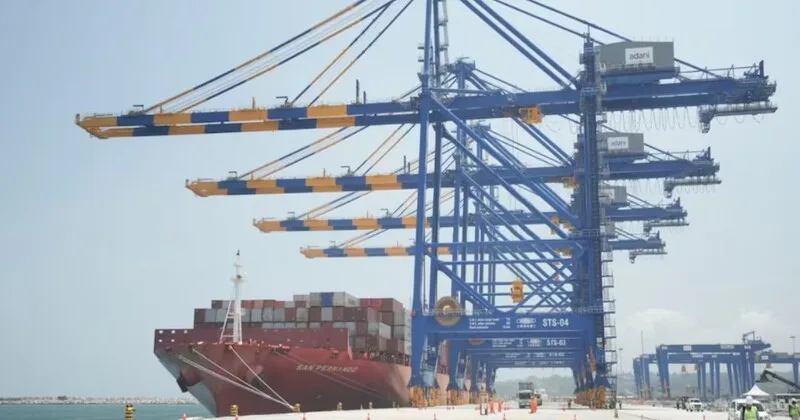
Situated at India’s southern tip, Vizhinjam deep-sea port holds strategic significance due to its proximity to major international shipping routes. It aims to position India competitively against hubs like Dubai, Singapore, and Sri Lanka. Enthusiasm in the air is apparent as India looks to up its game in the arena of international maritime trade. With Vizhinjam port, India will be able to attract ultra-large container and cargo vessels for the first time, boosting container and cargo traffic.
A transshipment port is a kind of transit hub where cargo from one ship is transferred to another ship on the way to its final destination. Mostly transhipment happens to transfer smaller cargos on to bigger mother ships which saves shipment cost and time. Since all the ports in the world are not directly linked, transshipment ports are needed. There are several other reasons why transshipment is done.
Often the port of origin or destination is not big enough for large vessels that ply directly between two destinations. In such a case, either cargo is sent in smaller vessels to a transshipment port to be loaded on bigger vessels or unloaded at a transshipment port onto smaller vessels which would head to the port with less depth which can’t harbour large vessels. This is India’s foremost reason to have a transshipment port.
Experts feel that the country’s first semi-automated deepsea harbour equipped with state-of-the-art equipment and advanced automation and IT systems will serve as a gateway for trade between Southeast Asia, West Asia and Africa and translate into reduced logistics costs while boosting India’s share in international trade.
The port is strategically positioned to facilitate connections with major international shipping routes between the Swiss canal and the Strait of Malacca, providing a direct link to Europe, the Persian Gulf, and the Far East.
The port’s construction, which commenced in 2016, is a public-private partnership project with a total investment of Rs 8,867 crore. The total investment for the Vizhinjam port is Rs 8,867 crore. Out of this, the state government and the Central government have allocated Rs 5,595 crore and Rs 818 crore respectively. It is expected to be fully commissioned in September or October 2024.
By 2028-29, when all four phases of this project are completed, the Kerala government and Adani Vizhinjam Port will have invested a total of Rs 20,000 crore in this outstanding example of a large-scale PPP project. Adani Ports and Special Economic Zone Ltd. plans to ramp up its investment to $1.2 billion to boost the port.
Currently, 25 percent of India’s container traffic is transshipped en route to the destination. Until now, despite India’s rising trade with the world, the country did not have a dedicated transshipment port, resulting in three-fourths or 75 percent of India’s transshipped cargo being handled by ports outside India.
The proximity to the international shipping routes that account for 30% of global cargo traffic and boasts natural depths ranging from 20 to 24 meters, with a rare rocky ocean bottom, eliminating the need for dredging to achieve such depths.
Until now, the biggest container ships have been skipping India because its harbors weren’t deep enough to handle such vessels and docking at neighboring ports. Poor shipping connectivity had hindered India’s integration into the global value chain.
The Modi government is working on a Maritime India Vision 2030 that seeks to develop world-class mega ports, transshipment hubs and modernize infrastructure at an estimated investment of Rs 1.25 lakh crore. The port will also be a boost to India’s ambitions to become an alternative manufacturing destination to China.
The port will certainly provide India the much needed geo-strategical edge and will allow India to grab a bigger slice of the international maritime trade currently dominated by China. This port is the attempt to counterbalance encirclement policy and String of Pearls theory through the port facilities in India’s neighborhood, especially the Hambantota and Colombo port. Vizhinjam port perfectly aligns with the central government advancing port infrastructure upgrades through programs such as SAGAR (Security and Growth for all in the Region) and Sagarmala.
The multifaceted Vizhinjam port benefits significantly from being located only at a distance of 10 Nautical Miles from East-West shipping axis and international sea route which is the busiest seaport on the west coast of India. Because it was designed primarily as a transshipment port, it stands to benefit from increased maritime traffic. Because of its deep natural draught, the port would also help operationally. Most importantly, it has the potential to put India on the global maritime map by stimulating hinterland gateway traffic and creating new supply-chain networks.
In the long run, it wouldn’t be a surprise if this port becomes an inalienable part of the evolving multimodal International North-South Transport Corridor (INSTC) which serves a gateway to several important strategic geographies connecting the Indian Ocean and the Persian Gulf to the Caspian Sea via Iran, then is connected to St. Petersburg and North Europe via the Russian Federation.
From an economic strategic convergence perspective, the Vizhinjam project would shed light on the country’s maritime policy’s new vigour and fundamental transformation. Apart from addressing domestic maritime sector concerns, the efforts associated with the Vizhinjam port may enable India to chart a maritime course by crafting a strong economic discourse. Thus, the port will prove to be of great benefit to India.
The Vizhinjam port is just the beginning. India seeks to one of the leading maritime nations in the world. India aspires to develop this kind of port in Maharashtra and Andaman & Nicobar Islands as well— both at the East and West coast of India to have global access.













Comments