





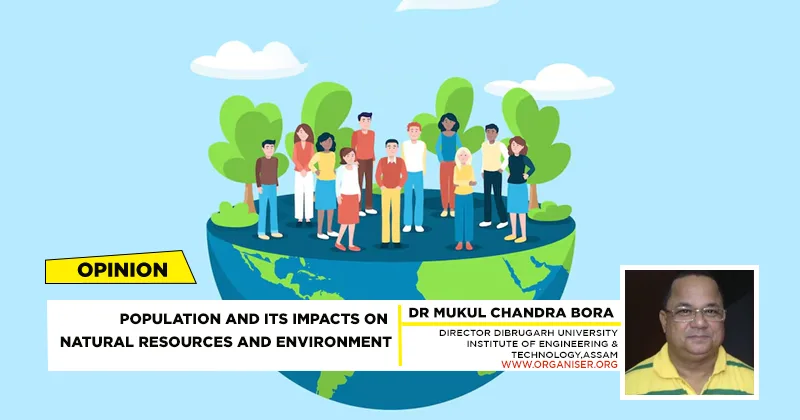
Population is a vague term which is only used for the Human being and is not found to be true as per my understanding on the issue. So far my knowledge goes this should include all the creatures which are found in this beautiful world. This includes river, ocean, lake, tree, grass and all the animals of the animal kingdom. The selfishness of the population scientist has bring us to this level of uncertainty and in turn will finish the entire human population due to scarcity of natural resources. When no a single inch of land has been created by the human then how we can claim that the whole world is belongs to us and that is the point when we will have to face severe consequences. The land spaces of the world is going to reduce further if the earth temperature increases by another 3.5 °C in coming days and will happen due to melting of Glaciers and we have forgotten this due to one sided development and materialistic psychology of the people of the world. There are enormous evidence of research which were published from 80’s and showing the results of uncontrolled population growth in developing countries in the name of uneducated and poor population. But it is equally true that when there are large number of ways available why these developing counties like India has not taken strict measures to mitigate the population growth. In an average the land space available per head of population is about 1995 sq.m which is equal to 4.1 Katha. So where the resources for this huge population of India and what will be done by 4.1 Katha of land by our human being. Is in not a relevant question to be asked to the Government? Are they really want that human being should live with dignity? This is of urgent need to diffuse this population bomb to make us survive.
According to a report published by International Union for Conservation of Nature and Natural Resources IUCN in the year 1984, the World Conservation Strategy provides a guide to sustainable development through the careful use of natural resources but does not explore the complex interrelationships between populations, natural resources, and social and economic conditions. This discussion attempts to make good that omission and, suggesting appropriate action, focuses on the following: population trends and the resource challenges of biological diversity, cropland, and food, water, and energy resources. Among the poorest groups even the basic needs for food, water, fuel, and shelter are far from adequately met at this time. Often, rapid growth or mal distribution of population undercuts efforts to meet elementary needs, but a high quality of life entails much more than the simple provision of physical necessities. The links between human numbers and natural resources must be analysed in terms of overall social goals. Population and conservation policies must be part of broader efforts to evolve ecologically sustainable patterns of development in countries at all economic levels.
The current global rate of population growth of some 1.7 per cent masks great differences among regions. Populations have nearly stabilized in the more developed countries but are growing at 3 per cent in Africa. In most countries, no serious effort has been made to introduce measures for the joint management of population and resources. Almost entirely through loss of habitat, which in turn reflects the upsurge in human numbers and consumption, species are becoming extinct at a rate of hundreds and possibly thousands each year. This represents an irreversible loss of unique genetic materials. Throughout the world the quality of arable land is being impaired by a combination of urbanization, desertification, erosion, and salinization, and in most countries the rate of soil loss from croplands is far in excess of the rate of soil formation. According to a recent Food and Agriculture Organization study, 65 countries will be unable to feed their projected population from their own lands by the end of the century if farming methods remain at their present low levels. Demand for water is growing several times faster than population. In addition to problems of supply, the reliability of water flow is being disrupted in many areas as watersheds are deforested. A serious consequence of rising prices and scarcity of fossil fuels will be increases in the costs of food production.
Similarly a report entitled Land and people, the growing pressure (1983) by Harrison states that the land resources and population supporting capacity in 117 countries, conducted by the Food and Agriculture Organization (FAO) reveal that at subsistence levels of farming, the entire cultivable lands of the developing world–3 or 4 times the present cultivated area–would barely be able to support the expected population for the year 2000. 65 countries would be unable to feed their population from their own lands at the end of the century. The study methodology was very complex. The findings of this study present an unanswerable challenge to those who hold that there are no limits to food production except those deriving from social and economic structures and there is no such thing as overpopulation.
On a global scale, the results look misleadingly reassuring. Even at low farming levels, the lands of the developing countries studied could support 1-1/2 times their expected populations for the year 2000. The closer the results come to national and local levels, the more alarming they become. The regional picture is cause for concern in Africa, which with low inputs could support only 1-1/2 times its year 2000 populations; in Central America and the Caribbean, which could support 1.4 times the expected numbers; and in Asia 1.1 times. Only Southwest Asia (the Middle East) would be unable to feed its population at the end of the century, even with intermediate inputs, but with high inputs could just about manage. In the other regions, raising the level of inputs allows much higher population supporting capacities. What the maps show is reviewed in detail for Africa, Asia, Latin America, and Southwest Asia.
The research report on Global warming, population growth, and natural resources for food production (1991) by D Pimentel and published in a Journal of National Institute of Health of US states that Destruction of forests and the considerable burning of fossil fuels is directly causing the level of carbon dioxide and other greenhouse gases including methane, carbon monoxide, and nitrous oxide in the atmosphere to rise. Population growth in the US and the world indirectly contributes to this global warming. This has led the majority of scientists interested in weather and climate to predict that the planet’s temperature will increase from 1.5 to 4.5 degrees Celsius by 2050. These forecasted climactic changes will most likely strongly affect crop production. Specifically these scientists expect the potential changes in temperature, moisture, carbon dioxide, and pests to decrease food production in North America. The degree of changes hinges on each crop and its environmental needs. If farmers begin using improved agricultural technology, the fall in crop yields can be somewhat counterbalanced. Even without global warming, however, agriculture in North America must embrace sensible ecological resource management practices such as conserving soil, water, energy, and biological resources. These sustainable agricultural practices would serve agriculture, farmers, the environment, and society.
Agriculturalists, farmers, and society are already interested in sustainable agriculture. Still scientists must conduct more research on the multiple effects of potential global climate change on many different crops under various environmental conditions and on new technologies that farmers might use in agricultural production. We must cut down our consumption of fossil fuel, reduce deforestation, erase poverty, and protect our soil, water, and biological resources. The most important action we need to take, however, is to check population growth.
Research studies on Population and climate change (2010) by Joel E Cohen studied the four broad dimensions of complex human problem which includes its impact on climate change and human population, economics, culture, and environment and concluded that all these dimensions are strongly interact with each other and in all directions with many time-scales. It was observed that the human population is likely to grow exponentially from 2010 to 2050 and more slowly the older and more urban.
It is projected that by 2050 more than 2.6 billion people (almost 94% of global urban growth) will be added to the urban population in today’s developing countries. That works out to 1.26 million additional urban people in today’s developing countries every week from 2010 to 2050. The human population is the only creatures which has tremendously emitting the greenhouse gases which in turn leads to the situation of climate change and altering the atmospheric components. It is worth mentioning that the humans’ emissions of carbon into the atmosphere increased by 15 (fifteen) times in between the year 1900 and 2000, while the numbers of people increased less than fourfold. Population growth alone, with constant rates of emissions per person, could not account for the increase in the carbon emissions to the atmosphere. The world economy grew 16 (sixteen) fold in the twentieth century, accompanied by enormous increases in the burning of gas, oil, and coal. In the last quarter of the twentieth century, population grew much faster in developing countries than in high-income countries, and, compared with population growth, the growth of carbon emissions to the atmosphere was even faster in developing countries than in high-income countries. The ratio of emissions-to-population growth rates was 2.8 in developing countries compared with 1.6 in high-income countries. Emissions of CO2 and other greenhouse gases are influenced by the sizes and density of settlements, the sizes of households, and the ages of householders. Between 2010 and 2050, these demographic factors are anticipated to change substantially and demography will play a substantial role in the dynamics of climate changes.
Population growth, population ageing and decline, as well as migration and urbanization, affect virtually all development objectives that are on top of national and global development agendas. They affect consumption, production, employment, income distribution, poverty and social protections, including pensions; they also complicate our efforts to ensure universal access to health, education, housing, sanitation, water, food and energy. Population growth, in particular, places increasing pressures on the planet’s resources — water, forests, land and the earth’s atmosphere — contributing to climate change and challenging environmental sustainability. However, population dynamics do not only affect critical development objectives; they are themselves affected by social, economic and environmental changes. Population dynamics do not only pose challenges, they also provide important opportunities for more sustainable development. A fall in fertility levels and slower population growth, for example, leads to an increased concentration of the population in the working age range, which can enable countries to reap a demographic bonus and jumpstart economic development.
A human rights approach is also crucial in migration policies, which should be designed in full respect for, and protection of, the human rights of migrants and migrant workers. Such policies can generate large economic and social gains from migration, while ensuring decent living and working conditions for migrants. A rights-based approach is essential, as well, in choosing policies for addressing urbanization and sustainable settlement patterns.
According to latest studies by United Nations the 17 Sustainable Development Goals aim to achieve decent lives for all on a healthy planet by 2030 and most of them are likely to missed only due to population explosion which is recently seen in the NITI Aayog report for the states of India in which Assam is miserably failed to achieve the required parameters. So this is the high time to control the population in our country to save the human being from the catastrophic disaster which are going to happen if the Government hesitate to take hard decision to mitigate the population explosion. These measures may include administrative, Social and use of modern medical science. So on the eve of International Population Day, I request the all the people of my state and country to come forward to save the humanity from the population bomb. The population explosion in the name of uneducated people and poverty has got no relevance in modern society to save the human from this crisis of natural resources and Environment which are the major concerns for any developing nations like India.















Comments