





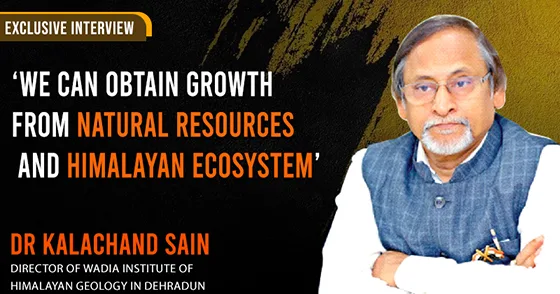
To meet the aspirations of the people living in the hills of Bharat and foster socio-economic growth, it is important to explore potential of the Himalayas for development. However, climate change has made the Himalayan States vulnerable to diverse kinds of disasters. Fortunately, Wadia Institute of Himalayan Geology in Dehradun is using remote sensing techniques to generate data on extreme geological phenomena like earthquakes. Dr Kalachand Sain, Director of Wadia Institute of Himalayan Geology in Dehradun, emphasises the importance of understanding the Himalayan region’s geological composition for sustainable economic growth in an exclusive interview with freelance journalist Ratnajyoti Dutta. Excerpts:
How is the remote sensing technique utilised for earthquake forecasts?
In the inaccessible terrain of the Himalayan region, modern techniques such as remote sensing, satellite imagery and drones are extensively used to generate data as part of precursor studies related to the identified earthquake prone areas caused by any movement of Earth’s plate. The data generated through these techniques are processed on a real-time basis through application of AI tools for studies related to earthquake forecast. These techniques help analyse subsurface data and also to study homogeneity of rocks in the run up to predict intensity of anticipated earthquake. With the help of remote sensing and other advance techniques any abnormal anomalies in the subsurface area can be noticed as part of a precursor study for earthquake prediction. Remote sensing, satellite imagery and drone techniques aim at studying spatial and temporal parameters in a precursor study. All these techniques can predict an earthquake prone area /region but when and what intensity the natural disaster would strike remain elusive. Precision in forecast on the possible intensity of an expected earthquake would help save collateral damages of life and property.
How does Artificial Intelligence (AI) help in earthquake forecasting?
AI tools have been increasingly used in recent years to analyse spatial-temporal data for earthquake forecasting. These tools use machine learning algorithms to identify patterns and correlations in seismic data that can help scientists predict the likelihood of an earthquake occurring in a particular area. By analysing seismic activity over time, these tools can also help to identify areas where there is a higher risk of earthquakes. This information can be used to develop early warning systems that can alert people in affected areas before an earthquake strikes, giving them time to take protective measures. Overall, the use of AI tools in earthquake forecasting has the potential to significantly improve our ability to predict and prepare for seismic events.
Why is the subject of Himalayan geology important for the scientific community?
It’s fascinating to explore the potential of the Himalayas for development. There are numerous opportunities for construction of roads, bridges, tunnels, and ropeways, as well as building hydro-power projects, geothermal or hybrid energy plants, and expanding micro-scale industries based on Himalayan resources. These initiatives can help meet the aspirations of people living in the Himalayas and foster socio-economic growth. Climate change has made the Himalayan States particularly vulnerable to diverse kinds of disasters, which makes it crucial to educate people on preparedness, protection, and disaster risk reduction. It’s vital to include geology in the school/college curriculum to nurture the young minds and provide solutions to societal issues and alleviate local challenges. Lithology, geomorphology, structures, tectonics, slopes & gradients, vegetation or forest cover, rock strengths, etc. play a crucial role in the mountain-specific town planning, design of building codes, construction works, and their impact on the surroundings and downstream.
How is the Wadia Institute trying to mitigate disaster management issues in the Himalayan region?
It is important to comprehend the root causes of disasters or geo-hazards in the Himalayas, such as earthquakes, landslides, glacial/snow avalanches, flash floods, debris flow, and river incision. The Wadia Institute has state-of-the-art facilities for data acquisition, analysis, processing, and interpretation, as well as field instruments to study the subsurface and surface processes in the Himalayas. The institute has prepared vulnerability, susceptibility, or risk maps based on remote sensing and ground observations to identify the most vulnerable zones or hotspots of different types of envisaged disasters. The institute has also deployed specific sensors for monitoring earthquakes, glaciers and glacier-lakes, and landslides, and is developing AI-enabled Early Warning Systems (EWS). To build a disaster-resilient and climate-adaptable future, the institute is continuing its efforts through Outreach Programmes to sensitise local people about their responsibilities and disseminate scientific knowledge to city planners, administrators, investors, politicians, intellectuals, environmentalists, etc. through seminars, media and popular lectures.
How to avoid a Silkyara tunnel-like incident in the Himalayan region?
Constructing tunnels in the Himalayan terrain is crucial for the development of infrastructure, transportation and utility services such as water supply, mining and electricity. To ensure safety and durability, it is important to carefully plan and execute the construction process while avoiding hazards such as soil instability, rock collapse, and poisonous gas. Geoscientific investigation before, during, and after the project is essential to gather relevant information and determine site selection, shape, size, alignment, and construction method based on various geoscientific parameters.
Any focus area of the Wadia Institute that the public at large needs to know.
The Himalayan region has faced various forces, including surface and subsurface processes, climate-driven extreme events and anthropogenic activities, making many parts of the region fragile. To address this, it is important to identify the most vulnerable areas and take appropriate measures. This can be done by using remote sensing and ground-based data sets to prepare land-use maps for green corridors, looking into multiple factors, monitoring specific geo-hazards using state-of-the-art web-based sensors, developing AI-enabled Early Warning Systems, and sensitising locals about their responsibilities. Other steps include disseminating scientific knowledge and information to decision-makers, implementing mountain-specific town planning and building codes, utilising green resources and maintaining a balance between resource exploitation and preservation of the Himalayan ecology. It is crucial to take a collaborative approach involving city planners, administrators, investors, politicians, intellectuals, and environmentalists in this effort.










Comments