





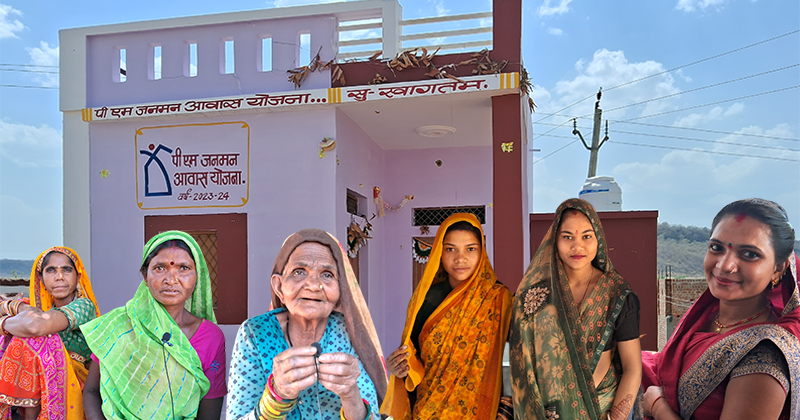
On November 15, 2023, Prime Minister Narendra Modi introduced the Pradhan Mantri Janjati Adivasi Nyaya Maha Abhiyan (PM-JANMAN) scheme, targeting the ‘particularly vulnerable tribal group’ (PVTGs) scattered across Bharat. Geared towards furnishing essential amenities such as housing, water, and roads to the vanvasi communities, the scheme has demonstrated remarkable progress in a mere five-month period.
PM-JANMAN comprises eleven distinctive initiatives spanning nine ministries, backed by a budget of Rs 24,000 crores to be allocated over three years. These initiatives are designed to ensure secure housing, clean water, sanitation, and improved access to education, healthcare, nutrition, and sustainable livelihood opportunities. Historically overlooked, the PVTG tribes are poised for greater inclusion through this scheme.
Among the 75 tribes listed under the PVTG category, Madhya Pradesh hosts seven, including Abujh Maria, Baiga, Bharia, Birhor, Hill Korba, Kamar, and Sahariya.
Mamata Adivasi, belonging to the Sahariya Janjati community, has become the second individual nationwide and the first in MP to receive a pucca house, toilet, gas connection, and water supply under the scheme. Hailing from Kalothra panchayat in Shivpuri district, Mamata’s story underscores the tangible impact of PM-JANMAN.
During a visit to the Shivpuri district, situated in the north-western part of the state and home to numerous tribes and PVTGs, this correspondent engaged with beneficiaries residing in four remote villages. Witnessing the transformation firsthand, it was indeed evident that PM-JANMAN is bringing real change on the ground.

The following report comprises details from the visit conducted on April 24, 2024.
3357 families slated to benefit under PM-JANMAN
The journey commenced from Gwalior district in Madhya Pradesh, spanning approximately 115 kilometres to reach Shivpuri. This distant city, adorned with lush green forest canopies, greeted Organiser with posters featuring Union Minister Jyotiraditya Scindia. Notably, Scindia contested the Lok Sabha elections from Guna, another 100 kilometres from Shivpuri, which voted on May 7. The constituency covers Guna, Ashok Nagar, and Shivpuri districts.
The correspondent’s cab driver, Sanjay Kumar, remarked that the region from Gwalior to Guna is Scindia’s stronghold, expressing confidence in his victory. The Congress has fielded Rao Yadvendra Singh Yadav to garner Yadav votes against him.

Upon meeting District Coordinator Rajendra Kumar Jatav in Shivpuri, the journey to meet PM-JANMAN beneficiaries commenced. Beneficiaries of this scheme were dispersed throughout the district, with an official account mentioning 33567 families slated to benefit over three years. Additionally, 26,368 houses have been registered on the AWAS Portal, linked with Aadhar-linked bank accounts for direct fund transfers.
A breakdown of the disbursement in PM-JANMAN includes the first instalment of Rs. 50,000 distributed to 14,140 beneficiaries, earmarked for completing construction till the plinth. The second installment of Rs. 75,000 was disbursed to 10332 beneficiaries who utilised the first installment and geo-tagged their houses on the AWAS Portal, with construction expected to progress till the lintel (roof). Finally, the third installment of Rs. 75,000 was provided to 4810 beneficiaries to complete the construction. An additional sum of Rs. 39,000 was allocated for toilet construction and MGNREGA wages.
Organiser visited Hatod (10 kilometres from Shivpuri), Kota (18 kilometres from Hatod), Sakalpur (22 kilometres from Shivpuri), and Kalothra (35 kilometres from Sakalpur) panchayats, engaging with numerous beneficiaries. These panchayats predominantly host Sahariyas, who live in small hamlets of approximately fifty to hundred houses each. Remarkably, these hamlets have undergone significant transformations through the implementation of the PM-JANMAN scheme.
“I never even dreamt of having a kutcha house with a toilet, let alone a pucca one”
The first stop, Hatod Panchayat, is constructing houses under PM-JANMAN resembling colonies. This initiative stemmed from the requests of Lalita and Vidya Adivasi, who engaged with the PM after the completion of their houses in Kalothra and Hatod Panchayats, respectively. Their vision was to replicate the style of houses found in big cities, featuring a central compound with a community space and play area.
Military Singh Adivasi, the panchayat secretary of Hatod Panchayat, guided Organiser to a government-built colony for Sahariya’s, facilitated by the PM-JANMAN scheme. During the visit, 16 houses were completed, with plaster and painting work pending. The compound also included a central area designated for community activities. This project utilises government land to accommodate PVTGs without land ownership.
It’s worth noting that a similar colony has been built in the village under the Chief Minister Awas Scheme. However, under this scheme, both land and installments are shared between the beneficiary and the state government, unlike PM-JANMAN, which is solely funded by the central government. By April 2024, 117 houses had been constructed in the village under the PM-JANMAN scheme.
The village’s access road was constructed under the Pradhan Mantri Gram Sadak Yojna, while the already built houses were facilitated by the CM Awas Yojna. Additionally, every house has a gas connection through the Ujjawala Yojna and a tap water connection under the Jal Jeevan Mission.
Maniram and Mathura Bai Sahariya proudly showcased their under-construction house to the correspondent, radiating happiness. Maniram expressed gratitude, stating, “This government is the only one to consider people like us, who have lived on the city outskirts without any certainty all our lives. Now, I have a house and a toilet. I never even dreamt of having a kutcha house with a toilet, let alone a pucca one. I am thankful to Modi ji.”


The houses constructed under PM-JANMAN follow a typical one BHK layout, comprising a room, attached toilet, kitchen, porch, and open area. While the structure remains uniform, beneficiaries have the flexibility to alter the design and positioning of gates and windows.
The village boasts approximately 1400 voters, with over 65 per cent belonging to the Sahariya tribe, alongside other tribes such as Bhil and Baiga.
About five kilometres away from the settlement constructed under PM-JANMAN stood another hamlet boasting over 100 houses, all inhabited by Sahariya tribes. Geeta Adivasi, speaking with Organiser, expressed profound gratitude for the transformative impact of the government’s initiatives on her life. “My fortunes have changed under this government,” she shared.
“Now, two of my sons have a pucca houses, I receive Rs. 1500 from the state government, we have gas connections, benefit from kisan samman nidhi, receive rations, have an Ayushman card, water connection, and much more. None of this was even a part of our dreams. I hope Modi remains as PM for the next fifty years,” she added.
Meanwhile, the village had several houses yet to be completed. Villagers mentioned that they had received two installments and were awaiting the final installment.
Reflecting on their ancestry, Janki Bai Sahariya traced the origins of their tribe back to the Ramayana period, claiming lineage to Shabri. Another belief narrates a tale where Brahma, the creator, initially positioned a Sahariya at the centre of all beings but later displaced them to the outskirts due to external pressures. Legend has it that Brahma, displeased by the Sahariya’s inability to endure pressure, decreed their existence in forests and remote areas.
Despite various narratives, there exists no official account of their origin. The Saharia, also known as Sehariya, primarily constitute a tribe in the state of MP.
They reside in clusters of dwellings situated in areas known as saharana, located outside the main villages. Their homes, typically built from stone boulders and topped with locally termed patore, bear resemblance to ancient architectural standards. Mud structures are prevalent, while brick and concrete constructions are rare.
Proficient in forestry, Saharias excel in gathering forest products such as catechu from Khair trees. Their primary occupations involve collecting and selling forest produce and medicinal herbs, crafting baskets, engaging in mining and quarrying, and, to a lesser extent, settled cultivation. This cultivation typically focuses on crops like wheat, pearl millet, and maize, relying primarily on rainfall due to limited irrigation resources. Once bonded labourers, some now work as landless labourers in various capacities.
Janki’s ancestors used to inhabit forests, relying on them for sustenance. However, access to the forest has been restricted by the forest department. Consequently, they have transitioned to farming and labour work, expressing contentment with their current lifestyle. “We have everything we need here; we can lead a simple life now. There’s no need for us to venture into the forest and risk encountering wild animals,” Janki added.


“Hum sab ko kuti de di, ration de raha hai.. Modi hi to de raha hai sabkuch…usko hi vote denge”
Subsequently, the correspondent travelled to Kota Panchayat, housing over 3000 residents, with fifty per cent belonging to the Sahariya tribe. The remaining residents are Hindus from Gurjar and Rajput castes.
The Panchayat secretary, Pawan Bohare and the Sarpanch, Anusuiya Adivasi accompanied the correspondent to the village, where the first sight was of a couple carrying construction materials on their heads. Bohare explained that they were building their own house and were beneficiaries under the PM-JANMAN scheme.
It’s worth noting that the scheme also encompasses MGNREGA, allowing registered beneficiaries to work on their houses and receive their daily wage as per MGNREGA regulations. Bohare mentioned that the current wage stands at Rs. 243 per day. He showcased several houses that had been constructed or were under construction in the village, revealing that 45 out of 94 houses listed under the scheme had been built.
An elderly woman, Shanti Adivasi, who was busy tending to her grandchild, shared her joy at witnessing her children and grandchildren preparing to move into a pucca house. Since their house had only been constructed up to the door level, they were currently residing in a temporary shanty.
Aware of the upcoming Lok Sabha elections, she declared, “I will vote for Modi.” When asked about her knowledge of him and the works she appreciated, she replied, “Accho..Accho, hume kuti de di.. hum sab ko de di, Ration de raha hai.. Modi hi to de raha hai sabkuch..,usko hi vote denge (Good… Good, he has given us a pucca house, ration not just to us but to everyone. He is so generous; I will vote for him).”


‘Building a house may be a small step, but it means the world to us’
The correspondent proceeded to Sakalpur Panchayat in Shivpuri district, home to approximately 400 families, totalling around 1800 residents, with 269 families belonging to the Sahariya tribe.
Gopal Chouhan, the Panchayat secretary, informed Organiser that during the initial phase of PM-JANMAN implementation, they aimed to complete 165 houses. Out of these, 152 have been finished, with their terrace construction completed.
The first house visited belonged to Prakash and Meena Bai Sahariya, painted in a vibrant yellow hue with distinct markings for the kitchen and toilet. Adjacent to this house stood a kuccha structure where the family previously resided. Both Prakash and Meena expressed gratitude to the government for providing them with such a beautiful home.
Prakash, a field labourer, had just returned home from work when he met the correspondent. He mentioned that previously, he used to collect medicinal plants from the forest, as it was a family tradition, but now he works as a labourer.
Travelling deeper into the village, the correspondent observed children playing with water from a hand pump installed by the gram panchayat, as informed by Chouhan.
The next stop was with another hamlet housing over 100 families. Beyond the settlement, bare ground emitted heat waves, while children played with sand piled outside an under-construction house. A woman introduced herself as Poonam Adivasi came out of the house, Chouhan introduced her as the Sarpanch of the village.
Poonam kept her face covered, only after Chouhan had departed did she finally remove her ghunghat. “I am a graduate from Gwalior and got married just last year ago. My husband lives elsewhere; he is a teacher. It feels isolating to live here, but this is our reality. Our ancestors have endured similar circumstances. Thanks to this government, which is finally considering people like us and our neglected tribe. It’s a small step, but it means the world to us,” expressed Poonam.
While Poonam’s house was still under construction, many others in the village had already been completed, adorned with beautiful red and yellow paint. For instance, the houses of two brothers, Khunman and Shashi Adivasi, stood side by side.
In a settlement like this, temporary shanties made of stone and straw were once common, but now, as Organiser observed, they had been replaced by sizable homes—some still under construction, some freshly painted in vibrant hues.
Chouhan informed the correspondent that the village boasted a total of 1030 voters, with 693 belonging to the Sahariya tribe. Every individual the correspondent encountered in the village expressed their intention to vote for Modi. They said they have seen hin in mobile phones and videos.


“We were neglected for so long, used only for votes by politicians who disappeared after elections. Now, it’s different”
The correspondent proceeded to the Kalothara panchayat, where the first house in the state was constructed under the PM-JANMAN scheme. Guided by a local villager named Ram Kumar Adivasi, they followed a semi-broken concrete road leading to the basti of Sahariya’s. The Sarpanch of the village, Ramshri Adivasi, also hailed from the Sahariya tribe.
Upon inquiring about Mamta Adivasi, Ram Kumar led the correspondent to her beautifully painted house in bright lavender colour, adorned with grills bearing quote, “PM-JANMAN Awas Yojna”. Mamta, busy in the field, was called by Ram Kumar, who mentioned that there had been many visitors like the correspondent before.
Meanwhile, Ram Kumar showed another house adjacent to Mamta’s, where a woman named Kunti emerged. This house had tile flooring, a gas stove inside, stairs leading to the terrace, and a toilet adjacent with all necessary fittings.
These were model houses constructed within a month of the scheme’s implementation, indicating that all under-construction houses would resemble them.
By then, Mamta had arrived, arranging a chair on the porch amidst remnants of decorative items on the walls. As she poured water for the correspondent, she expressed the indescribable feeling of owning such a house. Mamta shared, “My parental family lives here too, in a kuccha house while their house is being built. Sometimes, I pinch myself, wondering if this newfound reality is a dream. But as I stand here, I realise it’s my home and I cherish every single day..”
She continued, “It’s not just me; it’s our children, our future. We’ve been overlooked for far too long, tossed aside after elections like discarded pawns. But now, there’s a glimmer of hope. Our children dare to dream, and I trust that this government will be the beacon guiding them towards those aspirations.”
Similar sentiments echoed among many other households, where houses had either been constructed or were in progress. The residents didn’t just express gratitude but bestowed blessings upon PM Modi and the BJP government. The depth of loyalty to the party among those whose voices often go unheard seemed almost surreal.
During the village visit and interactions with locals, this correspondent stumbled upon a distinctive temple. Ram Kumar explained that the religious customs of the Sahariya community blend elements of Animism and Folk Hinduism, with reverence for various deities like Veer Teja, Thakar Baba, Maa Durga, Hanuman Ji, among others, celebrated during festivals such as Janmashtami, Raksha Bandhan, and Holi. In addition to nature gods like Budha and Bada deo, they hold a special devotion to Bhagwan Ram.
As previously mentioned, the Sahariya’s proudly trace their lineage back to Shabri, and the names of the individuals the Organiser encountered only reinforced this belief; nearly all bore names linked to Ram or the Ramayana in some form.
Furthermore, he explained that endogamy prevails within the community, with marriages typically arranged among different clans. During marriage ceremonies, totems are drawn as symbols of reverence. While the community discourages child marriages, arranged unions are customary after the age of 15. Widow remarriage is permitted but confined to fellow widowers or divorcees within the community.
Ram Kumar elaborated that the village housed approximately 300 families, with over 120 currently having their homes either under construction or completed through the scheme.


Why will PM-JANMAN be remembered by generations to come?
The visit made by Organiser stirred emotions that echoed through the ages. Witnessing firsthand the transformative impact of providing homes to the long-neglected, living in temporary shanties on the city outskirts, was nothing short of awe-inspiring.
At this moment, it became apparent that Modi’s efforts would be etched in the collective memory for generations to come. It wasn’t merely about constructing homes; it was about restoring dignity and hope to those who had long been overlooked.
Each encounter with a beneficiary unveiled a shared sentiment, a profound disbelief mingled with overwhelming gratitude. To them, owning such a home was beyond the realm of possibility, a dream they dared not to entertain. Yet, here they stood, amidst walls that promised security and roofs that harbored dreams.
The legacy being forged in these humble abodes transcended bricks and mortar; it was a testament to the power of compassion and determination.

















Comments