
Industry 4.0 is a term that refers to the fourth industrial revolution that involves the integration of digital technologies such as IoT, cloud computing, artificial intelligence, blockchain and more into the manufacturing and supply chain processes.
Industry 4.0 aims to improve the efficiency, quality, safety and sustainability of the production and distribution of goods and services. Industry 4.0 has been transforming the food and beverage sector by enabling faster delivery time, lower delivery costs, higher customer satisfaction, and greater market reach and in many other ways such as:
- It can improve productivity and efficiency by using sensors, simulations and analytics to monitor and control the production parameters and environmental conditions.
- It can enhance food safety surveillance, traceability and product recall by using smart machines that can communicate with each other and track the origin and movement of raw materials and finished products along the value chain.
- It can increase customer satisfaction, personalisation and innovation by using cloud systems, blockchain and artificial intelligence to collect and analyse customer feedback, preferences and trends and to create new products and services that meet their needs.
- It can reduce costs and increase profit margins by optimising resource utilisation, energy consumption and waste reduction.
- It can enable more potential for innovation and accelerated response to customer needs by using digital technologies to create a more dynamic, connected and intelligent ecosystem.
Industry 5.0 in the Food & Beverage Industry
Industry 5.0 is a new paradigm that aims to reinforce the role and contribution of humans in the industry. It is a human-centric approach that focuses on the well-being of employees and society as a whole. The food and beverage industry is slowly transitioning to Industry 4.0, and the progression into Industry 5.0 is already being conceptualised.
Industry 5.0 is a relatively new concept that provides a vision of industry that aims beyond efficiency and productivity as the sole goals, and reinforces the role and the contribution of industry to society. It places the wellbeing of the worker at the center of the production process and uses new technologies to provide prosperity beyond jobs and growth while respecting the production limits of the planet.
In the context of food and beverage, Industry 5.0 could mean using technologies such as automation, robotisation, big data analytics, smart systems, virtualisation, AI, machine learning and Internet of Things to improve the quality, safety, and sustainability of food production and consumption.
Industry 5.0 can transform the food and beverage sector by enabling more human-centric and sustainable production systems using new technologies to create more value for society and the environment, while also improving efficiency and quality. Here are some more examples of how this can be done:
- Using smart systems, sensors and simulations to monitor and control the temperature, pressure, pH, and other parameters of food processing operations, ensuring optimal product quality, safety and traceability throughout the supply chain.
- Using artificial intelligence–based autonomous systems to adjust the processing parameters in real time based on the feedback from sensors and simulations, reducing human errors and increasing productivity so as to create personalised and customised food products that meet consumer preferences and dietary needs.
- Implementing circular economy principles to reduce food waste, reuse resources, and regenerate natural systems.
- Using additive manufacturing or 3D printing to create customised food products with different shapes, textures, flavors, and nutritional profiles, catering to individual consumer preferences and needs.
- Using cloud systems and blockchain to store and share data on the origin, processing, transportation, and storage of food products, enhancing traceability and transparency throughout the supply chain.
- Using human-machine collaboration apps to train and assist workers in performing complex or hazardous tasks, improving their skills, creativity, and satisfaction.
- Using social responsibility and ethical standards to guide the selection of raw materials, suppliers, partners, and customers, ensuring that the food production process respects human rights, animal welfare, and environmental sustainability.
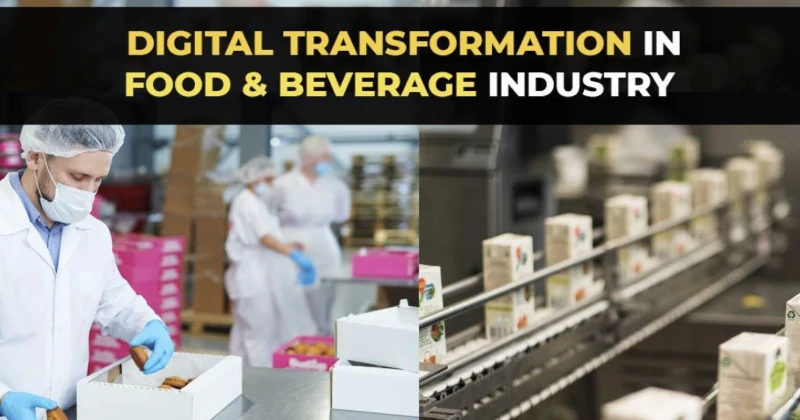
Digital Transformation in the Food & Beverage Industry
Digital transformation is a process of using digital technologies to transform business operations and customer experience. The food and beverage industry is no exception to this trend. Digital transformation can help the industry in several ways such as improving operational efficiency, enhancing customer experience, and increasing transparency.
Digital technology can automate processes, optimise supply chain management, and provide data insights for better decision-making. It can also increase digital brand awareness for food and beverages which helps businesses acquire new customers, retain old customers and stand out from their competition.
Digitalisation in the food industry has several benefits such as enhanced supply chain visibility and efficiency. Digital technologies such as sensors, blockchain, and RFID are being used to track food products, manage inventory, and reduce waste leading to a more efficient and sustainable supply chain.
In addition to this, digital technology can enhance food and beverage quality by controlling processes strictly.
The only way digital strategies disrupt a food and beverage manufacturing business is by bringing in a breath of fresh air in terms of thinking, allowing room for bold innovations, and breaking all the shackles of the old system. These strategies are all about visibility, communication and data-sharing.
Digital Transformation is transforming the food and beverage sector in many ways like:
Integration of digital technologies in various aspects of the food production, processing, distribution, and consumption: Digital technologies are being integrated into the food industry to improve efficiency and reduce costs. For example, sensors can be used to monitor the temperature and humidity of food products during transportation and storage.
Greater transparency in its supply chain: Digital transformation can help provide greater transparency in the food industry’s supply chain. For example, blockchain technology can be used to track food products from farm to table.
Improved efficiency and thereby reduced costs: Digital transformation can help improve efficiency in the food industry by automating processes and reducing waste. For example, automation can be used to sort and package food products
Enhanced customer experience: Digital transformation can help enhance the customer experience by providing personalised recommendations and improving the quality of food products.
Adopting collaborative cloud-based platforms: Cloud-based platforms can be used to share data and collaborate with other companies in the food industry.
Updating to industrial internet of things (IIoT) infrastructure: IIoT infrastructure can be used to monitor and control food production processes in real-time.
Implementing automation and robotics: Automation and robotics can be used to improve efficiency and reduce costs in the food industry. For example, robots can be used to pick and package food products.
Improving quality control: Digital transformation can help improve quality control in the food industry by providing real-time data on food production processes.
Reducing waste: Digital transformation can help reduce waste in the food industry by automating processes and improving inventory management.
Increasing efficiency: Digital transformation can help increase efficiency in the food industry by automating processes and improving supply chain management.
Enhancing safety: Digital transformation can help enhance safety in the food industry by providing real-time data on food production processes and improving traceability.