Book Review: New Bharat reconnects with old
December 6, 2025
  • Read Ecopy
  • Circulation
  • Advertise
  • Careers
  • About Us
  • Contact Us
Android AppiPhone AppArattai
Organiser
  • ‌
  • Bharat
    • Assam
    • Bihar
    • Chhattisgarh
    • Jharkhand
    • Maharashtra
    • View All States
  • World
    • Asia
    • Europe
    • North America
    • South America
    • Africa
    • Australia
  • Editorial
  • International
  • Opinion
  • RSS @ 100
  • More
    • Op Sindoor
    • Analysis
    • Sports
    • Defence
    • Politics
    • Business
    • Economy
    • Culture
    • Special Report
    • Sci & Tech
    • Entertainment
    • G20
    • Azadi Ka Amrit Mahotsav
    • Vocal4Local
    • Web Stories
    • Education
    • Employment
    • Books
    • Interviews
    • Travel
    • Law
    • Health
    • Obituary
  • Subscribe
    • Subscribe Print Edition
    • Subscribe Ecopy
    • Read Ecopy
  • ‌
  • Bharat
    • Assam
    • Bihar
    • Chhattisgarh
    • Jharkhand
    • Maharashtra
    • View All States
  • World
    • Asia
    • Europe
    • North America
    • South America
    • Africa
    • Australia
  • Editorial
  • International
  • Opinion
  • RSS @ 100
  • More
    • Op Sindoor
    • Analysis
    • Sports
    • Defence
    • Politics
    • Business
    • Economy
    • Culture
    • Special Report
    • Sci & Tech
    • Entertainment
    • G20
    • Azadi Ka Amrit Mahotsav
    • Vocal4Local
    • Web Stories
    • Education
    • Employment
    • Books
    • Interviews
    • Travel
    • Law
    • Health
    • Obituary
  • Subscribe
    • Subscribe Print Edition
    • Subscribe Ecopy
    • Read Ecopy
Organiser
  • Home
  • Bharat
  • World
  • Operation Sindoor
  • Editorial
  • Analysis
  • Opinion
  • Culture
  • Defence
  • International Edition
  • RSS @ 100
  • Magazine
  • Read Ecopy
Home Bharat

Book Review: New Bharat reconnects with old

How PM’s stress on assertive nationalism, cultural rootedness and a model for social justice is propelling Bharat to become Vishwa Guru has been explained in Dr Swadesh Singh’s seminal book

Swasti SharmaSwasti Sharma
Apr 2, 2024, 07:00 pm IST
in Bharat, Books
Follow on Google News
FacebookTwitterWhatsAppTelegramEmail
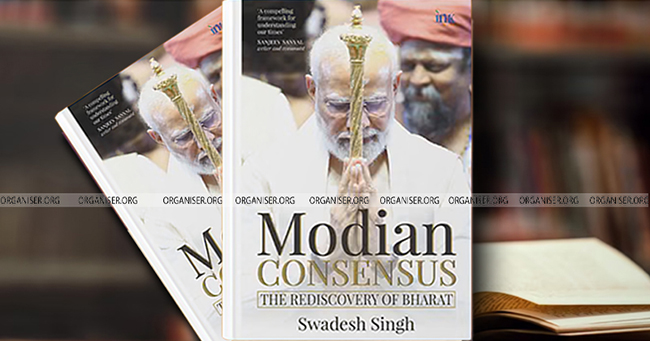
Title: Modian Consensus: The Rediscovery of Bharat , Author: Dr Swadesh Singh, Publisher: BluOne Ink ,
Pp 304 , Rs 599.00

In his formative work, Modian Consensus: The Rediscovery of Bharat, Dr Swadesh Singh identified four major concords: ‘Civilisational Consensus’, ‘Gandhian Consensus’, ‘Nehruvian Consensus’, and ‘Secular Consensus’. However, it is the fifth one, i.e. ‘Modian Consensus’, which has gained popularity owing to PM Modi’s contribution towards humanity and society. The book offers a nuanced approach and a compelling framework for navigating recent political developments. A book conceived during brainstorming sessions organised by two leading think tanks is now striving to change the paradigm of socio-political intellectual discourse in India.

The book is set against the backdrop of 150 years of civilisational awakening. It has been divided into three sections and ten chapters. The first section traces the origin of the term ‘consensus’ and its evolution in the Bharatiya context where diverse points of view converge despite ideological chasms. This churning results in policy-making, clearly demonstrating how consensus provides ample space for disagreement on core ideas while paving the way for society’s structural growth. Dr Singh raises and responds to a crucial question, “how does a consensus end?” in his introductory remarks. The answer lies in faithless mimicking of dominant ideas. While underscoring an important study, Dr Singh has argued that “the sphere of consensus becomes a mosaic of groups”, implying a corpus of ideas that effectively shape our polity and policies. A marked distinction between consensus and unanimity has been prudently established by the author. The reader discovers a meaningful dialogue and a thought-provoking deliberation around consensus-building prior to Indian Independence in the book. The 1870s was the decade distinguished by the reawakening of collective consciousness in Bharat, leading to the rejection of the Western hegemonic framework. This ‘Civilisational Consensus’, emanating from the will of the Rishis or Bhadram Ichanti Rishiyah formed the backbone of the Indian independence movement which was later led by Mahatma Gandhi. This section also examines several convergences and divergences between the ‘Gandhian Consensus’ and the ‘Civilisational Consensus’. The enduring struggle for freedom was characterised by the repudiation of the British sense of superiority and the espousing of indigenous value systems. By escalating the faultlines along the categories of class, race, and language, civilisational consensus was weakened by the British. The categories of ‘Civilisational Consensus’, ‘Gandhian Consensus’, ‘Nehruvian Consensus’ and ‘Modian Consensus’ have been probed closely by Dr Singh in this section. It was the consolidation of the BJP with PM Vajpayee Ji at the helm of affairs that provided a critical intervention. It began aligning the narrative toward a
cultural renaissance.

In the second section, the ideological vision of Prime Minister Modi has been amplified. The binary of confusion v consensus arising out of the previous regime’s instability, Gujarat Model of Governance, and Modi Sarkar 2.0’s accomplishments are the key highlights of this section that exhibit a remarkable shift under Modi’s development-oriented governance. Dr Singh has cited several initiatives undertaken by Modi Sarkar aimed at spreading the idea of cultural rootedness. For instance, the Left-liberal lobby’s attempt at imitating British propaganda of Aryan Invasion Theory has been systematically debunked by a new set of integrationist scholars under the Modian regime. In a nutshell, such endeavours illustrate the success of the Modian consensus. Besides logically responding to the “question of dissent” raised by PM Modi’s critics, Dr Singh has unequivocally praised the rise of assertive nationalism, which is a major hallmark of PM Modi’s leadership. This has not only cemented foreign relations but also strengthened national security. With the impetus on Antyodaya, an inspiration drawn from the stalwart political predecessors, PM Modi has produced an inclusive model of social justice and governance. Dr Singh has described in great detail how such welfare schemes cater to the needs of the marginalised community with the aim of Sabka Saath,Sabka Vikas.

With the impetus on Antyodaya, an inspiration drawn from the stalwart political predecessors, PM Modi has produced an inclusive model of social justice and governance

The third section is dedicated to a subtle understanding of the term “Modian Consensus”, a transformative turn in the Indian political trajectory. Dr Singh has delineated the idea of a ‘new’ India based on collective ethos and participation while simultaneously describing the roots of the Modian Consensus and how it took shape. Some of the challenges to the Modian Consensus have been discussed by the author. Concerted efforts to delegitimise PM Modi’s position and malicious propaganda are a couple of such insidious challenges. Dr Singh has quite interestingly drawn a comparison between the tenure of PM Nehru and PM Modi which the readers will find intriguing. What is the way ahead? The author replies to this question by positing that the ten years of Modi Sarkar have solidified a consensus “that revolves around the politics of Modi who has played a major role in shaping up opinions and building a gradual organic concord along these issues.” Dr Singh succinctly emphasises the need to draw a blueprint for the two landmark years-2030 and 2047. He has provided a list of amrit lakshya during this Amrit Kaal for prospective agenda. On an optimistic note, the author ends by acknowledging and admiring the renewed vigour of Vishwa Guru Bharat under PM Modi.

The book has both extensively and intensively assessed India’s political evolution, PM Modi’s vision, and the pillars of Modian Consensus- cultural rootedness, assertive nationalism, and inclusive welfare for all. The book is a must-read for inquisitive scholars interested in Indian polity, governance, and International Relations.
Topics: Vishwa Guru BharatBharat reconnectsModian ConsensusPrime Minister Modi
Share4TweetSendShareSend
✮ Subscribe Organiser YouTube Channel. ✮
✮ Join Organiser's WhatsApp channel for Nationalist views beyond the news. ✮
Previous News

Big boost to IAF: Overnight trial of emergency landing strip at Bijebehara succesfully done

Next News

“No big achievement comes without hard work”: EAM Jaishankar confident on India’s bid for permanent seat in UNSC

Related News

Representative Image

Why the crucial swadeshi movement in India needs inspiration from Australia

Red terror ground lost; Ideological battle continues

(Left) Russian President Vladimir Putin (Right) PM Narendra Modi

Russian President Vladimir Putin to visit India: Major geopolitical steering amidst Trump tariff row

This is the first conflict where most systems used were homegrown: Former Chairman of DRDO Dr G Satheesh Reddy

Swadeshi in defence sector for self-reliance: A matter of conviction

Prime Minister Narendra Modi chairing a meeting with External Affairs Minister Dr S Jaishankar, Defence Minister Rajnath Singh, NSA Ajit Doval, Chief of Defence Staff General Anil Chauhan, Chief of the Air Staff Air Chief Marshal A P Singh, Navy Chief Admiral Dinesh Kumar Tripathi, Chief of the Army Staff General Upendra Dwivedi and Foreign Secretary Vikram Misri, at his residence in New Delhi

11 Years of Modi Government: Redefining Bharat’s political discourse through nationalism

Load More

Comments

The comments posted here/below/in the given space are not on behalf of Organiser. The person posting the comment will be in sole ownership of its responsibility. According to the central government's IT rules, obscene or offensive statement made against a person, religion, community or nation is a punishable offense, and legal action would be taken against people who indulge in such activities.

Latest News

PM Modi presents Putin with Bhagavad Gita, chess set, and silver horse

Cultural ties strengthened: PM Modi presents Putin with Bhagavad Gita, chess set, and silver horse

Image for representational purpose only, Courtesy Vocal Media

Bihar to get ‘Special Economic Zones’ in Buxar and West Champaran

Thirupparankundram Karthigai Deepam utsav

Andhra Pradesh: AP Dy CM Pawan Kalyan reacts to Thirupparankundram row, flags concern over religious rights of Hindus

23rd India-Russia Annual Summit

India-Russia Summit heralds new chapter in time-tested ties: Inks MoUs in economic, defence, tourism & education

DGCA orders probe into IndiGo flight disruptions; Committee to report in 15 days

BJYM leader Shyamraj with Janaki

Kerala: Widow of BJP worker murdered in 1995 steps into electoral battle after three decades at Valancherry

Russian Sber bank has unveiled access to its retail investors to the Indian stock market by etching its mutual fund to Nifty50

Scripting economic bonhomie: Russian investors gain access to Indian stocks, Sber unveils Nifty50 pegged mutual funds

Petitioner S Vignesh Shishir speaking to the reporters about the Rahul Gandhi UK citizenship case outside the Raebareli court

Rahul Gandhi UK Citizenship Case: Congress supporters create ruckus in court; Foreign visit details shared with judge

(L) Kerala High Court (R) Bouncers in Trippoonithura temple

Kerala: HC slams CPM-controlled Kochi Devaswom Board for deploying bouncers for crowd management during festival

Fact Check: Rahul Gandhi false claim about govt blocking his meet with Russian President Putin exposed; MEA clears air

Load More
  • Privacy
  • Terms
  • Cookie Policy
  • Refund and Cancellation
  • Delivery and Shipping

© Bharat Prakashan (Delhi) Limited.
Tech-enabled by Ananthapuri Technologies

  • Home
  • Search Organiser
  • Bharat
    • Assam
    • Bihar
    • Chhattisgarh
    • Jharkhand
    • Maharashtra
    • View All States
  • World
    • Asia
    • Africa
    • North America
    • South America
    • Europe
    • Australia
  • Editorial
  • Operation Sindoor
  • Opinion
  • Analysis
  • Defence
  • Culture
  • Sports
  • Business
  • RSS @ 100
  • Entertainment
  • More ..
    • Sci & Tech
    • Vocal4Local
    • Special Report
    • Education
    • Employment
    • Books
    • Interviews
    • Travel
    • Health
    • Politics
    • Law
    • Economy
    • Obituary
  • Subscribe Magazine
  • Read Ecopy
  • Advertise
  • Circulation
  • Careers
  • About Us
  • Contact Us
  • Policies & Terms
    • Privacy Policy
    • Cookie Policy
    • Refund and Cancellation
    • Terms of Use

© Bharat Prakashan (Delhi) Limited.
Tech-enabled by Ananthapuri Technologies