





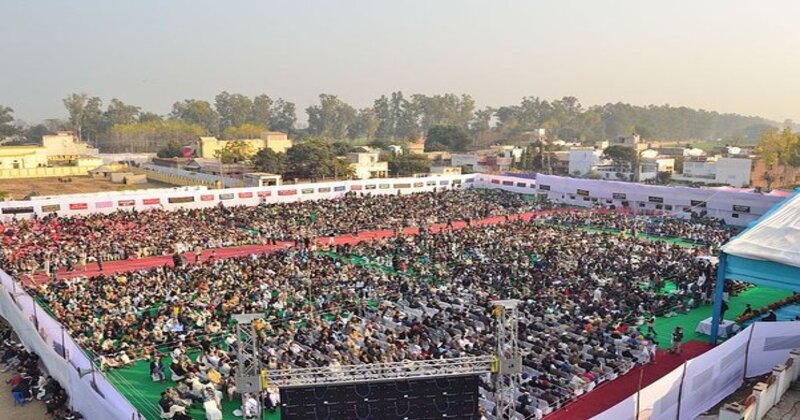
Ahmadiyas in Pakistan could not vote this time in the February 8 elections out of fear of being harmed. They now stand disenfranchised en masse, and this hostility towards the Ahmadiyas was officially stamped by the Election Commission of Pakistan (ECP). The story of their collective disempowerment is a story of Pakistan moving inexorably towards fostering hatred in society towards minorities.
In a clearly hostile act, the ECP decided to publish their names separately under the heading “Qadiani men/women’’. In earlier elections, the voters’ lists were common for all communities, but the names of Ahmadiyas were published in this manner for the first time. It bears mention here that the Ahmadiyas call themselves Muslims, but the Pakistan Constitution does not recognise them as such from 1974 onwards.
The campaign to get Ahmadiyas declared non-Muslims was led in 1974 by Zulfikar Ali Bhutto. Angered by this amendment to the Pakistan Constitution, foremost Pakistani nuclear scientist Abdus Salam left the country in protest the same year, never to return. Salam is considered as founder of Pakistan’s nuclear programme and was awarded the Nobel Prize in 1979. More about him later, as we return to more immediate things.
Incidentally, all through Pakistan, being identified as a Qadiani man or woman can often put Ahmadiyas in grave danger as there is tremendous hatred against them. In view of this, the community disassociated itself from the entire election process and did not move out of their homes on the polling day. Community spokesperson Amir Mahmood said that due to being identified in this openly hostile manner, the Ahmadiyas were unable to cast their votes.
Mahmood contended that this departure from joint electorate rolls was clearly unconstitutional. This was also against the Objectives Resolution enshrined in the Pakistan Constitution, which was purportedly designed to “provide equal rights for all citizens of Pakistan, regardless of their race, religion, or background’’.
One of the 11-point Objectives Resolution of the Pakistan Constitution states that “Fundamental rights should be guaranteed. They include equality of status, opportunity, and before law, social, economic, and political justice; and freedom of thought, expression, belief, faith, worship, and association, subject to law and public morality’’. However, it is clear that Pakistan officially does not believe in all these values listed herein above, as they are breached blatantly day in and day out.
A Pakistani journalist and former member of Pakistan’s Parliament Ayaz Amir had termed it mockingly as of “no practical benefit to anyone’’. When the Objectives Resolution was taken up in the Constituent Assembly in 1949, all non-Muslim members opposed it. Incidentally, despite claims to the contrary, of guaranteeing equal rights to all citizens, the name of Republic of Pakistan was then officially changed to “Islamic Republic of Pakistan’’.
Commenting on the Constitution of 1973, Pakistani intellectual Rubina Saigol said: …. Article 25 says that all citizens are equal before the law, while Article 2 says that Islam shall be the state religion. When one religion, to the exclusion of all others, is established as the state religion, how can the followers of other religions be equal citizens. And if they cannot be equal citizens, is democracy possible without citizenship equality?
Let us now revert to the story of Dr. Abdus Salam, referred to in a few paragraphs earlier. The story has an Indian connection and deserves to be recounted, for it helps explain the different values that India and Pakistan espouse very strongly. After winning the Nobel Prize in 1979, Dr Salam approached the Indian government and requested that he visit India to meet his teacher, Professor Anilendra Ganguly, who taught him at Sanatana Dharma College in Lahore at one time.
Time virtually stood still as Professor Ganguly (of Lahore) could not be traced for a long time. It was two years later that Dr Salam visited Kolkata in January 1981 to pay his respects to Professor Ganguly, who had left Pakistan after Partition. Escorted by Indian officials who facilitated this meeting, between a teacher and student who had parted company decades ago, Dr Salam met Professor Ganguly, who was bedridden.
In a wonderful acknowledgement of his gratitude, Dr Salam took out the medal (of Nobel Prize) and is reported to have said: Sir, this medal is a result of your teaching and love of mathematics you instilled in me.’’ Putting the medal around Professor Ganguly’s neck, Dr Salam said: “This is your prize, Sir. It’s not mine.”
Countless teachers must have taught Dr Salam after Professor Ganguly at Sanatana Dharma College in Lahore. This clearly tells us that at Sanatana Sharma College, students were not discriminated against on the basis of their caste, creed, religion, or standing in the society. This is the beauty and strength of Sanatana dharma, which is all embracing.
Now, an incident or two from Pakistan relating to Dr Salam also needs to be mentioned here. A little more than 15 years later, Dr Salam died in November 1996 after choosing to go self-imposed exile in 1974. When he died, he had been living for over two decades at Oxford in England. As luck would have it, his body was brought back to Pakistan (a country he had deliberately left) under the impression that things may have changed (for the better for Ahmadiyas) in between 1974 and 1996. But that presumption was unfounded, and something very unpleasant was done.
His admirers gathered to pay their last respects to Dr Salam and it is said that at least 30,000 people attended his funeral prayers at Rabwah (meaning high place in Arabic) of Jhang district of Punjab. Incidentally, Rabwah (now called Chenab Nagar) is a small town located near Chiniot and has been the headquarters of the Ahmadiya Muslim community in Pakistan.
In 1998, barely two years after Dr Salam’s burial at Rabwah, the name of the city was changed to Chenab Nagar after a resolution was passed to this effect in Punjab Assembly. This was opposed by the Ahmadiyas of the city who comprise over 95% of its population. But brute majority commanded by Nawaz Sharif in the assembly set aside these objections. Incidentally, it is widely believed in India that Sharif was a liberal, not given to fundamentalist Islamic tendencies.
Not only this, Dr Salam’s tombstone declared him to be a Muslim. But a local official objected to this term being associated with an Ahmadiya and got the tombstone removed. The tombstone of an international nuclear physicist, winner of the Nobel Prize, was disposed of on instructions from a local magistrate, perhaps equivalent to the rank of a tehsildar, or even lower.
Ironically, after the May 1998 nuclear tests, the Pakistan government issued a commemorative stamp in honour of Dr Salam who could not call himself a Muslim in Pakistan, neither alive, nor dead. This desecration of Ahmadiya graveyards is something that keeps on happening now and then to this day. In the most recent reported incident, at least eight graves of Ahmadiyas were desecrated and their tombstones broken. This happened in Kotli town in Pakistan Occupied Jammu Kashmir (POJK) barely 10 days ago.
The report was blacked out by most newspapers and TV channels of Pakistan completely, with The Friday Times published by Najam Sethi, being an exception. Some years ago, in 2020, a group of science students in Faislabad town had blackened the face of Dr Salam’s picture that hung from the wall. Why? The fact of his being an Ahmadiya (or Qadiani which is used as a term of derision in Pakistan) was enough of a provocation for this act of vandalism.
The original headquarters of the Ahmadiya community is Qadian in Gurdaspur district, 18 km from Batala. This place was set up on a piece of land allotted to the Ahmadiyas, also known as Qadianis, by Maharaja Ranjit Singh in 1834, some years before his death. It continues to bustle with Ahmadiyas even today, as they practice their religion unimpeded as equal Indian citizens. They call themselves Muslims, and no Indian law, rule, or authority interferes in their beliefs or practices.











Comments