





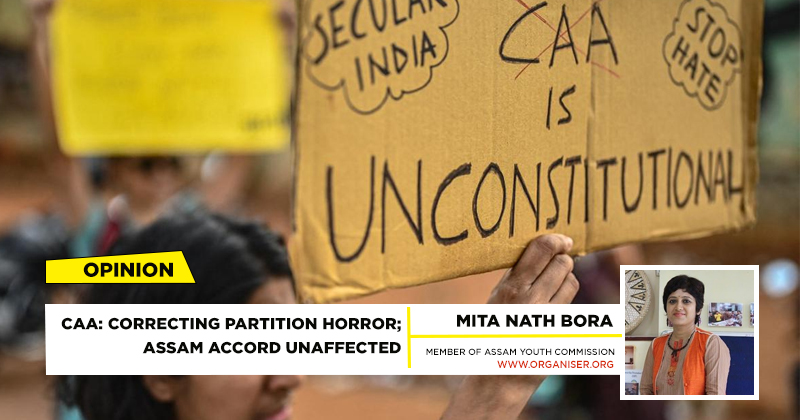
Article 14 of the Indian Constitution States- “The State shall not deny to any person equality before the law or the equal protection of the laws within the territory of India.” Also, Article 21 ensures “Protection of Life and Personal Liberty: No person shall be deprived of his life or personal liberty except according to procedure established by law.” These fundamental rights are available to every person, citizens and foreigners alike. Both these articles remain untouched under the Citizenship Amendment Act (CAA).
We all know that India’s Partition (an unwilling, forceful partition) is a horror story of genocide and generational loss. Around August 14 1947, united India was cruelly divided into three parts- India, West Pakistan and East Pakistan that came at a cost: the cost of millions of citizens losing their lives. Experts say that overnight, 20 million Indians were uprooted from their land, and what followed was mass torture, killing, murder, burning, and looting all across. More than 2 million Indians were murdered, accounting for the world’s worst historical horrors of mass genocide. Cold-blooded, ruthless murder of babies, children, pregnant women, and men of all ages happened as they got displaced. Vehicles, trains, and buses carrying lakhs of people were burnt, with humans turned into ashes in them. Many ran helter-skelter, had no choice nor the opportunity and were forced to stay put in Pakistan and East Pakistan (now Bangladesh) without getting the chance to cross borders.
Within the few years after partition, these Indian people residing in Pakistan and Bangladesh started to face religious persecution; they were made landless, then turned into minorities, and finally were at the receiving end of another torturous treatment. Within 50 years, their numbers started to decline fast and are now in an existential crisis. These minority groups consist mostly of Hindu, Christian, Sikh, Jain, Buddhist, and Parsi religions.
Farahnaz Ispahani, media advisor to the president of Pakistan from 2008 to 2012, writes that there has been a steady decline in religious tolerance in Pakistan over the last 65 years. From 23 per cent in 1947, Pakistan’s minority constitute a mere 3-4 per cent of the population today. She mentions how Pakistan followed a Top-Down Islamization and adopted four stages to enforce the slow extinction of minorities. Stage one was Muslimisation (1947-51), which saw a massive decline in Hindu and Sikh populations, and therefore, Pakistan became more Muslim demographically. Stage two was pushing Islamic Identity (1958 onwards) when state-sponsored textbooks rejected pluralism, painted religious minorities very negatively, and highlighted and glorified Islamic history with no South Asian basis. Next was Stage Three when General Zia ul Haq, Pakistan’s third military ruler who ruled from 1977-88, imposed a policy of state-led Islamisation. Islamisation started when legal frameworks against minorities were created via imposing legislation. Next was the stage of Militant Hostility, better known as the stage of terrorism and organised violence against the left minorities.
Persecution is at an all-time high, so much so that human rights concerns are being raised, and soon, a time is going to come when Pakistan, Afghanistan, and Bangladesh will be asked – Where are your Hindus? Where are your Sikhs? Where are your Christians? Where are your Jews, Buddhists and other minorities?
India’s Citizenship Amendment Act is the first step in addressing such human rights concerns in South Asia. CAA provides amnesty and a fast track to citizenship for certain refugees currently in India who have fled religious persecution in Afghanistan, Bangladesh, and Pakistan, such as persecuted Hindus, Sikhs, and Jains – who have nowhere to go except for India, and also the Buddhists. For these groups, India is a sacred homeland and has no realistic options for resettlement in any nation in South Asia other than India. CAA also provides them with a missed opportunity apart from presenting a way to better address human rights concerns in South Asia.
In the US, The Lautenberg Amendment (1990), the extension of which has received broad-based, bipartisan support over the years, creates a fast-track or legal presumption of refugee status for certain religious minorities. Initially, the amendment specified Jews and Evangelical Christians from the Soviet Union as well as members of the Ukrainian Catholic and Ukrainian Orthodox churches. Over the years, the law, with the passage of the Specter Amendment (2004), has expanded the scope to include Baha’i, Christians, and Jews from Iran. In contrast to the Lautenberg-Specter Amendment, the fast track created by the CAA is not indefinite. It applies only to certain religious minorities who fled to India on or before December 31, 2014. That said, even the Lautenberg- Specter Amendment could use more neutral language about the principle of secularism.
India CAA also only provides legal status and a fast track to citizenship to refugees who are in India because they have fled religious persecution from neighbouring states that privilege Islam as the official state religion. India has a centuries-long history of providing shelter to members of many of these groups. As recently as 2018, India extended citizenship to exiled Baloch leader Brahumdagh Bugti and several others.
The Act is not a violation of Article 14. The justiciability of citizenship or laws regulating foreign entry is often treated as a ‘sovereign space’ where the courts are reluctant to intervene. For example, in Trump v Hawaii No. 17-965, 585 US (2018), the US Supreme Court upheld a travel ban from several Muslim countries, holding that regulation of foreigners is a “fundamental sovereign attribute exercised by the Government’s political departments largely immune from judicial control.” Indian courts have generally followed similar reasoning. In David John Hopkins vs. Union of India (1997), the Madras High Court held that the right of the Union to refuse citizenship is absolute and not fettered by equality.
Protection under Article 14. Similarly, in Louis De Raedt vs. Union of India (1991), the Supreme Court held that a foreigner’s right to live in India is confined to Article 21, and he cannot seek citizenship as a matter of right.
CAA is not against Muslims. CAA does not alter the rights of any Indian citizen, nor does it establish any religious test for immigration or exclude Muslims from immigrating to India. Muslims remain able to immigrate to India through any legal channel. It is important to note that CAA does not change citizenship or other immigration laws.
The Ahmediyas and Rohingyas can still seek Indian citizenship through naturalisation (if they enter with valid travel documents). In any case, they would not be pushed back since India follows the principle of non-refoulment (even without acceding to the Refugee Convention 1951). If a Shia Muslim is facing persecution and is in India seeking shelter, his case to continue to reside in India as a refugee shall be considered on its merits and circumstances. About Balochi refugees, Balochistan has long struggled to be independent of Pakistan, and including Balochis in the CAA could be perceived as interference in Pakistan’s internal affairs.
The CAA, therefore, does not exclude Muslims from Pakistan, Bangladesh, and Afghanistan from applying for Indian citizenship. They can continue to do so in the same way singer Adnan Sami, for example, applied for citizenship. It is important to note that even minorities shall not be granted automatic citizenship. They would need to fulfil conditions specified in the Third Schedule to the Citizenship Act, 1955, namely, the good character requirement and physical residence in India.
Harish Salve, one of India’s biggest names in national and international law, has stated that the CAA is not anti-Muslim. Salve states that the countries specified in the CAA have their state religion and Islamic rules, adding that Islamic-majority nations identify their people as people who follow Islam and who do not. Addressing governance problems in neighbouring countries is not the purpose of the CAA. Besides the issue of Rohingyas, he states that a law that addresses one evil does not need to address all the evils in all countries. It is notable here that Myanmar, though a Buddhist majority nation, does not have a state religion, and Myanmar does not feature in the CAA Act.
Concerning North East, CAA is not in Violation of the Assam Accord. It does not dilute the sanctity of the Assam Accord as far as the cut-off date of March 24, 1971, stipulated for the detection/deportation of illegal immigrants is concerned. The Citizenship Amendment Act is not Assam-centric. It applies to the whole country. The Citizenship Amendment Act is not against the National Register of Citizens (NRC), which is being updated to protect indigenous communities from illegal immigrants. Further, there is a cut-off date of December 31, 2014, and benefits under the Citizenship Amendment Act will not be available for members of the religious minorities who migrate to India after the cut-off date.















Comments