






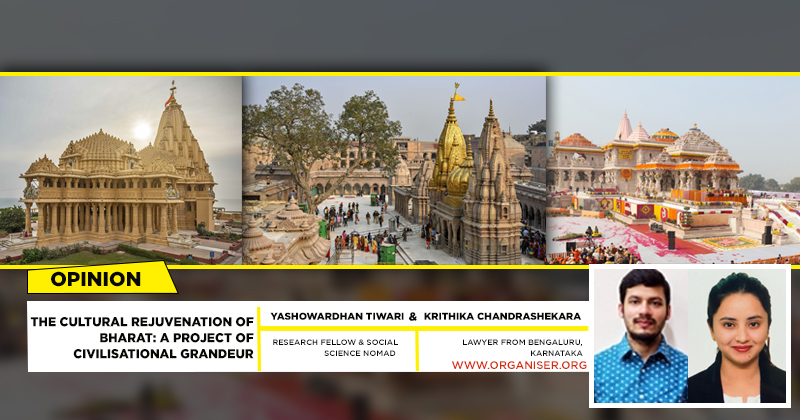
For the past several centuries, Bharat has been witnessing waves of colonisation coupled with a near-absolute decimation of its sacred geographies, subjugation of its cultural psyche, followed by endless attempts at civilisational resurgence in loops. Whenever power has vested in individuals or groups that wear Bharatiya culture on their sleeves, such power formations have always attempted to restore the grandeur of our culture through its authentic manifestations, primarily our sacred spaces. The replenishment of our nation with its spiritual markers, and the contemporization of our ancient heritage and traditional insignia has constantly been a point of serious introspection even during our colonial struggle against the British. While such efforts during the initial post-Independence period have been slow and sluggish, they have surely boomed manifold post 2014 with the arrival of the Narendra Modi government. In the past decade since 2014, the Modi government has achieved something strikingly unique – the transformation of Hindutva Lebenswelt from a socio-cultural discourse to an established paradigm of civilisational resurgence, smoothly manoeuvring between modernity and civilisational heritage. It has made huge strides against the museumization of our traditions by reinventing them and bringing back to life the remnants of our civilisational past in their full grandeur. History is the testament of continuity of cultures, and a nuanced understanding of history is central to securing the flourishing of civilisational values and traditional practices. Today, the time is ripe for Bharat’s cultural resurgence, given the background of withering Anti-Hindu animus and the looming collapse of Abrahamic religious aggression, and now the object and avowed purposes of revitalisation of the ancient traditions of Bharat are seen to be turning to fruition.
Political developments in India in recent years indicate that unity and civilisational nationalism are being epitomised at large. The Bharatiya Janata Party, at the helm of political affairs in the country, has assertively led a movement that glorifies our rich traditions, ideals, culture, and philosophical principles. Today, in India, there are multiple approaches being used to preserve and honour the lost heritage, which shows the ‘Emerging National Vision’. The world at large is witnessing the echoes of a billion āstikas who contend that we ought not to mask things that are of paramount importance to our faith in order to be in line with supposed dharmanirpekṣta. This newfound enthusiasm in the country shows that we are already in the era of cultural rejuvenation.
The Bharatiya Janata Party and the Rashtriya Swayamsevak Sangh have both taken up the mantle of introducing phenomenal changes in Indian polity and society, while simultaneously articulating their positions and ideas according to the contextual framework. They have been constantly transforming the contours of Hindutva through a multi-pronged approach to the project: a pan-Bharat cultural rejuvenation and rebuilding of the sacred spaces, infusing sweeping changes in the social structure through an assertive inclusion of the margins, and adding new terminologies to the Indian political lexicon that can establish an intimate connect with the masses.
As often repeated by political observers and social commentators, the post-2014 regime has ushered in a new era of relationship between statehood and religion, where the state no longer appears just as a distant observer, unresponsive to the religious beliefs and practices of society. Instead, it has now emerged as a patron, facilitating the revival of cultural activities and traditional practices with renewed vigour. The idea of statehood has been able to finally transcend the boundaries of secular discourse and break the barriers of secular-religious dichotomy and compartmentalization. The central government has created the required conditions for what may be described as ease of access to the celebration of culture, and has consequently propelled a cultural rejuvenescence through increased connectivity.
The development of Bharat’s sacred spaces has invariably led to a boost in infrastructural development as a by-product of the rejuvenation process, and the government’s focus on improving inter-connectivity of the cultural spaces is now acting as a huge facilitator of spiritual tourism across the geographical expanse of Bharat for the masses. Several state governments have also started replicating this peculiar development model of the Modi government, ((such as the Odisha government and its implementation of Shree Jagannatha Heritage Corridor project). Hindutva and its spiritual outlook has been an integrated whole for time immemorial, and this reality has reflected itself in the intricately connected conceptualization of our sacred spaces, such that all of these sites across our nation are interwoven together in the Hindu itihasa, philosophy, and outlook. This reality is being resurrected by the present government, by reconnecting the sites through infrastructure and public lore (for instance, the development of Ram Van Gaman Path, which marks the reconnecting of all spiritually significant sites as described in the Ramayana as a part of Prabhu Shri Ram’s route of exile).
A pertinent point to be noted is the public articulation of the process of cultural rejuvenation in the language of decolonization. Such articulation comes as a timely acknowledgement of the subjugation of our national soul, described as ‘chiti’ by Pandit Deendayal Upadhyay, nudges the Bharatiya society from a state of historical amnesia to that of historical consciousness, and opens up the possibility for a remedial hermeneutics of our troubled yet glorious past. The language of decolonization also serves as a reasonable explanation for the need for such rejuvenation, and explains why it can’t be dismissed as simply an undue indulgence in cultural hypernationalism or religious fundamentalism. As Prime Minister Modi has put it on various occasions, Bharat has borne the brunt of a thousand years of colonialism, reeling under its barbaric impact, and now it needs to embrace this project of cultural rejuvenation alongside development in today’s Amrit Kaal for the next twenty-five years, so as to ensure the stature of Bharat as a Vishwaguru for the next thousand years.
Under the Modi government, the evolving praxis of Hindutva has focused on three crucial aspects: the revival and development of our millennia old cultural and spiritual centers reeling under the colonial impact (reconstruction of the Ayodhya Ram Mandir, Kashi Vishwanath corridor, Ujjain Mahakaal corridor are pertinent illustrations); the resurrection of our civilisational heritage strewn along the margins and peripheries of both the geographical and cultural vision of Bharat with a similar grandeur (the Sharda Devi peeth in Kashmir and Maa Tripur Sundari Mandir in Tripura are examples), paving the path for their integration into the cultural consciousness of Bharatiya society and re-establishing them as spiritual centers; and a cultural assertion by the state and political leaders, creating impactful iconography and imagery of the leaders as proud flag bearers of our Hindu culture and traditions. Moreover, the parallel construction of Hindu temples abroad (such as the BAPS temples in Abu Dhabi and New Jersey) marks the globalization of Hindutva as an all-embracing, inclusive, legitimate, cultural worldview.
Exemplars that reflect on the peculiarities of the emerging Hindu consciousness:
1. The earliest reference to the scepter is found in the Dharmaśāstra. Even the greatest of sagas, the Ramayana and the Mahabharata, have mentioned it with the appellation ‘Rajadaṇda’ and it is seen as a paragon for maintenance of law and order. The ancient Tamil text ‘Tirukkural’ explains that the Sengol held by the king is said to determine the worth of the priest’s word and men’s honor. Hence, the installation of this traditional insignia in the new parliament is both a symbol of good governance and an instrument that molds Hindu Polity.
2. The inauguration of Kashi Vishwanath Dham Corridor provides yet another precedent to the efflorescence of Bharat’s resurgence. It can be well understood what a colossal work it is to propagate the philosophy of Bhagwan Shiv from his rightful abode. PM Modi, while addressing the gathering during its inauguration, made a reference to Chhatrapati Shivaji Maharaj and Raja Suheldev who had formed a bulwark against the invaders. ‘Kashi toh avinashi hai’, he added and vowed to fortify Kashi’s timeless opulence in the minds of all his compatriots.
3. Cultural reconstruction only heightens the sense of omnipresence of the divine. The establishment of Sharada Devi Temple near the LoC is a befitting extolment to the perennial practice of Shakti-worship in the valleys. Kashmir, that withstood ravages of time, is today a sensate witness to the goddess occupying her sacred space. The rising spirit of the ‘Land of Kashyapa’ on the one hand, and the murti of Adi Shankaracharya Bhagavatpada in the midst of snow-capped peaks of Kedarnath, together symbolize the power of nature at its purest. In a similar vein, another shakti peeth, Kalika Mata Mandir, majestically placed atop the Pavagadh Hill in Gujarat, was given a facelift. The sizable tribal population in the vicinity of the temple, and its ensuing socio-cultural and economic upliftment, is the case in point.
To be sure, herculean efforts have been made to bind the entire galaxy of offshoots of the Hindu community together, and therefore, there is a confidence that Bharat can rise to its veritable mounting of being a Vishwaguru. The efforts to bind the Hindu community, and the extended Bharatiya rashtra, together, are being led from the forefront by the political leadership. The exuberant cultural assertion being exuded by the leadership, whether during darshan of temples across Bharat, or in a dignified carrying of the sengol or trishool, promise hope of nurturing deep rooted, solid foundations for a flourishing Bharatiya civilisation.












Comments