





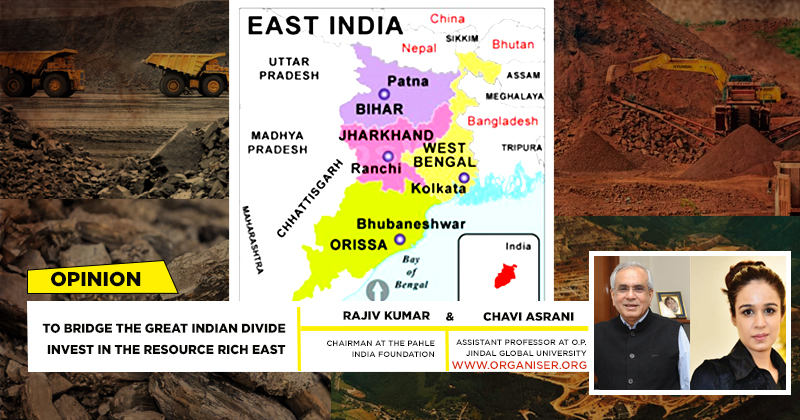
By the centenary year of India’s independence, India will progress from its’ current status of low-middle income group country to high-middle income group country, as per the World Bank classification. On this growth path during the ‘Amrit Kaal’ it is crucial that all Indian regions and states contribute equitably to India’s development. For unleashing the ambition of ‘Viksit Bharat@2047’ a matching participation in India’s growth story by all Indian states will not only ensure greater social inclusion, but also nurture and support the country’s fascinating diversity, which distinguishes India from other nation states.
Currently, there are visible differences in the economic performance between the six southern states (Goa, Tamil Nadu, Kerala, Andhra Pradesh, Karnataka and Telangana) and the six eastern states (Madhya Pradesh, Bihar, Chhattisgarh, Jharkhand, Uttar Pradesh, and West Bengal). As per official statistics the per-capita income in Goa is about ten times that of Bihar! The average per-capita income of the six peninsular states during 2021-2022 was Rs 1.50 lakhs (in constant 2011-12 prices). The average of the six eastern states in the period stood at only Rs 56 thousand, or a third of their southern counterparts. This divide is even more pronounced when the seven north-eastern states are included. The differences in per capita income cogitate the lack of opportunities in these states; this is also reflected in the migration pattern of the population which is induced by the low livelihood earning opportunities. As per the last census around 40 per cent of the Indian migrants are from these six eastern states.
Similarly, most human development indicators, reported by the Vth National Family Health Survey are at significantly lower level in the eastern states as compared to those in the six southern states. This is true for indicators like child malnutrition, longevity, literacy, women suffering from anaemia etc. This results in a sharp variations between the two set of states in terms of the Sustainable Development Goals (SDGs). Nearly all the six peninsular states have a SDG score in the 70s with Kerala topping the list with a score of 75. Whereas, the six eastern states on average manage a score in the 50s, around 20 points lower than the southern states.
A glance at indicators about SDG-10 (Reduced Inequality) reflects that the states of Madhya Pradesh, Bihar and Jharkhand have high inequalities. It must be noted that, there is a vicious circle here- low incomes and high inequality feed into high crime rates, and this high crime rate discourages entrepreneurial activities. In terms of absolute poverty (SDG-1), eastern states’ performance is significantly weaker than the rest of the country. Bihar, Jharkhand, Madhya Pradesh, and Chhattisgarh are the worst states in terms of performance related to SDG-1 (No Poverty). As per NITI Aayog’s National Multidimensional Poverty Index, Bihar and Jharkhand are the poorest Indian states.
The weaker economic performance of eastern India, when compared to the southern and western regions is ironic, as the eastern region boasts of much larger share of India’s natural resources, but has lagged to tap into the desired industrial development. For instance, together Jharkhand, West Bengal, Chhattisgarh, Madhya Pradesh and Bihar hold over 60 per cent of India’s coal reserves. Jharkhand and Chhattisgarh have around 45 per cent India’s iron ore reserves, however, these two states account for only about 25 per cent in the production of iron ore in the country. The eastern region also has the most fertile and well-irrigated arable land, being an integral part of the Gangetic river basin. The region contributes a large share of India’s agriculture produce (20 per cent of rice, wheat and oilseeds and 80 per cent of jute). But, this produce is mostly sold in its primary form without any processing or value addition, which is often done in the more industrialised states. This reflects the major weakness of the eastern region which is its inability to attract private investment flows that are necessary for establishing industrial and manufacturing capacities.
For markets to develop and function efficiently and for investment to flow into these six states, there is a need for a robust enabling ecosystem, comprising of a strong law and order enforcement; business friendly policy and regulatory framework; development of skills and human talent; and a world class physical infrastructure. The eastern states suffer from weaknesses in all these areas. The India Residential Energy Survey data informs that residents of Jharkhand and Bihar experience power outages for long periods, indicating bottlenecks in the provisioning of the energy and power requirements of the region. Data from Telecom Regulatory Authority of India reflects that Bihar, Madhya Pradesh and West Bengal lag in their digital uptake both in the rural and urban areas.
Next, highlighting the demographics of Indian states it may be noted that as per latest available estimates, the six eastern states have a combined population of 61 crore or 44 per cent of India’s population, with Uttar Pradesh and Bihar being leaders demographically. In contrast the six southern states with a combined population of 27 crore, account for only 19 per cent of the total population. This can result in a growing dichotomy of increasing political influence of the more populated eastern states and the higher and rising economic clout of the southern states.
Growing regional imbalances can be inimical to not only inclusive growth but can also result in national security issues. In as diverse a country as India, large movements of migrant worker populations can result in straining the social fabric in the recipient states. The states that supply the migrants, a vicious circle of poverty, lack of investment, slow economic growth and continued outflow of working age population can create an atmosphere of hopelessness and despair. Market forces themselves will not address the issue as capital tends to flow to areas which are already developed and have better quality of physical and social infrastructure. Conscious policy direction and consistent and effective implementation of government projects to improve the eco-system in the less developed states is needed to reverse this vicious cycle. President Kalam’s and Professor Indresan’s idea of providing urban facilities to rural areas (PURA) could be the framework for future government policy action.
Two sets of measures should be undertaken to make the India’s economic growth more inclusive and regionally balanced. First, the Central and State governments should work together to harvest the demographic dividend in the more populous six eastern states and also in the seven north-eastern states. But for that to happen, the youth, both young men and women, has to be skilled, educated and assured of good health. Without converting its rich human resource to high quality human capital, the eastern region could see the large population becoming a liability rather than an asset. Implementation of the National Education Policy in all its dimensions can be the key to the required transformation of the human resources in these six states.
Second, a major effort is required to improve the physical infrastructure in the region in form of highways, electricity, railways and airports. The government of India has envisaged massive infrastructure projects like Gati Shakti and Bharatmala to ensure that all Indian states have access to sufficient electricity/power, highway network, airports and digital infrastructure. State governments must allocate more resource for the development of physical infrastructure by way of constructing state highways, improving the power transmission and distribution systems and creating industrial parks to attract private investments. These measures are critical to ensure that going forward India achieves a regionally balanced growth, which will make country’s economic performance more equitable, sustainable and inclusive.













Comments