





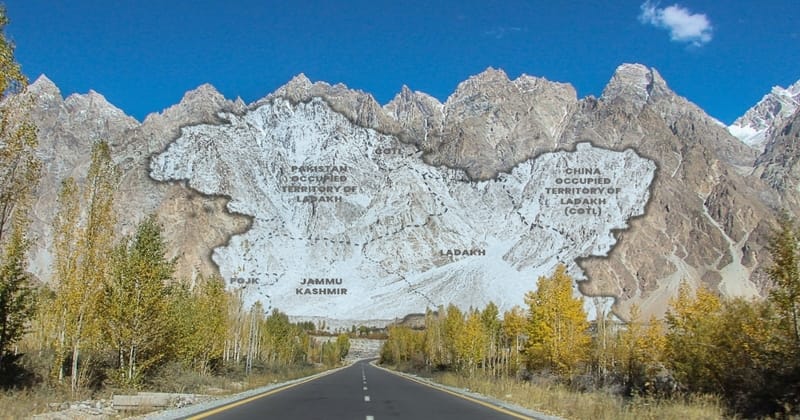
Every year, February 22 is commemorated as Jammu & Kashmir Sankalp Diwas, a day signifying the resolute commitment of Indian people, as articulated by its parliamentary representatives, to reclaim Indian territory that fell victim to aggression by the Islamic Republic of Pakistan in 1948.
On the historical date of February 22, 1994, both Houses of the Indian Parliament unified in passing a unanimous resolution, resoundingly affirming that Pakistan’s occupation of regions in Jammu & Kashmir was untenable. Parliamentarians from both houses of the Indian Parliament, in no uncertain terms, expressed India’s unwavering determination to regain control over these unlawfully aggressed upon and seized territories. The resolution further underscored Pakistan’s exploitation of occupied areas as training grounds for terrorists, deployed to inflict harm upon India. It explicitly called upon Pakistan to cease its support for such nefarious activities.
Central to the resolution was the steadfast assertion that the State of Jammu & Kashmir constitutes an integral part of India, demanding the immediate evacuation of Pakistani forces from the occupied regions. Highlighting the importance of adhering to the Shimla Agreement after its defeat by India in 1971, Pakistan witnessed over 92,000 of its army personnel surrendering to the Indian Army in East Bengal, leading to the creation of a new nation-state, Bangladesh.
The agreement cautioned Pakistan against internationalising the Jammu & Kashmir issue, urging it to resolve all issues bilaterally. The Shimla Agreement shone a spotlight on two additional disconcerting issues. First, it raised the alarm about egregious human rights violations taking place in Pakistan-occupied areas of Jammu & Kashmir. Secondly, it highlighted the deplorable living conditions endured by the residents of these territories.
In essence, Sankalp Diwas serves as a poignant reminder of the resolute commitment expressed by the Indian Parliament to reclaim and safeguard its sovereign territories, urging Pakistan to uphold
International agreements and address pressing historic issues associated with its occupation of Jammu & Kashmir and ongoing humanitarian concerns.
Background
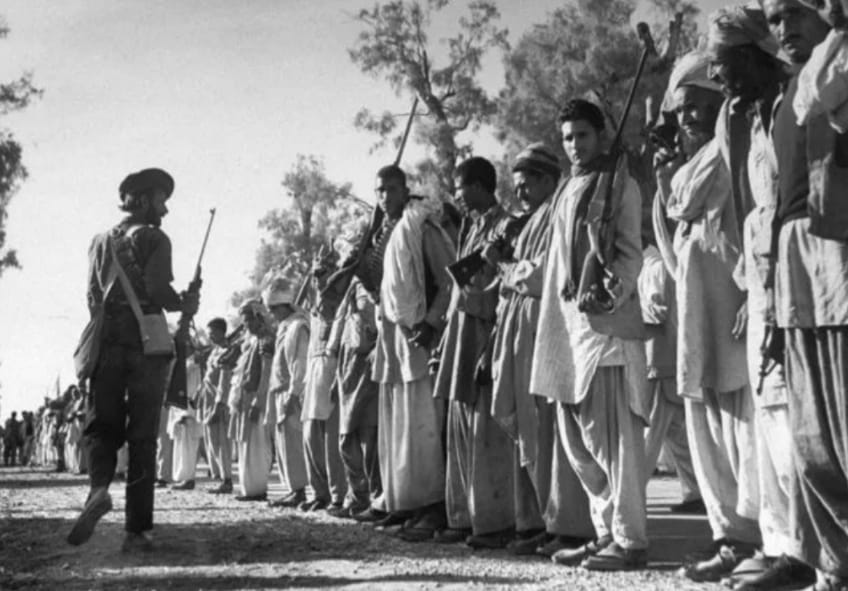
In the aftermath of India’s independence and subsequent partition of erstwhile British-occupied India, Princely States were vested with the prerogative to decide their accession to either the dominion of India or Pakistan, contingent upon geographical coherence as per Indian Independence Act of 1947. This foundational principle was disrupted on the night of October 22/23, 1947, when the Pakistani army, along with its allied tribal raiders, initiated a forceful assault on the Princely State of Jammu & Kashmir. Subsequently, Maharaja Hari Singh formally acceded to the dominion of India on October 26, 1947, prompting the deployment of the Indian army. The then Indian Prime Minister Jawaharlal Nehru, cognizant of the gravity of Pakistani aggression, brought the matter to the attention of the international community, seeking intervention through the United Nations. The ensuing Kashmir war persisted until a UN-mandated ceasefire was implemented from midnight on December 31, 1948, to January 1, 1949. Regrettably, Pakistan has maintained the unlawful occupation of these territories since the ceasefire, defying several UN resolutions and international laws.
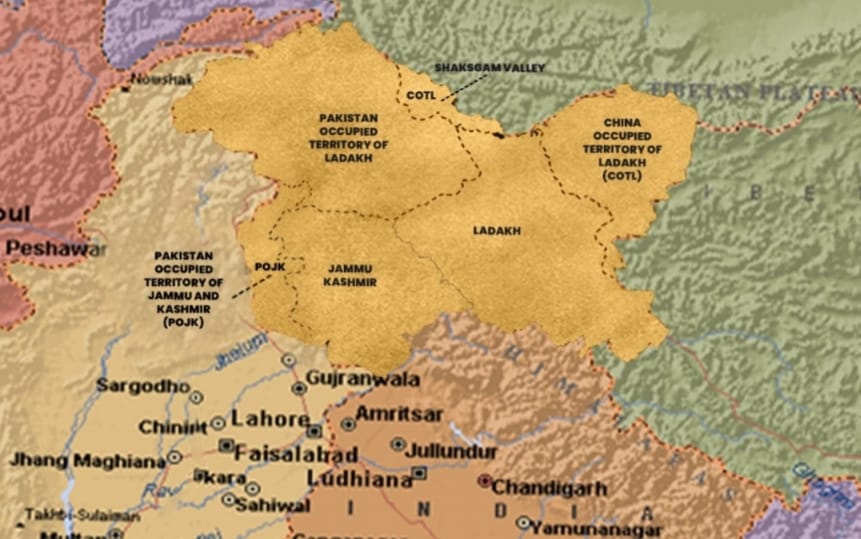
Areas under illegal occupation, constituting the (erstwhile) State of Jammu & Kashmir, encompass Mirpur-Muzzafarabad regions, spanning approximately 14,000 sq km—an area identified as PoJK (Pakistan-occupied Jammu & Kashmir) by India and falsely labelled ‘Azad Jammu Kashmir’ by Pakistan. Significantly, this territory is integral to the present-day Union Territory of Jammu & Kashmir. Furthermore, Pakistan’s occupation extends to about 75,000 sq km of Gilgit and Baltistan, which currently form part of the Union Territory of Ladakh, specifically within the bounds of the Leh district. A separate dimension of territorial issue unfolded in Eastern Ladakh, where China, following the Indo-China war from October 22 to November 21, 1962, illegally occupied approximately 35,000 sq km, known as Aksai Chin. Concurrently, Pakistan, in breach of international law, ceded around 5,100 sq km of Shaksgam Valley to China in March 1963 through a Sino-Pak boundary agreement. These precise coordinates and area figures underscore the intricate geopolitical landscape of Indian territories currently under occupation by Pakistan and China. This highlights India’s legitimate assertion of sovereignty over these areas and emphasises the imperative to safeguard its territorial integrity.
Context for the Resolution
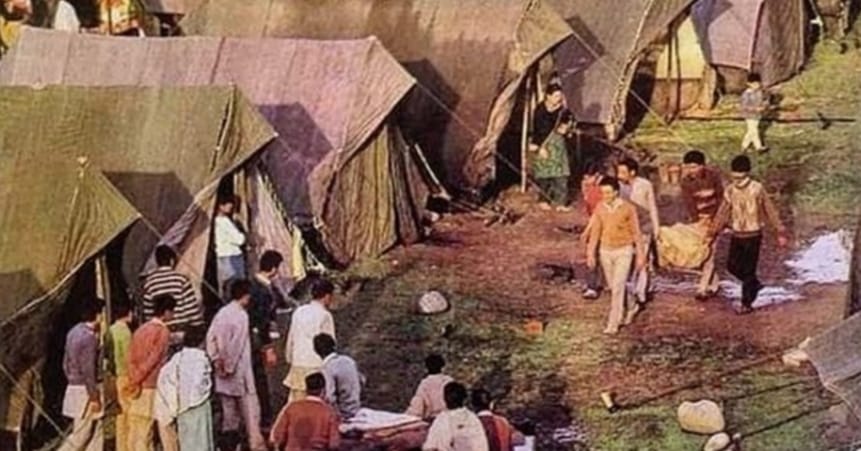
The parliamentary resolution of February 22, 1994, holds profound geopolitical significance, necessitating an exploration of the contextual backdrop that prompted its enactment. The roots of this resolution can be traced back to the tumultuous events unfolding in the Kashmir valley region of Jammu & Kashmir since 1984, marked by escalating terror activities and consequential exodus leading to the internal displacement of its native habitants, the Kashmiri Hindus.
Against this backdrop, Pakistan emerged as a geopolitical player, strategically aligning itself as a key ally of the United States amidst unfolding dynamics in Afghanistan. Harnessing this newfound importance, Pakistan relentlessly endeavoured to internationalise the issue pertaining to Jammu & Kashmir. It fervently advocated for a plebiscite in Jammu & Kashmir, disregarding the UN resolution mandating Pakistan’s withdrawal from occupied territories (Pakistan occupied Jammu & Kashmir a.k.a Azad Jammu & Kashmir and Gilgit Baltistan) as a prerequisite for any plebiscitary process.
The year 1990 witnessed a significant development when, under the leadership of Benazir Bhutto, the National Assembly of Pakistan passed a resolution rejecting Jammu & Kashmir’s accession to India. During this period, the United States adopted a pro-Pakistan stance on Jammu & Kashmir, emboldening Pakistan in its pursuit. It is crucial to underscore that the Instrument of Accession, a legal document having its roots in the British Parliament’s India Independence Act, governed Jammu & Kashmir’s accession to India, and was not subject to international jurisdiction.
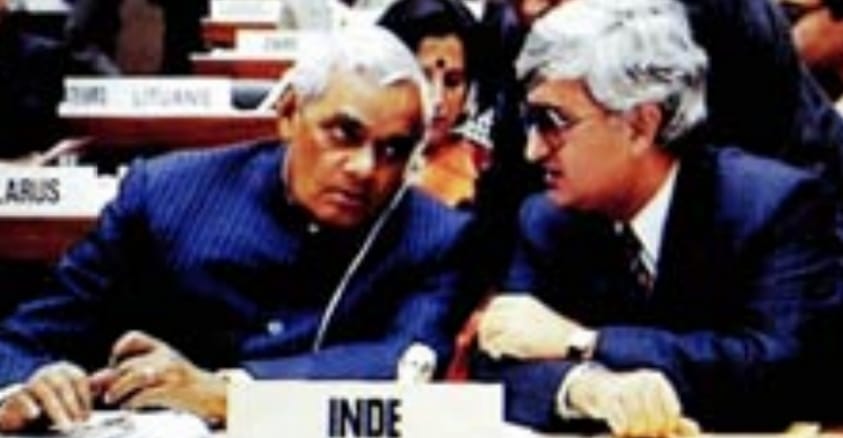
Amidst these developments, the United State’s endorsement of Pakistan’s stance escalated tensions, with Pakistan articulating its intent to table a resolution at the United Nations Human Rights Conference in Geneva in March 1994. Pakistan had meticulously crafted a narrative portraying alleged ‘human rights violations’ by India in Jammu & Kashmir. The passage of such a resolution could have paved the way for United Nations Security Council (UNSC) sanctions against India and intervention by the international community. However, on February 22, 1994, the Indian Parliament, through unanimous consensus, deftly responded to international lobbying orchestrated by the United States. This parliamentary resolution of February 22, 1994, effectively countered Pakistan’s claims, thereby reaffirming India’s legal and sovereign rights over the entire Jammu & Kashmir. By March 7, 1994, a diplomatic triumph ensued as the Indian delegation, led by the Leader of the Opposition, Atal Bihari Vajpayee, garnered sufficient support from countries in Geneva to dissuade them from backing Pakistan’s ulterior resolution. Consequently, Iran retracted its support, prompting Pakistan to withdraw its proposed resolution on March 9, 1994, to avoid loss of credibility.
Current Scenario
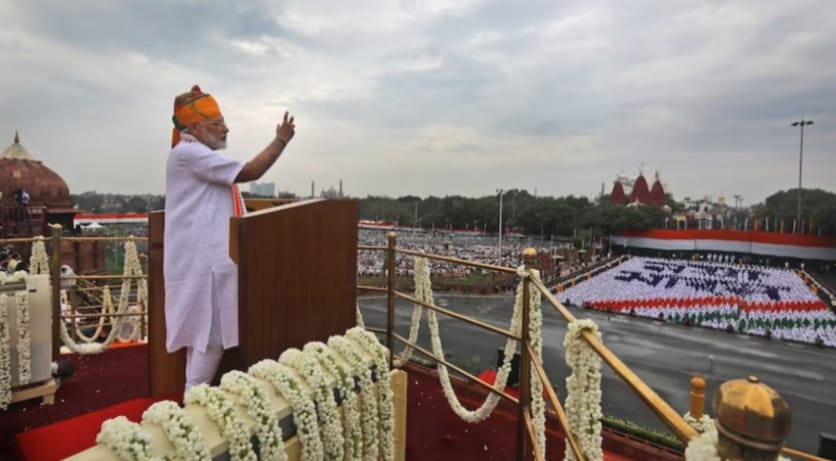
On August 15, 2016, then-newly elected Prime Minister Narendra Modi redirected international attention towards the long-standing issue of Pakistan-occupied Jammu & Kashmir and Gilgit Baltistan in his address at the Red Fort. Subsequently, on August 5, 2019, the amendment of Article 370 of the Indian constitution marked a significant turning point as the State of Jammu & Kashmir was reorganised into two Union Territories of Jammu & Kashmir and Ladakh. Notably, on August 6, 2019, Home Minister Amit Shah invoked the crucial Parliamentary Resolution of 1994, underscoring the integral status of Jammu & Kashmir within India and reiterating Parliament’s commitment to reclaim both Pakistan-occupied territories and Aksai Chin.
In the aftermath of 2019, the Indian Home and Defence Ministries have consistently referenced the Parliamentary resolution, emphasising that any dialogue with Pakistan hinges on the unequivocal vacation of Indian territories occupied by Pakistan. On October 27, 2022, commemorating Shaurya Diwas, Indian Defence Minister Rajnath Singh reaffirmed India’s unwavering commitment to reclaim Pakistan-occupied Jammu & Kashmir (PoJK) and Gilgit Baltistan, aligning with the principles outlined in Parliamentary Resolution of February 22, 1994. Subsequently, former Indian Army Chief Manoj Mukund Naravane reiterated the military’s preparedness to reclaim these territories, affirming the resolution’s pivotal role in shaping India’s unanimous stance.24 The Parliamentary Resolution of February 22 stands as a crucial milestone in India’s history. It not only laid the foundation for the reclamation of occupied territories but effectively countered Pakistani propaganda concerning human rights in Jammu & Kashmir, drawing attention to dire conditions prevailing in Pakistan-occupied territories of J&K and Ladakh.
Importantly, the resolution definitively clarified doubts about the legality of the Instrument of Accession while upholding Shimla Agreement clauses as the primary mechanism for resolution. Following the reorganisation of Jammu & Kashmir, Indian territories occupied by Pakistan are now, for the first time, officially represented as districts of Mirpur and Muzzafarabad in the map of the Union Territory of Jammu & Kashmir. Additionally, Gilgit and Baltistan find representation as part of the Leh district within the Union Territory of Ladakh, with the boundary aligning to its pre-1901 configuration. This innovative representation marks a departure from historical practices and underscores India’s commitment to addressing territories under occupation through legal and diplomatic means.














Comments