





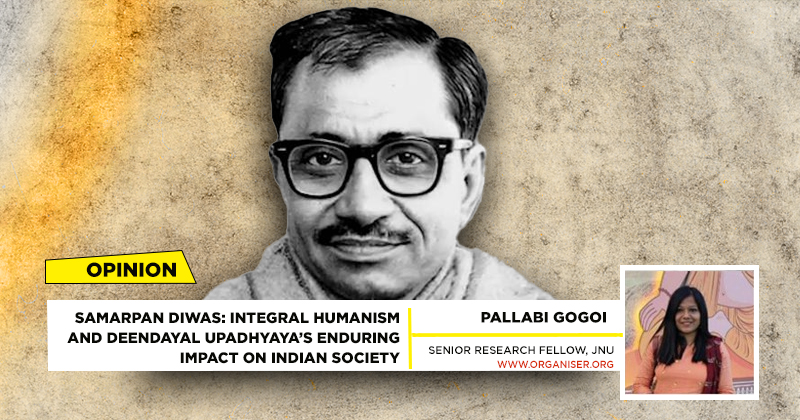
Samarpan Diwas, observed annually on February 11, commemorates the death anniversary of Deendayal Upadhyaya, a notable figure whose profound influence has left a lasting impact on India’s political landscape. This day serves as a tribute to Upadhyaya’s contributions and enduring legacy in shaping the nation’s political spectrum. His ideas and principles continue to exert influence, inspiring individuals and instilling a sense of dedication and commitment to the improvement of Indian society. Samarpan Diwas encourages reflection on Upadhyaya’s visionary concepts, motivating citizens to actively participate in initiatives aligned with his principles for the enhancement of Indian society.
Deendayal Upadhyaya, characterised by his lofty idealism and exceptional organisational skills, initiated the publication of the monthly magazine “Rashtra Dharma,” the weekly ‘Panchajanya,’ and the daily ‘Swadesh.’ In 1951, with the founding of the Bhartiya Jana Sangh by Dr. Syama Prasad Mookerjee, Deendayal assumed the pivotal role of the first General Secretary for its U.P. branch and was later appointed as the All India General Secretary. His sharp intellect and precise approach deeply impressed Dr. Mookerjee, prompting the famous remark, “If I had two Deendayals, I could transform the political face of India.” This acknowledgment underscores the substantial influence of Deendayal Upadhyaya’s leadership and organisational prowess within the Bhartiya Jana Sangh, contributing significantly to the political evolution of the nation.
Deendayal Upadhyaya was a profound and original thinker, as evidenced by his philosophy of Integral Humanism. This philosophy, synthesising the material and the spiritual, as well as the individual and the collective, reflects his intellectual depth. In the domains of politics and economics, Deendayal was known for his practical and down-to-earth approach. His vision for India was marked by a call for a decentralized polity and a self-reliant economy, with the village serving as the cornerstone. Embracing the benefits of modern technology, Deendayal advocated for its adaptation to suit the unique requirements of India. Deendayal’s distinctive quality lay in his constructive approach to governance. He encouraged people to collaborate with the government when its actions were commendable and fearlessly oppose it when errors were evident. This nuanced perspective showcased his dedication to the nation’s welfare and his belief in a harmonious integration of tradition and progress. The enduring impact of Deendayal’s philosophy continues to shape political discourse in India, resonating across various facets of societal development.
Deendayal Upadhyaya’s deep concern about the prevailing conditions in India during his time reflected a profound unease with what he perceived as an erosion of societal values and moral integrity. He observed a shift towards self-centeredness, where individuals prioritised personal interests over the collective well-being of society. In expressing the urgency of the situation, Upadhyaya’s poignant remark about society holding a “begging bowl” underscored the critical need to address societal issues promptly. He believed that indifference to society’s demands could result in significant losses, emphasising the necessity of a collective effort to strengthen the nation. For Upadhyaya, the organising principles of the RSS offered a solution to the moral and societal challenges faced by India. The RSS, with its emphasis on selfless service, discipline, and cultural rootedness, was viewed by Upadhyaya as a means to rejuvenate and empower society. His dedication to the RSS and its principles was evident in his personal choices, as he prioritised the organization’s mission over considerations of job security, personal achievements, and even building a family. This commitment reflected his belief that the principles of the RSS were essential for the well-being and prosperity of the country.
Upadhyaya’s critique of contemporary Indian politics stemmed from his belief that the post-independence political leadership had misunderstood or misapplied Western notions of a good society to Indian conditions. He argued that Western political thought, which influenced post-independence political ideologies, had not adequately addressed the condition of the citizens, even in the West. This perspective fueled Upadhyaya’s call for a more indigenous approach, drawing from the cultural and philosophical traditions of India. In essence, his concerns and criticisms were not mere expressions of dissatisfaction but served as a foundation for his vision of a revitalised and morally grounded society. His emphasis on the principles of the RSS and the need for an indigenous understanding of societal organisation reflected his commitment to building a stronger, virtuous, and prosperous India.
The integrative humanism philosophy of Upadhyaya sought to reconcile individual aspirations with the collective well-being of society. It emphasised the integral development of all aspects of human life, including the physical, mental, intellectual, and spiritual dimensions. Upadhyaya advocated for a socio-economic system that respected the individual’s dignity and promoted a sense of duty and responsibility towards the community. His vision was deeply rooted in India’s cultural and spiritual heritage, and he envisioned a society that harmonised modernity with traditional values. Upadhyaya’s emphasis on the principles of dharma (duty/righteousness) and swadharma (one’s own duty) reflected his commitment to aligning individual actions with ethical and moral values. While Upadhyaya outlined the philosophical foundations of Integral Humanism, it is important to note that he did not provide a detailed policy agenda. Instead, his lectures can be seen as laying the groundwork for further exploration and development of specific policies. His ideas guided researchers, policymakers, and thinkers to delve deeper into the practical implications of Integral Humanism.
Over the years, some of Upadhyaya’s concepts have become integral to the discourse on Bharatiya thought. The enduring relevance of his ideas can be observed in the current discussions about the need to integrate traditional wisdom with contemporary governance and development strategies. Deendayal Upadhyaya’s Integral Humanism was a visionary attempt to provide an indigenous and culturally rooted alternative to existing socio-political and economic ideologies. The enduring impact of his ideas lies in their ability to inspire further research and discussion, contributing to the ongoing evolution of Bharatiya thought. His ideas on Integral Humanism aimed to offer an alternative perspective to prevailing socio-political and economic ideologies, reflecting his deep engagement with India’s cultural and philosophical traditions, particularly rooted in Sanatan Dharma.
Looking ahead, Deendayal Upadhyaya’s legacy urges us to actively adopt his visionary principles. Samarpan Diwas serves as a source of inspiration for collaborative efforts with commendable government actions and a courageous stance against errors, fostering a nuanced approach to governance. The relevance of a decentralized polity, self-reliant economy, and a harmonious blend of tradition and progress persists as we navigate present-day challenges. Upholding Upadhyaya’s emphasis on Integral Humanism, the path forward encourages exploration of practical policies aligning individual aspirations with societal well-being, while striking a balance between modernity and traditional values. In ongoing discussions, his enduring ideas prompt us to integrate traditional wisdom with evolving strategies, rooted in India’s rich cultural and philosophical heritage. As we shape our future, let us draw inspiration from Upadhyaya’s commitment to a stronger, virtuous, and prosperous India.










Comments